
Fact-checked by the The Credit Scout editorial team
Quick Answer
A good credit score is generally defined as 670 or higher on the FICO Score scale, which ranges from 300 to 850. As of July 2026, the average American FICO Score stands at 717, placing most consumers in the “good” range — but lenders often prefer scores of 740 or above for the best rates.
As of July 2026, understanding what is a good credit score has never been more consequential. With mortgage rates still elevated and auto loan approvals tightening, your three-digit number directly determines the interest rate you pay, the credit limit you receive, and sometimes whether you get approved at all. A score of 670 or above qualifies as “good” under the standard FICO Score model, but the threshold lenders actually use for premium pricing is considerably higher.
According to Experian’s most recent consumer credit review, approximately 67% of Americans now hold a FICO Score of 670 or above (Experian, 2025). The Consumer Financial Protection Bureau (CFPB) has also documented that borrowers with scores below 620 pay an average of 3–5 percentage points more in mortgage interest than those with scores above 740, representing tens of thousands of dollars over the life of a loan (CFPB, 2025).
In this guide, you will learn the exact score ranges for every credit tier, how FICO and VantageScore differ, what lenders actually look for beyond your number, and a concrete action plan to move your score into the range that unlocks genuinely competitive rates.
Key Takeaways
- A good credit score starts at 670 on the FICO Scale (300–850), but lenders typically reserve their best rates for borrowers with scores of 740 or higher (myFICO, 2025).
- The average U.S. FICO Score reached 717 in 2025, up from 714 in 2022, signaling a gradual upward trend in consumer creditworthiness (Experian, 2025).
- Borrowers with scores below 580 are classified as “poor” credit and may face APRs exceeding 25% on personal loans compared to sub-8% rates for those above 760 (LendingTree, 2025).
- Payment history accounts for 35% of your FICO Score — making it the single largest factor, followed by credit utilization at 30% (FICO, 2025).
- A single 30-day late payment can drop a score of 780 by as many as 90–110 points, according to FICO modeling data (FICO, 2024).
- VantageScore 4.0, used by many lenders and free credit monitoring services, defines “good” as 661–780 — slightly wider than FICO’s equivalent tier (VantageScore Solutions, 2025).
In This Guide
- What Are the Credit Score Ranges and What Do They Mean?
- How Do FICO and VantageScore Differ?
- What Credit Score Do Lenders Actually Want?
- How Is Your Credit Score Calculated?
- What Is the Average Credit Score in America?
- How Much Does Your Credit Score Affect Your Interest Rate?
- How Do You Check Your Credit Score for Free?
- How Can You Improve Your Credit Score in 2026?
- What Are the Biggest Credit Score Myths in 2026?
What Are the Credit Score Ranges and What Do They Mean?
Credit scores in the U.S. fall into five standardized tiers based on the dominant FICO scoring model, ranging from a low of 300 to a perfect 850. Each tier carries real financial consequences, affecting loan approvals, interest rates, insurance premiums, and even employment background checks.
FICO Score Range Breakdown
The five tiers recognized by FICO, Experian, TransUnion, and Equifax are defined as follows. Understanding where your score sits tells you exactly what products and rates you can realistically access today.
| Score Range | FICO Category | Typical Mortgage APR | Typical Personal Loan APR |
|---|---|---|---|
| 800–850 | Exceptional | 6.20%–6.50% | 7.00%–9.50% |
| 740–799 | Very Good | 6.45%–6.80% | 9.50%–13.00% |
| 670–739 | Good | 6.80%–7.40% | 13.00%–18.00% |
| 580–669 | Fair | 7.40%–8.50% | 18.00%–25.00% |
| 300–579 | Poor | Often denied or FHA only | 25.00%–36.00%+ |
Source: myFICO rate estimates and Experian credit tier definitions (2025). APR ranges reflect national averages and will vary by lender and market conditions.
Only about 23% of Americans have a FICO Score in the “exceptional” range of 800 or above, making elite credit a genuinely rare achievement (Experian, 2025).
What Does “Good Credit” Unlock in Practice?
A score of 670–739 typically qualifies you for most mainstream credit products: conventional mortgages, standard auto loans, and mid-tier credit cards with rewards. However, the absolute best promotional rates — 0% APR balance transfers, jumbo mortgage pricing, and premium travel cards — generally require a 740 or higher.
At the “very good” tier (740–799), borrowers gain access to lender best-tier pricing at institutions like SoFi, LightStream, and major banks including Chase and Bank of America. The practical difference between a 670 and a 750 can be hundreds of dollars per month on a mortgage payment.
How Do FICO and VantageScore Differ?
FICO and VantageScore are the two dominant credit scoring models in the United States, and they use different algorithms, different tier definitions, and are used by different types of lenders. Knowing which model a lender uses matters before you apply.
The Key Differences Between Models
FICO Scores are used by approximately 90% of top lenders in major credit decisions, including most mortgage underwriters (myFICO, 2025). VantageScore 4.0 — developed jointly by Experian, TransUnion, and Equifax — is widely used for free credit monitoring services, including those offered by Credit Karma, Credit Sesame, and many bank dashboards.
| Feature | FICO Score 8 / 9 / 10 | VantageScore 4.0 |
|---|---|---|
| Score Range | 300–850 | 300–850 |
| “Good” Tier | 670–739 | 661–780 |
| Minimum History Needed | 6 months of activity | 1 month of activity |
| Trended Data Use | FICO 10T uses trended data | Yes, standard in 4.0 |
| Medical Debt | Weighted in FICO 9+ | Excluded in 4.0 |
| Primary Use | Mortgages, auto, credit cards | Monitoring, fintech, some cards |
Source: myFICO and VantageScore Solutions official model documentation (2025).
Before applying for a major loan, ask the lender which specific scoring model they use. Many mortgage lenders still use FICO Score 2, 4, or 5 — older models that can score differently from the FICO Score 8 displayed on most free monitoring apps.
Which Score Should You Focus On?
For mortgage applications, focus on your FICO Score 2 (Experian), FICO Score 5 (Equifax), and FICO Score 4 (TransUnion) — the three scores most commonly pulled in tri-merge mortgage reports. For auto loans and personal loans, FICO Score 8 or 9 is most commonly used. For monitoring progress day-to-day, VantageScore 4.0 is a useful directional indicator.
What Credit Score Do Lenders Actually Want?
Lenders use credit score minimums as gatekeepers and tiered pricing as profit tools. The minimum to get approved and the score needed to get the best rate are two very different benchmarks — most borrowers conflate them at significant financial cost.
Minimum Score Requirements by Loan Type
For a conventional mortgage, the Federal Housing Finance Agency (FHFA) requires a minimum FICO Score of 620 for most conforming loans. FHA loans backed by the Federal Housing Administration allow scores as low as 500 with a 10% down payment, or 580 with 3.5% down (HUD, 2025).
Auto lenders typically approve borrowers with scores of 600 or above, though subprime auto lenders will work with scores below 580 at significantly higher rates. For unsecured personal loans from major lenders like SoFi or Discover Personal Loans, a minimum of around 640–660 is standard (LendingTree, 2025). For more detail on auto financing requirements, see our guide on what credit score you need to buy a car.
“Getting approved is only half the battle. A borrower with a 680 score may qualify for a mortgage, but they’ll pay tens of thousands more in interest over 30 years compared to someone at 760. The score that matters most is the one that gets you the lender’s best pricing tier — not just their minimum threshold.”
What Lenders Look at Beyond the Number
Sophisticated lenders evaluate your full credit profile, not just a single score. Key factors include your debt-to-income ratio (DTI), which most mortgage lenders cap at 43% for conventional loans, and your credit utilization ratio, which ideally should remain below 30% (CFPB, 2025).
Lenders also review the number and age of your accounts, recent hard inquiries, and the presence of derogatory marks such as collections, charge-offs, or bankruptcies. If you need to understand how mortgage lenders specifically use your score, our detailed breakdown of what credit score you need to buy a house covers each threshold in depth.
Borrowers with FICO Scores of 760 or above receive mortgage APRs that are on average 1.5 percentage points lower than borrowers with scores of 680 — translating to roughly $94,000 in additional interest on a $400,000 30-year mortgage (myFICO loan savings calculator, 2025).
How Is Your Credit Score Calculated?
Your FICO Score is calculated using five weighted factors drawn from your credit reports at Experian, TransUnion, and Equifax. Each factor contributes a different percentage to your final number, and each can be influenced by specific financial behaviors.
The Five FICO Score Factors
Payment history carries the most weight at 35%, reflecting whether you pay all your bills on time every month (FICO, 2025). Missing even one payment has an outsized negative effect, particularly on higher scores. To understand exactly how long a missed payment can haunt your report, read our analysis of how long a late payment stays on your credit report.
Credit utilization — the ratio of your current balances to your total available credit — accounts for 30% of your score. Most credit experts recommend staying below 10% utilization for optimal scoring, though below 30% is the commonly cited safe threshold. Our full breakdown of credit utilization ratio explains exactly how this factor works.
The remaining three factors are: length of credit history (15%), credit mix such as cards, loans, and mortgages (10%), and new credit inquiries (10%) (FICO, 2025). Each hard inquiry from a new application can temporarily lower your score by 5–10 points.

What Doesn’t Affect Your Score
Several common misconceptions lead people to worry about the wrong things. Your income, savings account balance, employment status, and net worth are NOT included in FICO Score calculations (CFPB, 2025). Neither is your race, religion, marital status, or age — factors prohibited under the Equal Credit Opportunity Act (ECOA).
Checking your own credit score — called a “soft inquiry” — does not lower your credit score in any way. Only “hard inquiries” from lenders processing a new credit application can affect your number (FICO, 2025).
What Is the Average Credit Score in America?
The average American FICO Score is 717 as of the most recent Experian State of Credit report, placing the typical U.S. consumer firmly in the “good” credit tier (Experian, 2025). This represents a steady improvement from 711 in 2020, driven partly by pandemic-era debt paydowns and rising consumer financial literacy.
Average Credit Scores by Age Group
Credit scores vary substantially by age because the length of credit history factor rewards older consumers with established records. According to Experian’s 2025 data, average FICO Scores by generation break down as follows.
- Generation Z (18–26): Average FICO Score of 680
- Millennials (27–42): Average FICO Score of 690
- Generation X (43–58): Average FICO Score of 709
- Baby Boomers (59–77): Average FICO Score of 745
- Silent Generation (78+): Average FICO Score of 760
Source: Experian State of Credit Report (2025).
Average Credit Scores by State
Geography plays a meaningful role in credit score averages. Minnesota consistently ranks as the state with the highest average FICO Score at approximately 742, while Mississippi typically records the lowest at around 680 (Experian, 2025). These regional differences correlate with median income levels, local employment rates, and access to financial education resources.
The share of Americans with “exceptional” FICO Scores (800+) has grown to 23% of the population in 2025, up from just 18% in 2015 — a decade-long trend of improving consumer credit health (Experian, 2025).
How Much Does Your Credit Score Affect Your Interest Rate?
Your credit score has a direct, measurable, and often dramatic impact on the interest rates you receive across every major borrowing category. The difference between a good and an exceptional score can mean thousands — or in the case of mortgages, hundreds of thousands — of dollars over time.
Credit Score Impact on Mortgage Rates
Using the myFICO loan savings calculator with current 30-year fixed mortgage rates, the spread between a 620 score and a 760+ score is approximately 1.5–1.8 percentage points in APR (myFICO, 2025). On a $350,000 mortgage, that difference adds up to roughly $80,000–$100,000 in additional total interest paid over the life of the loan.
This is why understanding what is a good credit score for homebuying — and actively working to achieve it before applying — is one of the highest-ROI financial decisions any borrower can make.
“I tell every client the same thing: work on your credit score for six months before you start shopping for a mortgage. Moving from a 680 to a 740 is achievable with focused effort, and the savings over the life of the loan are far greater than any other financial optimization they’ll make that year.”
Credit Score Impact on Auto Loans
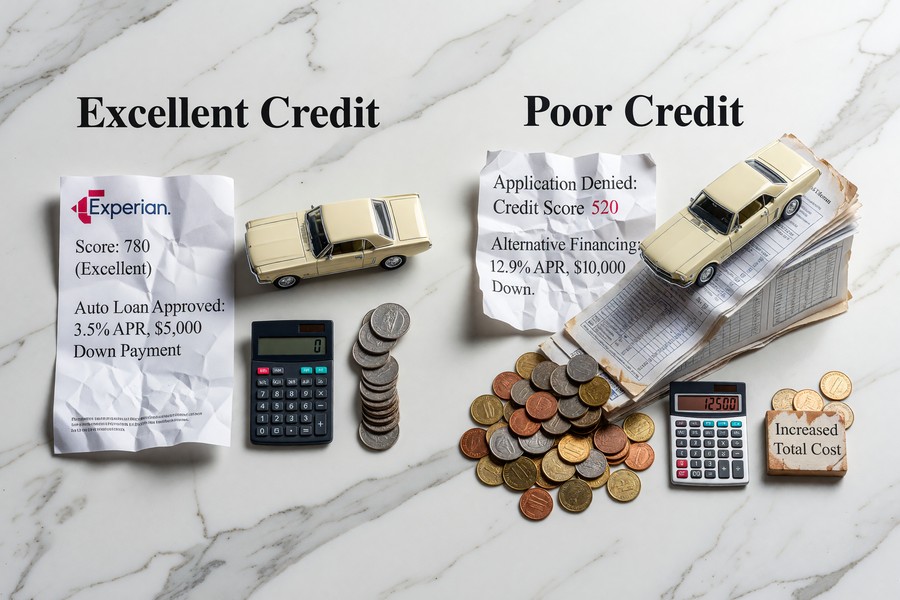
According to Experian’s State of the Automotive Finance Market report, borrowers with “super prime” scores (781+) received average new-vehicle loan rates of 5.08% in early 2025, while “subprime” borrowers (501–600) paid an average of 12.85% (Experian Automotive, 2025). On a $35,000 vehicle over 60 months, that spread represents over $8,000 in additional interest payments.
For a full comparison of how lenders price auto loans at each credit tier, see our in-depth guide to the best auto loan rates in 2026.
How Do You Check Your Credit Score for Free?
You can check your credit score for free through multiple legitimate channels in 2026, and doing so does not harm your score in any way. Several federal laws and consumer protections guarantee your right to access this data without paying.
Free Credit Score Sources
The most authoritative free option is AnnualCreditReport.com — the only federally mandated source where you can access your full credit reports from all three bureaus (Experian, TransUnion, and Equifax) at no cost. As of 2023, the Consumer Financial Protection Bureau (CFPB) made weekly free report access permanent, up from once per year (CFPB, 2023).
Note that AnnualCreditReport.com provides your full credit report but may not always include your actual FICO Score number. For your score specifically, the following free options are available:
- Credit Karma — Provides VantageScore 3.0 from TransUnion and Equifax, updated weekly.
- Experian.com — Provides your FICO Score 8 from Experian data, updated monthly for free.
- Discover Credit Scorecard — Free FICO Score 8 access, even for non-Discover cardholders.
- Most major bank and credit union dashboards — Chase, Bank of America, Citi, and Wells Fargo all offer free score access to account holders.
What to Look for When Reviewing Your Report
When reviewing your reports, check for errors in personal information, unfamiliar accounts (potential identity theft), incorrect payment statuses, and duplicate entries. The Federal Trade Commission (FTC) estimates that approximately 1 in 5 consumers has an error on at least one credit report that could affect their score (FTC, 2021). If you find an error, our step-by-step guide on how to dispute a credit report error and actually win walks you through the entire process.
Avoid any website that claims to offer “free credit scores” but requires a credit card number for a “trial.” These are often subscription traps. The legitimate free sources listed above never require payment information for basic score access.
How Can You Improve Your Credit Score in 2026?
Improving your credit score is achievable through consistent, evidence-based actions — and some changes can produce meaningful score increases within 30–90 days. The strategies below are ranked by impact and speed of results.
High-Impact Improvements
Paying down revolving credit card balances is the fastest way to improve your score if your utilization is above 30%. According to FICO modeling, reducing utilization from 50% to 10% can increase a mid-range score by 40–100 points within a single billing cycle (FICO, 2024). This single action addresses the second-largest scoring factor immediately.
Disputing and correcting errors on your credit report is another high-impact strategy requiring no new credit behavior. Research from the Consumer Financial Protection Bureau (CFPB) found that consumers who successfully disputed errors saw score increases averaging 25 points, with some seeing improvements of 100+ points after major errors were removed (CFPB, 2023).
Structural Improvements Over Time
Becoming an authorized user on a creditworthy family member’s or partner’s credit card account can add years of positive history to your profile almost immediately — without requiring you to spend on the card. This strategy is especially powerful for those building credit from scratch.
Avoiding new hard inquiries for six months before a major loan application helps protect your score from small but compounding drops. Each hard inquiry can reduce a score by 5–10 points, and multiple inquiries in a short window (outside of rate-shopping exceptions) can have a cumulative negative effect (FICO, 2025).
For a complete 90-day strategy with specific milestones and tools, follow our detailed action plan to improve your credit score fast in 2026.
What Are the Biggest Credit Score Myths in 2026?
Several persistent myths lead consumers to make financially harmful decisions about their credit. Separating fact from fiction is essential to managing your score effectively.
Common Myths Debunked
Myth 1: Closing old credit cards improves your score. In reality, closing a credit card reduces your total available credit and can increase your utilization ratio — and if it’s your oldest account, it may also shorten your credit history. Both outcomes typically lower your score.
Myth 2: Carrying a small balance helps your score. FICO has confirmed this is false. You do not need to carry a balance and pay interest to build credit. Paying your statement balance in full each month demonstrates responsible use while keeping utilization low and avoiding interest charges entirely (myFICO, 2025).
Myth 3: Your income affects your credit score. As noted earlier, income is not a factor in any standard FICO or VantageScore model. A minimum-wage worker who always pays on time can score higher than a high-earner who misses payments.
Myth 4: Checking your credit hurts your score. Soft inquiries — including checking your own score and pre-qualification checks from lenders — have zero impact on your score. Only hard inquiries from formal credit applications count (CFPB, 2025).
Myth 5: A perfect 850 is necessary for the best rates. Most lenders offer their best pricing tier starting at 760. Going from 760 to 850 typically produces no additional rate benefit at the majority of major lenders (myFICO, 2025).
Approximately 56% of Americans incorrectly believe that carrying a small credit card balance each month helps build their credit score, according to a survey by the National Foundation for Credit Counseling (NFCC, 2024). This misconception costs cardholders billions in unnecessary interest annually.
Real-World Example: From 628 to 741 in 11 Months
James, 31, a marketing coordinator in Atlanta, had a FICO Score of 628 in January 2025. He carried $9,400 in credit card balances across three cards with a combined limit of $14,000 — a utilization rate of 67%. He also had one 30-day late payment from 18 months earlier.
Over 11 months, James executed three targeted changes: he used a $4,000 tax refund (detailed strategies available in our guide on using your tax refund to build credit) to pay down his highest-utilization card, he set up autopay for the minimum on all accounts to prevent future late payments, and he was added as an authorized user on his mother’s 12-year-old credit card with a $15,000 limit and perfect payment history.
By November 2025, his FICO Score reached 741 — a 113-point improvement. His utilization had dropped from 67% to 19%. He subsequently refinanced his 2022 Honda CR-V at 5.9% APR instead of the 11.4% APR he was paying, saving $142 per month and approximately $8,520 over the remaining 60-month term.
Your Action Plan
-
Pull your free credit reports from all three bureaus
Visit AnnualCreditReport.com to download your Experian, TransUnion, and Equifax reports at no cost. Review each for errors, unfamiliar accounts, incorrect payment statuses, and outdated negative items. You can now access these weekly at no charge under the CFPB’s permanent free access rule.
-
Dispute any errors immediately
File disputes directly with the credit bureau that shows the error using their online dispute portal (Experian.com, TransUnion.com, or Equifax.com). Bureaus are required by the Fair Credit Reporting Act (FCRA) to investigate and respond within 30 days. For a step-by-step walkthrough, use our guide on how to dispute a credit report error.
-
Calculate and reduce your credit utilization
Divide your total current card balances by your total credit limits to find your utilization ratio. If it exceeds 30%, create a debt paydown plan targeting your highest-utilization card first. For detailed guidance on this metric, see our credit utilization ratio explainer. Aim to reach below 10% for maximum score impact.
-
Set up autopay for at least the minimum on every account
Log in to every creditor’s portal — whether Capital One, Chase, American Express, or a student loan servicer — and set up automatic minimum payments. This eliminates the risk of a missed payment destroying your payment history score factor, which accounts for 35% of your FICO Score.
-
Check your actual FICO Score (not just VantageScore)
Visit Experian.com and sign up for a free account to access your FICO Score 8 based on Experian data. Alternatively, Discover’s Credit Scorecard tool provides a free FICO Score to anyone — no Discover account required. Know your starting baseline before you begin improving.
-
Avoid new hard inquiries for at least 6 months before any major loan
Each new credit application triggers a hard inquiry that can lower your score by 5–10 points. If you are planning a mortgage or auto loan, resist any new store card or personal loan applications in the months leading up to your primary application.
-
Consider becoming an authorized user or opening a secured card
If you have a thin credit file, ask a family member with a long, clean credit history to add you as an authorized user on an existing card. Alternatively, open a secured credit card through Discover, Capital One, or your local credit union — deposit $200–$500 as collateral and use it for small, regular purchases paid in full monthly.
-
Monitor your progress monthly and re-evaluate quarterly
Use Credit Karma (free), your bank’s credit score dashboard, or the Experian app to track your score monthly. Set a 90-day review date to assess which actions moved the needle most. Adjust your strategy based on what is actually showing up in your credit report changes.
Frequently Asked Questions
What is a good credit score for a first-time home buyer?
A score of 620 is the minimum for a conventional mortgage, but first-time buyers should target 740 or above to qualify for the best available rates. FHA loans allow scores as low as 580 with a 3.5% down payment (HUD, 2025). Every 20-point improvement above 620 typically results in a meaningfully lower APR offer.
What is a good credit score for renting an apartment?
Most landlords and property management companies look for a minimum score of 620–650, though in competitive rental markets, 700 or above is increasingly expected. Some high-end property managers use 740 as their benchmark (TransUnion SmartMove, 2025). Scores below 580 frequently result in denial or a requirement for a larger security deposit.
How long does it take to build a good credit score from scratch?
With consistent on-time payments and responsible credit use, most consumers can achieve a score of 670 or above within 12–18 months of opening their first credit account. A VantageScore can be generated after just one month of activity. Six months of history is required before a FICO Score can be calculated (myFICO, 2025).
Does checking my credit score lower it?
No — checking your own credit score is classified as a “soft inquiry” and has no effect on your score whatsoever. Only “hard inquiries” triggered by formal credit applications from lenders can lower your score, typically by 5–10 points temporarily (FICO, 2025).
What is considered a good credit score for a car loan?
A score of 661 or above typically qualifies as “prime” for auto lending purposes, unlocking significantly better rates than subprime categories. For the very best auto loan rates, a score of 781 or higher places you in the “super prime” category, where average new-vehicle loan rates were 5.08% in 2025 (Experian Automotive, 2025).
Can I get a loan with a 600 credit score?
Yes, a 600 score (classified as “fair” by FICO) qualifies for some personal loans, FHA mortgages with higher down payments, and most auto loans — though at substantially higher interest rates. Subprime personal loan APRs for scores in the 580–669 range often exceed 20–25% annually. Improving to 670 before applying can save significant money.
What credit score do I need for a credit card?
Entry-level secured credit cards are available with no minimum score requirement. Standard rewards cards typically require 670 or above, while premium travel cards like the Chase Sapphire Reserve or American Express Platinum generally require 740+. Capital One and Discover offer cards for fair credit borrowers in the 580–669 range (NerdWallet, 2025).
How many points does a late payment drop your credit score?
A single 30-day late payment can reduce a score of 780 by as many as 90–110 points, and a score of 680 by approximately 60–80 points (FICO, 2024). The higher your starting score, the more dramatic the drop — because the algorithm penalizes deviations from established patterns more severely for previously pristine profiles.
What is the fastest way to raise my credit score by 100 points?
The fastest path to a 100-point increase typically involves two simultaneous actions: dramatically reducing credit card utilization (from above 50% to below 10%) and disputing significant errors on your credit report. Combined, these two strategies can produce 80–120 point improvements within 30–60 days in the right circumstances (FICO modeling data, 2024). Sustained improvement also requires on-time payments going forward.
Is 700 a good credit score?
Yes — a score of 700 falls solidly within FICO’s “good” tier (670–739) and qualifies the borrower for most mainstream loan products at competitive (though not best-tier) rates. Reaching 740 would move this borrower into the “very good” tier, typically unlocking meaningfully lower APRs across mortgages, auto loans, and personal loans. Understanding what is a good credit score at this level means recognizing that 700 is solid but not optimal for major borrowing decisions.
Our Methodology
This article was researched and written using primary data from FICO’s official scoring documentation, Experian’s annual State of Credit reports, VantageScore Solutions’ model specifications, the Consumer Financial Protection Bureau (CFPB), the Federal Housing Administration (FHA/HUD), and the Federal Trade Commission (FTC). Credit score tier definitions reflect the standard FICO Score 8 model as documented by myFICO. Interest rate ranges cited are national averages compiled from myFICO’s loan savings calculator, Experian Automotive’s quarterly financing reports, LendingTree’s rate aggregation data, and Bankrate’s rate surveys — all referencing 2024–2025 data, the most recent available at time of publication. Rate ranges are illustrative and will vary based on individual borrower profile, lender, loan amount, term length, and prevailing market conditions. This article is updated periodically to reflect changes in scoring model definitions, federal policy, and national rate averages. The Credit Scout does not receive compensation for mentioning any specific lender, credit bureau, or financial institution in this article.
Sources
- myFICO — Credit Score Ranges and Education
- Experian — What Is a Good Credit Score?
- Consumer Financial Protection Bureau (CFPB) — Credit Reports and Scores
- AnnualCreditReport.com — Official Free Credit Report Source
- LendingTree — Personal Loan Statistics and Rate Data
- Bankrate — Average Personal Loan Interest Rates
- Experian — State of Credit Annual Report 2025
Fact-checked by the The Credit Scout editorial team
Quick Answer
A good credit score is generally defined as 670 or higher on the FICO Score scale, which ranges from 300 to 850. As of July 2026, the average American FICO Score stands at 717, placing most consumers in the “good” range — but lenders often prefer scores of 740 or above for the best rates.
As of July 2026, understanding what is a good credit score has never been more consequential. With mortgage rates still elevated and auto loan approvals tightening, your three-digit number directly determines the interest rate you pay, the credit limit you receive, and sometimes whether you get approved at all. A score of 670 or above qualifies as “good” under the standard FICO Score model, but the threshold lenders actually use for premium pricing is considerably higher.
According to Experian’s most recent consumer credit review, approximately 67% of Americans now hold a FICO Score of 670 or above (Experian, 2025). The Consumer Financial Protection Bureau (CFPB) has also documented that borrowers with scores below 620 pay an average of 3–5 percentage points more in mortgage interest than those with scores above 740, representing tens of thousands of dollars over the life of a loan (CFPB, 2025).
In this guide, you will learn the exact score ranges for every credit tier, how FICO and VantageScore differ, what lenders actually look for beyond your number, and a concrete action plan to move your score into the range that unlocks genuinely competitive rates.
Key Takeaways
- A good credit score starts at 670 on the FICO Scale (300–850), but lenders typically reserve their best rates for borrowers with scores of 740 or higher (myFICO, 2025).
- The average U.S. FICO Score reached 717 in 2025, up from 714 in 2022, signaling a gradual upward trend in consumer creditworthiness (Experian, 2025).
- Borrowers with scores below 580 are classified as “poor” credit and may face APRs exceeding 25% on personal loans compared to sub-8% rates for those above 760 (LendingTree, 2025).
- Payment history accounts for 35% of your FICO Score — making it the single largest factor, followed by credit utilization at 30% (FICO, 2025).
- A single 30-day late payment can drop a score of 780 by as many as 90–110 points, according to FICO modeling data (FICO, 2024).
- VantageScore 4.0, used by many lenders and free credit monitoring services, defines “good” as 661–780 — slightly wider than FICO’s equivalent tier (VantageScore Solutions, 2025).
In This Guide
- What Are the Credit Score Ranges and What Do They Mean?
- How Do FICO and VantageScore Differ?
- What Credit Score Do Lenders Actually Want?
- How Is Your Credit Score Calculated?
- What Is the Average Credit Score in America?
- How Much Does Your Credit Score Affect Your Interest Rate?
- How Do You Check Your Credit Score for Free?
- How Can You Improve Your Credit Score in 2026?
- What Are the Biggest Credit Score Myths in 2026?
What Are the Credit Score Ranges and What Do They Mean?
Credit scores in the U.S. fall into five standardized tiers based on the dominant FICO scoring model, ranging from a low of 300 to a perfect 850. Each tier carries real financial consequences, affecting loan approvals, interest rates, insurance premiums, and even employment background checks.
FICO Score Range Breakdown
The five tiers recognized by FICO, Experian, TransUnion, and Equifax are defined as follows. Understanding where your score sits tells you exactly what products and rates you can realistically access today.
| Score Range | FICO Category | Typical Mortgage APR | Typical Personal Loan APR |
|---|---|---|---|
| 800–850 | Exceptional | 6.20%–6.50% | 7.00%–9.50% |
| 740–799 | Very Good | 6.45%–6.80% | 9.50%–13.00% |
| 670–739 | Good | 6.80%–7.40% | 13.00%–18.00% |
| 580–669 | Fair | 7.40%–8.50% | 18.00%–25.00% |
| 300–579 | Poor | Often denied or FHA only | 25.00%–36.00%+ |
Source: myFICO rate estimates and Experian credit tier definitions (2025). APR ranges reflect national averages and will vary by lender and market conditions.
Only about 23% of Americans have a FICO Score in the “exceptional” range of 800 or above, making elite credit a genuinely rare achievement (Experian, 2025).
What Does “Good Credit” Unlock in Practice?
A score of 670–739 typically qualifies you for most mainstream credit products: conventional mortgages, standard auto loans, and mid-tier credit cards with rewards. However, the absolute best promotional rates — 0% APR balance transfers, jumbo mortgage pricing, and premium travel cards — generally require a 740 or higher.
At the “very good” tier (740–799), borrowers gain access to lender best-tier pricing at institutions like SoFi, LightStream, and major banks including Chase and Bank of America. The practical difference between a 670 and a 750 can be hundreds of dollars per month on a mortgage payment.
How Do FICO and VantageScore Differ?
FICO and VantageScore are the two dominant credit scoring models in the United States, and they use different algorithms, different tier definitions, and are used by different types of lenders. Knowing which model a lender uses matters before you apply.
The Key Differences Between Models
FICO Scores are used by approximately 90% of top lenders in major credit decisions, including most mortgage underwriters (myFICO, 2025). VantageScore 4.0 — developed jointly by Experian, TransUnion, and Equifax — is widely used for free credit monitoring services, including those offered by Credit Karma, Credit Sesame, and many bank dashboards.
| Feature | FICO Score 8 / 9 / 10 | VantageScore 4.0 |
|---|---|---|
| Score Range | 300–850 | 300–850 |
| “Good” Tier | 670–739 | 661–780 |
| Minimum History Needed | 6 months of activity | 1 month of activity |
| Trended Data Use | FICO 10T uses trended data | Yes, standard in 4.0 |
| Medical Debt | Weighted in FICO 9+ | Excluded in 4.0 |
| Primary Use | Mortgages, auto, credit cards | Monitoring, fintech, some cards |
Source: myFICO and VantageScore Solutions official model documentation (2025).
Before applying for a major loan, ask the lender which specific scoring model they use. Many mortgage lenders still use FICO Score 2, 4, or 5 — older models that can score differently from the FICO Score 8 displayed on most free monitoring apps.
Which Score Should You Focus On?
For mortgage applications, focus on your FICO Score 2 (Experian), FICO Score 5 (Equifax), and FICO Score 4 (TransUnion) — the three scores most commonly pulled in tri-merge mortgage reports. For auto loans and personal loans, FICO Score 8 or 9 is most commonly used. For monitoring progress day-to-day, VantageScore 4.0 is a useful directional indicator.
What Credit Score Do Lenders Actually Want?
Lenders use credit score minimums as gatekeepers and tiered pricing as profit tools. The minimum to get approved and the score needed to get the best rate are two very different benchmarks — most borrowers conflate them at significant financial cost.
Minimum Score Requirements by Loan Type
For a conventional mortgage, the Federal Housing Finance Agency (FHFA) requires a minimum FICO Score of 620 for most conforming loans. FHA loans backed by the Federal Housing Administration allow scores as low as 500 with a 10% down payment, or 580 with 3.5% down (HUD, 2025).
Auto lenders typically approve borrowers with scores of 600 or above, though subprime auto lenders will work with scores below 580 at significantly higher rates. For unsecured personal loans from major lenders like SoFi or Discover Personal Loans, a minimum of around 640–660 is standard (LendingTree, 2025). For more detail on auto financing requirements, see our guide on what credit score you need to buy a car.
“Getting approved is only half the battle. A borrower with a 680 score may qualify for a mortgage, but they’ll pay tens of thousands more in interest over 30 years compared to someone at 760. The score that matters most is the one that gets you the lender’s best pricing tier — not just their minimum threshold.”
What Lenders Look at Beyond the Number
Sophisticated lenders evaluate your full credit profile, not just a single score. Key factors include your debt-to-income ratio (DTI), which most mortgage lenders cap at 43% for conventional loans, and your credit utilization ratio, which ideally should remain below 30% (CFPB, 2025).
Lenders also review the number and age of your accounts, recent hard inquiries, and the presence of derogatory marks such as collections, charge-offs, or bankruptcies. If you need to understand how mortgage lenders specifically use your score, our detailed breakdown of what credit score you need to buy a house covers each threshold in depth.
Borrowers with FICO Scores of 760 or above receive mortgage APRs that are on average 1.5 percentage points lower than borrowers with scores of 680 — translating to roughly $94,000 in additional interest on a $400,000 30-year mortgage (myFICO loan savings calculator, 2025).
How Is Your Credit Score Calculated?
Your FICO Score is calculated using five weighted factors drawn from your credit reports at Experian, TransUnion, and Equifax. Each factor contributes a different percentage to your final number, and each can be influenced by specific financial behaviors.
The Five FICO Score Factors
Payment history carries the most weight at 35%, reflecting whether you pay all your bills on time every month (FICO, 2025). Missing even one payment has an outsized negative effect, particularly on higher scores. To understand exactly how long a missed payment can haunt your report, read our analysis of how long a late payment stays on your credit report.
Credit utilization — the ratio of your current balances to your total available credit — accounts for 30% of your score. Most credit experts recommend staying below 10% utilization for optimal scoring, though below 30% is the commonly cited safe threshold. Our full breakdown of credit utilization ratio explains exactly how this factor works.
The remaining three factors are: length of credit history (15%), credit mix such as cards, loans, and mortgages (10%), and new credit inquiries (10%) (FICO, 2025). Each hard inquiry from a new application can temporarily lower your score by 5–10 points.
What Doesn’t Affect Your Score
Several common misconceptions lead people to worry about the wrong things. Your income, savings account balance, employment status, and net worth are NOT included in FICO Score calculations (CFPB, 2025). Neither is your race, religion, marital status, or age — factors prohibited under the Equal Credit Opportunity Act (ECOA).
Checking your own credit score — called a “soft inquiry” — does not lower your credit score in any way. Only “hard inquiries” from lenders processing a new credit application can affect your number (FICO, 2025).
What Is the Average Credit Score in America?
The average American FICO Score is 717 as of the most recent Experian State of Credit report, placing the typical U.S. consumer firmly in the “good” credit tier (Experian, 2025). This represents a steady improvement from 711 in 2020, driven partly by pandemic-era debt paydowns and rising consumer financial literacy.
Average Credit Scores by Age Group
Credit scores vary substantially by age because the length of credit history factor rewards older consumers with established records. According to Experian’s 2025 data, average FICO Scores by generation break down as follows.
- Generation Z (18–26): Average FICO Score of 680
- Millennials (27–42): Average FICO Score of 690
- Generation X (43–58): Average FICO Score of 709
- Baby Boomers (59–77): Average FICO Score of 745
- Silent Generation (78+): Average FICO Score of 760
Source: Experian State of Credit Report (2025).
Average Credit Scores by State
Geography plays a meaningful role in credit score averages. Minnesota consistently ranks as the state with the highest average FICO Score at approximately 742, while Mississippi typically records the lowest at around 680 (Experian, 2025). These regional differences correlate with median income levels, local employment rates, and access to financial education resources.
The share of Americans with “exceptional” FICO Scores (800+) has grown to 23% of the population in 2025, up from just 18% in 2015 — a decade-long trend of improving consumer credit health (Experian, 2025).
How Much Does Your Credit Score Affect Your Interest Rate?
Your credit score has a direct, measurable, and often dramatic impact on the interest rates you receive across every major borrowing category. The difference between a good and an exceptional score can mean thousands — or in the case of mortgages, hundreds of thousands — of dollars over time.
Credit Score Impact on Mortgage Rates
Using the myFICO loan savings calculator with current 30-year fixed mortgage rates, the spread between a 620 score and a 760+ score is approximately 1.5–1.8 percentage points in APR (myFICO, 2025). On a $350,000 mortgage, that difference adds up to roughly $80,000–$100,000 in additional total interest paid over the life of the loan.
This is why understanding what is a good credit score for homebuying — and actively working to achieve it before applying — is one of the highest-ROI financial decisions any borrower can make.
“I tell every client the same thing: work on your credit score for six months before you start shopping for a mortgage. Moving from a 680 to a 740 is achievable with focused effort, and the savings over the life of the loan are far greater than any other financial optimization they’ll make that year.”
Credit Score Impact on Auto Loans
According to Experian’s State of the Automotive Finance Market report, borrowers with “super prime” scores (781+) received average new-vehicle loan rates of 5.08% in early 2025, while “subprime” borrowers (501–600) paid an average of 12.85% (Experian Automotive, 2025). On a $35,000 vehicle over 60 months, that spread represents over $8,000 in additional interest payments.
For a full comparison of how lenders price auto loans at each credit tier, see our in-depth guide to the best auto loan rates in 2026.
How Do You Check Your Credit Score for Free?
You can check your credit score for free through multiple legitimate channels in 2026, and doing so does not harm your score in any way. Several federal laws and consumer protections guarantee your right to access this data without paying.
Free Credit Score Sources
The most authoritative free option is AnnualCreditReport.com — the only federally mandated source where you can access your full credit reports from all three bureaus (Experian, TransUnion, and Equifax) at no cost. As of 2023, the Consumer Financial Protection Bureau (CFPB) made weekly free report access permanent, up from once per year (CFPB, 2023).
Note that AnnualCreditReport.com provides your full credit report but may not always include your actual FICO Score number. For your score specifically, the following free options are available:
- Credit Karma — Provides VantageScore 3.0 from TransUnion and Equifax, updated weekly.
- Experian.com — Provides your FICO Score 8 from Experian data, updated monthly for free.
- Discover Credit Scorecard — Free FICO Score 8 access, even for non-Discover cardholders.
- Most major bank and credit union dashboards — Chase, Bank of America, Citi, and Wells Fargo all offer free score access to account holders.
What to Look for When Reviewing Your Report
When reviewing your reports, check for errors in personal information, unfamiliar accounts (potential identity theft), incorrect payment statuses, and duplicate entries. The Federal Trade Commission (FTC) estimates that approximately 1 in 5 consumers has an error on at least one credit report that could affect their score (FTC, 2021). If you find an error, our step-by-step guide on how to dispute a credit report error and actually win walks you through the entire process.
Avoid any website that claims to offer “free credit scores” but requires a credit card number for a “trial.” These are often subscription traps. The legitimate free sources listed above never require payment information for basic score access.
How Can You Improve Your Credit Score in 2026?
Improving your credit score is achievable through consistent, evidence-based actions — and some changes can produce meaningful score increases within 30–90 days. The strategies below are ranked by impact and speed of results.
High-Impact Improvements
Paying down revolving credit card balances is the fastest way to improve your score if your utilization is above 30%. According to FICO modeling, reducing utilization from 50% to 10% can increase a mid-range score by 40–100 points within a single billing cycle (FICO, 2024). This single action addresses the second-largest scoring factor immediately.
Disputing and correcting errors on your credit report is another high-impact strategy requiring no new credit behavior. Research from the Consumer Financial Protection Bureau (CFPB) found that consumers who successfully disputed errors saw score increases averaging 25 points, with some seeing improvements of 100+ points after major errors were removed (CFPB, 2023).
Structural Improvements Over Time
Becoming an authorized user on a creditworthy family member’s or partner’s credit card account can add years of positive history to your profile almost immediately — without requiring you to spend on the card. This strategy is especially powerful for those building credit from scratch.
Avoiding new hard inquiries for six months before a major loan application helps protect your score from small but compounding drops. Each hard inquiry can reduce a score by 5–10 points, and multiple inquiries in a short window (outside of rate-shopping exceptions) can have a cumulative negative effect (FICO, 2025).
For a complete 90-day strategy with specific milestones and tools, follow our detailed action plan to improve your credit score fast in 2026.
What Are the Biggest Credit Score Myths in 2026?
Several persistent myths lead consumers to make financially harmful decisions about their credit. Separating fact from fiction is essential to managing your score effectively.
Common Myths Debunked
Myth 1: Closing old credit cards improves your score. In reality, closing a credit card reduces your total available credit and can increase your utilization ratio — and if it’s your oldest account, it may also shorten your credit history. Both outcomes typically lower your score.
Myth 2: Carrying a small balance helps your score. FICO has confirmed this is false. You do not need to carry a balance and pay interest to build credit. Paying your statement balance in full each month demonstrates responsible use while keeping utilization low and avoiding interest charges entirely (myFICO, 2025).
Myth 3: Your income affects your credit score. As noted earlier, income is not a factor in any standard FICO or VantageScore model. A minimum-wage worker who always pays on time can score higher than a high-earner who misses payments.
Myth 4: Checking your credit hurts your score. Soft inquiries — including checking your own score and pre-qualification checks from lenders — have zero impact on your score. Only hard inquiries from formal credit applications count (CFPB, 2025).
Myth 5: A perfect 850 is necessary for the best rates. Most lenders offer their best pricing tier starting at 760. Going from 760 to 850 typically produces no additional rate benefit at the majority of major lenders (myFICO, 2025).
Approximately 56% of Americans incorrectly believe that carrying a small credit card balance each month helps build their credit score, according to a survey by the National Foundation for Credit Counseling (NFCC, 2024). This misconception costs cardholders billions in unnecessary interest annually.
Real-World Example: From 628 to 741 in 11 Months
James, 31, a marketing coordinator in Atlanta, had a FICO Score of 628 in January 2025. He carried $9,400 in credit card balances across three cards with a combined limit of $14,000 — a utilization rate of 67%. He also had one 30-day late payment from 18 months earlier.
Over 11 months, James executed three targeted changes: he used a $4,000 tax refund (detailed strategies available in our guide on using your tax refund to build credit) to pay down his highest-utilization card, he set up autopay for the minimum on all accounts to prevent future late payments, and he was added as an authorized user on his mother’s 12-year-old credit card with a $15,000 limit and perfect payment history.
By November 2025, his FICO Score reached 741 — a 113-point improvement. His utilization had dropped from 67% to 19%. He subsequently refinanced his 2022 Honda CR-V at 5.9% APR instead of the 11.4% APR he was paying, saving $142 per month and approximately $8,520 over the remaining 60-month term.
Your Action Plan
-
Pull your free credit reports from all three bureaus
Visit AnnualCreditReport.com to download your Experian, TransUnion, and Equifax reports at no cost. Review each for errors, unfamiliar accounts, incorrect payment statuses, and outdated negative items. You can now access these weekly at no charge under the CFPB’s permanent free access rule.
-
Dispute any errors immediately
File disputes directly with the credit bureau that shows the error using their online dispute portal (Experian.com, TransUnion.com, or Equifax.com). Bureaus are required by the Fair Credit Reporting Act (FCRA) to investigate and respond within 30 days. For a step-by-step walkthrough, use our guide on how to dispute a credit report error.
-
Calculate and reduce your credit utilization
Divide your total current card balances by your total credit limits to find your utilization ratio. If it exceeds 30%, create a debt paydown plan targeting your highest-utilization card first. For detailed guidance on this metric, see our credit utilization ratio explainer. Aim to reach below 10% for maximum score impact.
-
Set up autopay for at least the minimum on every account
Log in to every creditor’s portal — whether Capital One, Chase, American Express, or a student loan servicer — and set up automatic minimum payments. This eliminates the risk of a missed payment destroying your payment history score factor, which accounts for 35% of your FICO Score.
-
Check your actual FICO Score (not just VantageScore)
Visit Experian.com and sign up for a free account to access your FICO Score 8 based on Experian data. Alternatively, Discover’s Credit Scorecard tool provides a free FICO Score to anyone — no Discover account required. Know your starting baseline before you begin improving.
-
Avoid new hard inquiries for at least 6 months before any major loan
Each new credit application triggers a hard inquiry that can lower your score by 5–10 points. If you are planning a mortgage or auto loan, resist any new store card or personal loan applications in the months leading up to your primary application.
-
Consider becoming an authorized user or opening a secured card
If you have a thin credit file, ask a family member with a long, clean credit history to add you as an authorized user on an existing card. Alternatively, open a secured credit card through Discover, Capital One, or your local credit union — deposit $200–$500 as collateral and use it for small, regular purchases paid in full monthly.
-
Monitor your progress monthly and re-evaluate quarterly
Use Credit Karma (free), your bank’s credit score dashboard, or the Experian app to track your score monthly. Set a 90-day review date to assess which actions moved the needle most. Adjust your strategy based on what is actually showing up in your credit report changes.
Frequently Asked Questions
What is a good credit score for a first-time home buyer?
A score of 620 is the minimum for a conventional mortgage, but first-time buyers should target 740 or above to qualify for the best available rates. FHA loans allow scores as low as 580 with a 3.5% down payment (HUD, 2025). Every 20-point improvement above 620 typically results in a meaningfully lower APR offer.
What is a good credit score for renting an apartment?
Most landlords and property management companies look for a minimum score of 620–650, though in competitive rental markets, 700 or above is increasingly expected. Some high-end property managers use 740 as their benchmark (TransUnion SmartMove, 2025). Scores below 580 frequently result in denial or a requirement for a larger security deposit.
How long does it take to build a good credit score from scratch?
With consistent on-time payments and responsible credit use, most consumers can achieve a score of 670 or above within 12–18 months of opening their first credit account. A VantageScore can be generated after just one month of activity. Six months of history is required before a FICO Score can be calculated (myFICO, 2025).
Does checking my credit score lower it?
No — checking your own credit score is classified as a “soft inquiry” and has no effect on your score whatsoever. Only “hard inquiries” triggered by formal credit applications from lenders can lower your score, typically by 5–10 points temporarily (FICO, 2025).
What is considered a good credit score for a car loan?
A score of 661 or above typically qualifies as “prime” for auto lending purposes, unlocking significantly better rates than subprime categories. For the very best auto loan rates, a score of 781 or higher places you in the “super prime” category, where average new-vehicle loan rates were 5.08% in 2025 (Experian Automotive, 2025).
Can I get a loan with a 600 credit score?
Yes, a 600 score (classified as “fair” by FICO) qualifies for some personal loans, FHA mortgages with higher down payments, and most auto loans — though at substantially higher interest rates. Subprime personal loan APRs for scores in the 580–669 range often exceed 20–25% annually. Improving to 670 before applying can save significant money.
What credit score do I need for a credit card?
Entry-level secured credit cards are available with no minimum score requirement. Standard rewards cards typically require 670 or above, while premium travel cards like the Chase Sapphire Reserve or American Express Platinum generally require 740+. Capital One and Discover offer cards for fair credit borrowers in the 580–669 range (NerdWallet, 2025).
How many points does a late payment drop your credit score?
A single 30-day late payment can reduce a score of 780 by as many as 90–110 points, and a score of 680 by approximately 60–80 points (FICO, 2024). The higher your starting score, the more dramatic the drop — because the algorithm penalizes deviations from established patterns more severely for previously pristine profiles.
What is the fastest way to raise my credit score by 100 points?
The fastest path to a 100-point increase typically involves two simultaneous actions: dramatically reducing credit card utilization (from above 50% to below 10%) and disputing significant errors on your credit report. Combined, these two strategies can produce 80–120 point improvements within 30–60 days in the right circumstances (FICO modeling data, 2024). Sustained improvement also requires on-time payments going forward.
Is 700 a good credit score?
Yes — a score of 700 falls solidly within FICO’s “good” tier (670–739) and qualifies the borrower for most mainstream loan products at competitive (though not best-tier) rates. Reaching 740 would move this borrower into the “very good” tier, typically unlocking meaningfully lower APRs across mortgages, auto loans, and personal loans. Understanding what is a good credit score at this level means recognizing that 700 is solid but not optimal for major borrowing decisions.
Our Methodology
This article was researched and written using primary data from FICO’s official scoring documentation, Experian’s annual State of Credit reports, VantageScore Solutions’ model specifications, the Consumer Financial Protection Bureau (CFPB), the Federal Housing Administration (FHA/HUD), and the Federal Trade Commission (FTC). Credit score tier definitions reflect the standard FICO Score 8 model as documented by myFICO. Interest rate ranges cited are national averages compiled from myFICO’s loan savings calculator, Experian Automotive’s quarterly financing reports, LendingTree’s rate aggregation data, and Bankrate’s rate surveys — all referencing 2024–2025 data, the most recent available at time of publication. Rate ranges are illustrative and will vary based on individual borrower profile, lender, loan amount, term length, and prevailing market conditions. This article is updated periodically to reflect changes in scoring model definitions, federal policy, and national rate averages. The Credit Scout does not receive compensation for mentioning any specific lender, credit bureau, or financial institution in this article.
Sources
- myFICO — Credit Score Ranges and Education
- Experian — What Is a Good Credit Score?
- Consumer Financial Protection Bureau (CFPB) — Credit Reports and Scores
- AnnualCreditReport.com — Official Free Credit Report Source
- LendingTree — Personal Loan Statistics and Rate Data
- Bankrate — Average Personal Loan Interest Rates
- Experian — State of Credit Annual Report 2025