Updated July 2026
Market Pulse
- 1. The S&P 500 ETF (SPY) closed at 769.60 on August 6, 2026, reflecting a -0.02% change from the prior close (Finnhub, 2026-08-06).
- 2. The Nasdaq-100 ETF (QQQ) ended at 716.33 on August 6, 2026, down 0.14% from the prior session (Finnhub, 2026-08-06).
- 3. The Vanguard Total Stock Market ETF (VTI) traded at 379.66 on August 6, 2026, unchanged from the prior day (Finnhub, 2026-08-06).
- 4. 37% of U.S. adults held stocks, bonds, ETFs, or mutual funds outside retirement accounts in 2025 (Federal Reserve, 2025 Survey of Household Economics and Decisionmaking).
- 5. 8% of investors began investing within the last two years, per the FINRA Investor Education Foundation (2024 National Financial Capability Study).
- 6. In July 2026, market sentiment turned cautiously positive, with news of sector-specific deals and insider activity lifting sentiment on August 4 (finance.yahoo.com, 2026-08-01).
You can start investing with $100 in 2026. That’s not a sales pitch, it’s just the math of where brokerage rules have landed. Zero minimums, fractional shares, and automated transfers have quietly dismantled most of the old barriers to entry. A decade ago, $100 wouldn’t have bought you much more than a sliver of one blue-chip stock. Now it buys a diversified slice of the entire U.S. market.
Timing helps too. Volatility has settled down since the corrections earlier this year, and inflation readings have cooled a bit, taking some pressure off household budgets. Regulatory disclosures are clearer than they used to be, and the apps themselves have gotten simpler. Saving for a vacation? Building a retirement cushion? Either goal, $100 put to work today is a reasonable first move.
Data as of
Official figures from the Board of Governors of the Federal Reserve System, the U.S. Bureau of Labor Statistics (BLS), and the Federal Reserve Economic Data (FRED) series were used. Market news and sentiment data are sourced from Finnhub and finance.yahoo.com. Official figures from FRED, BLS, and Federal Reserve reports; market color from news feeds-08-06.
What the Data Says
One number stands out above the rest: 37% of U.S. adults held non-retirement investments in 2025, according to the Federal Reserve’s 2025 Survey of Household Economics and Decisionmaking [source]. That’s nearly four in ten Americans already in the game.
Dig a little deeper and it gets more interesting. 8% of investors started within the past two years, per the 2024 National Financial Capability Study from the FINRA Investor Education Foundation [source]. No meme-stock frenzy explains that. Easier access and better financial education do.
| Indicator | Latest | Prior / YoY | Source |
|---|---|---|---|
| Unemployment Rate | 4.20% | 4.30% (prior); -2.3% MoM | BLS-06 |
| Gasoline Price (U.S. city average) | 358.518 | 396.961 (prior); -9.7% MoM | BLS-06 |
| Consumer Installment Loan Rate (48-month auto) | 7.47% | 7.37% (prior); +1.4% MoM | FRED-05 |
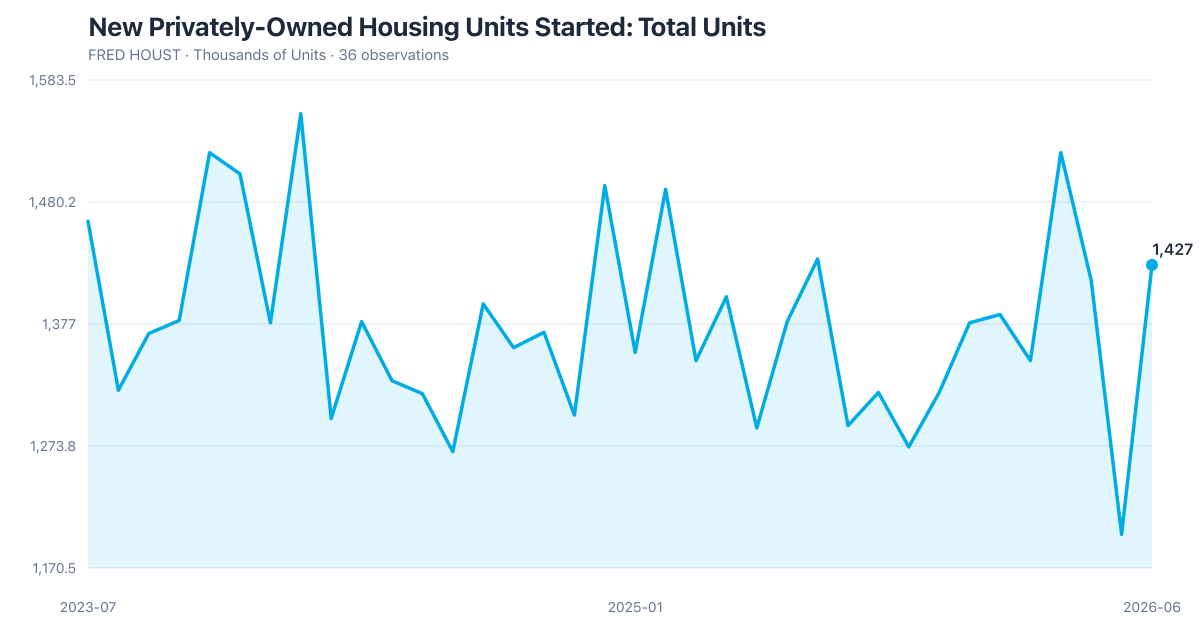
| Private Housing Starts (Total Units) | 1.4K Thousands | 1.2K Thousands (prior); +19% MoM | FRED-06 |
| Consumer Price Index (All items, SA) | 332.568 | 333.979 (prior); -0.4% MoM | BLS-06 |
The unemployment rate fell to 4.20%, down from 4.30% the prior month, signaling job growth. Gasoline prices dropped 9.7% month-over-month, suggesting easing inflation pressures.
Key Takeaway: Inflation is cooling. Jobs are holding steady. That combination makes $100 today more useful than $100 sitting idle. Interest paid on plain savings accounts still lags what a broad index fund has returned historically, which is part of the case for moving cash into productive assets. BLS, June 2026.
What Markets Are Reacting To
Markets have been chewing on a mixed batch of data lately: housing starts jumped, gas prices fell, and consumer confidence ticked up as a result. The S&P 500 ETF (SPY) closed essentially flat on August 6, 2026. The Nasdaq-100 (QQQ) slipped slightly. Nothing dramatic. Investors look cautious, not scared.
Sentiment actually brightened on August 4, thanks to a wave of tech deal-making and insider trading activity that read as bullish rather than alarming. A Yahoo Finance headline noted “major deals signed with the likes of Alphabet and Nvidia could signal renewed investor confidence” [source]. Insider sales at IQVIA and SkyWest, meanwhile, got filed under routine, not red flag.
Key Takeaway: No panic here. Low volatility plus a calmer news cycle makes this a sensible window to put $100 to work, assuming you treat it as a long-term position rather than a trade. Yahoo Finance, August 2026.
What This Means for You
$100 won’t change your life overnight. It changes your habits. People who start small and start early tend to stick with investing longer than people who wait for a bigger lump sum. Size matters less than consistency.
Before any of that, clear the decks. Pay down credit card debt above roughly 15% APR first; that math almost always beats what markets return. Then set aside three months of living expenses in an accessible account.
Once debt is handled and the cushion exists, take that $100 to a zero-minimum taxable brokerage account at Fidelity or Schwab. A broad index fund like VTI or SPY, both with expense ratios under 0.10%, keeps more of your money working instead of paying fees.
Here’s something a lot of guides skip: cash sitting still loses ground every year to inflation. At 3.5% annual inflation, $100 today is worth roughly $70 in a decade. Put that same $100 into a low-fee index fund instead, and history suggests it holds its value better and then some.
Budgeting apps and spreadsheets have their place, but automating the transfer matters more than the tracking. Several apps let you split a direct deposit straight into a brokerage account. Do that once, and investing stops being a decision you have to make every month.
Key Takeaway: Under 30 and debt-free? $100 invested now has decades to compound. That’s the whole advantage, and it’s a real one. Federal Reserve, 2025.
Should You Act Now?
Credit score above 670, and $500 already set aside for emergencies? Go ahead. Open an account at Fidelity or Schwab, fund it with $100, and buy fractional shares of a low-cost ETF.
Hold off if high-interest debt is still on the books or the emergency fund doesn’t exist yet. Investing before those basics are covered is a little like building on sand. One unexpected car repair and any gains get wiped out fast.
Taxes scare off a lot of beginners for no good reason. Accounts under $5,000 rarely run into tax-loss harvesting complexity. Most brokerages handle the gain and loss reporting automatically, so there’s not much for a new investor to manage there.
Where this advice falls short: it assumes steady income. Gig workers and hourly employees with irregular paychecks may need a bigger buffer than $500 before this timeline makes sense.
Key Takeaway: High-cost debt cleared, $500 emergency fund built. That’s the most defensible starting line for a $100 investment in 2026. FINRA, 2024.
Case Study: A Real $100 Investment Journey in 2026
Meet Maya, a 23-year-old barista in Austin, Texas. She saved $100 from a side gig and opened a Fidelity account with zero minimums. She bought fractional shares of VTI, just under 0.26 shares, and set up a $10 auto-contribution for each paycheck. By August 2026, her balance sat at $112.30, boosted by $1.80 in dividends. Nothing about her approach was perfect. It didn’t need to be.
Later, she used Fidelity’s “Savings Goal” tool to track money for a trip she’d been putting off for years. How to Save for a Dream Vacation Without Going Into Debt kept her off credit cards along the way.
By age 30, Maya had $1,800 in that account, built entirely from small, repeated deposits. $100 wasn’t the destination. It was the on-ramp.
Your Step-by-Step Action Plan to Start Investing with $100
Step 1: Clear high-interest debt, especially credit cards above 15% APR.
Step 2: Build a $500 emergency fund. Store it in a high-yield savings account.
Step 3: Open a zero-minimum brokerage account with Fidelity, Schwab, or Charles Schwab.
Step 4: Fund it with $100. Buy fractional shares of a low-cost ETF like VTI or SPY.
Step 5: Set up automatic $5–$10 monthly contributions using your bank’s “round-up” feature or a budgeting app like YNAB or Rocket Money.
Step 6: Review your account quarterly. Rebalance if needed, but avoid daily checking to prevent poor decisions.
Step 7: Learn more about investing fundamentals, dollar-cost averaging, and tax-advantaged accounts. Best Ways to Save for College as a Parent: 529 Plans and Beyond offers valuable insights even if you’re not a parent.
Frequently Asked Questions
Can I really start investing with $100 in 2026?
Yes. Major brokerages allow zero minimums and offer fractional shares, enabling investors to buy into ETFs with just $100. FINRA, 2023.
Should I invest my $100 now or wait for a market dip?
Waiting is riskier than it feels. Markets recover fast, and picking the bottom is nearly impossible even for professionals. Starting now lets dollar-cost averaging do the smoothing for you.
What’s the best fund for a beginner with $100?
Choose a low-cost, broad-market ETF like VTI or SPY. These funds track entire stock market indices and require no research. Their expense ratios fall under 0.10%.
How does inflation affect a $100 investment?
At 2026’s current inflation rate, $100 today will be worth around $70 in ten years if not invested. Putting it into stocks beats cash over time.
Can I lose my entire $100?
Yes, but only by investing in highly volatile or speculative assets. Diversified index funds reduce this risk significantly. Most investors who start with $100 in ETFs don’t wipe out their entire investment.
Is a Roth IRA better than a taxable account for small amounts?
A Roth IRA can be beneficial, especially if you’re under 50 and eligible to contribute up to $7,000 annually. Tax-free growth and withdrawals make it an ideal choice. However, if you’re not yet eligible, a taxable account works fine for small sums.
How do I avoid beginner mistakes?
Avoid chasing hot stocks or crypto. Stick to low-cost index funds. Set up automatic contributions even if they start small. Use tools like sinking fund strategy explained to save consistently.
How much should I save for a car down payment?
For a $20,000 car, aim for 20% as a down payment: $4,000. Starting with your $100 investment builds that habit. How Much Should I Save for a Car Down Payment? Strategies and Tips offers realistic strategies.
Can I save for a wedding on a tight budget?
Yes, and it begins with small steps. Fund your $100 investment, then set up automatic monthly contributions toward your wedding fund. How to Save for a Wedding on a Tight Budget shows how $5 a week adds up.
How much to save for a down payment on a house?
For a $300,000 home, you’ll need 20% as a down payment: $60,000. Start small; use your $100 investment to build the habit. How Much to Save for a Down Payment on a House: A Step-by-Step Guide walks through realistic timelines and tools.
What are the hidden costs of homeownership?
First-time buyers often overlook property taxes, insurance, maintenance, and HOA fees. The Hidden Costs of Homeownership First explains how to budget for them while investing small sums.
Which method helps save more: cash stuffing or digital envelopes?
Digital envelopes win for consistency; they sync with your budgeting app. But both methods work if you’re committed. Cash stuffing vs. digital envelopes: the real test is discipline, not tool choice.
Sources
- Board of Governors of the Federal Reserve System (2025). Savings and Investments in U.S. Households
- FINRA Investor Education Foundation (2024). National Financial Capability Study
- FINRA. Examination and Risk Monitoring Program: Fractional Shares
- U.S. Bureau of Labor Statistics. Employment Situation Summary, June 2026
- U.S. Bureau of Labor Statistics. Consumer Price Index, June 2026
- FRED. New Privately-Owned Housing Units Started, June 2026