
Fact-checked by the The Credit Scout editorial team
Verdict at a Glance
Cash stuffing wins for visual spenders and anyone who needs an ironclad, tangible brake on impulse purchases, because once the physical envelope is empty, you stop spending, no exceptions. Digital envelopes win if you earn an annual income above $75,000, share finances with a partner, or want to earn every possible dollar of credit card rewards and savings interest without losing category control.
It’s the most TikTok-famous budgeting debate in years: cash stuffing vs digital envelopes. Cash stuffing, filling actual envelopes with bills labeled “groceries,” “eating out,” “fun money”, forces you to spend only what you can touch. Digital envelopes, built into apps like Goodbudget or YNAB, replicate the envelope logic with instant syncing and zero trips to the ATM. The core difference is accountability: cash stops you cold when a category hits zero, while digital systems let you reallocate with a few taps, which is either lifesaving flexibility or a built-in loophole depending on your discipline.
A single factor swings the choice hardest: how badly you need a non-negotiable signal that a spending category is done. If running out of cash makes you find a free activity, cash stuffing delivers. If you need to cover an unexpected car repair by pulling from your “clothing” envelope without driving to the bank, digital envelopes keep your budget alive. Everything else, fees, security, your partner’s preferences, rides on that core difference.
Key Takeaways
- Physical cash creates a measurable “pain of paying” that suppresses impulse spending in ways a phone notification cannot replicate, according to financial planners cited by BuzzFeed.
- Out-of-network ATM fees averaged $4.77 per transaction in Bankrate’s most recent checking account survey, adding roughly $114/year for twice-monthly cash withdrawals.
- Keeping $2,000 in physical envelopes instead of a high-yield savings account earning 4%+ APY costs roughly $80–$90 in foregone annual interest, per FDIC national rate data.
- Cash accounted for only 18% of all consumer payments, according to the Federal Reserve’s Diary of Consumer Payment Choice, and that share has continued to shrink.
- FDIC deposit insurance protects bank-held funds up to $250,000 per depositor, per institution, per FDIC deposit insurance guidelines, a protection cash envelopes entirely lack.
- YNAB costs $14.99/month ($99/year), meaning the subscription itself becomes a real cost consideration for anyone on a genuinely tight budget.
| Attribute | Cash Stuffing | Digital Envelopes |
|---|---|---|
| Cost to maintain | $0 if you skip ATMs; typical ATM fees run $4.77 per out-of-network withdrawal | $0 (free apps like Goodbudget Basic) to $14.99/month (YNAB) |
| Setup time | 15–30 minutes per payday to withdraw and stuff envelopes | 5–10 minutes one-time; auto-syncs bank transactions |
| Spending cap enforcement | Physical: empty envelope means stop | Digital: can overspend if you transfer funds between categories instantly |
| Ideal for couples | Both partners must see and agree on physical cash movements | Both can view real-time balances; no physical hiding |
| Credit card reward integration | Hard: paying with cash forgoes cash-back and points | Easy: you can use rewards cards and still follow envelope limits if you pay the card from the right category |
| Security | Cash can be lost, stolen, or destroyed; no fraud protection | FDIC insurance, bank fraud protection, and chargebacks |
| Interest earned on budgeted money | Cash earns 0% | Money stays in an account earning the national average of 0.45%, or much more in a high-yield account |
| Cash-only merchant compatibility | Works everywhere cash is accepted, including small vendors | Requires a debit or credit card; fails at cash-only spots |
Which System Delivers Stronger Spending Discipline?
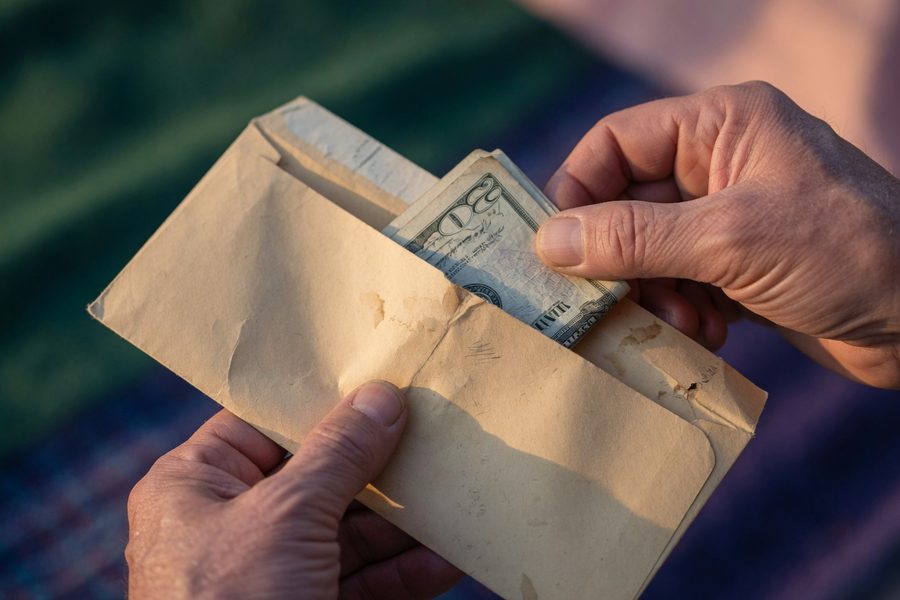
Cash stuffing wins on raw discipline by a wide margin. Physical cash creates what behavioral economists call the “pain of paying.” Danetha Doe, creator of Money & Mimosas, explained to BuzzFeed that “with the cash-stuffing method, you are feeling the cash in your hand, and this can help someone who is unaware of their spending decisions be more present.” When the grocery envelope is empty on day 23 of the month, you eat from the pantry. No app notification, no slick transfer button, just an empty paper sleeve.
Apps that track digital envelopes remove that pain almost entirely. Kendall Clayborne, a CFP at SoFi, pointed out that moving money between digital categories takes seconds and removes the primary behavioral brake that stops overspending. Apps do show a decreasing balance, but they can’t replicate the visceral moment of handing over the last $20. For someone whose main battle is impulse spending, the tactile feedback of cash is the stronger tool.
Cash stuffing has a real ceiling. It works best for people managing a relatively modest number of spending categories with straightforward finances. Once your budget grows more complex, multiple income streams, a shared household, credit card rewards you actually want to capture, the physical system starts to show its seams. It’s a powerful method, not a universal one.
Security, Convenience, and the Costs Nobody Talks About
On safety and convenience, the digital approach dominates, but the interest cost of cash stuffing is real. Physical cash carries zero fraud protection. If you lose an envelope with $300 in grocery money, that money is gone, no chargeback, no FDIC insurance. Bank-held funds, by contrast, are protected by federal deposit insurance up to $250,000 per depositor, per institution, plus bank-level fraud protections and card chargebacks. For a budget holding hundreds of dollars across categories, that difference matters.
The cash drag is real. The national average savings account rate sat at 0.45% as of mid-2025, according to the FDIC, and many high-yield accounts still delivered over 4% APY through 2026. Keeping $2,000 in physical envelopes instead of an interest-bearing account can mean leaving roughly $80–$90 in annual interest on the table. Cash stuffing also means regular ATM trips. The average out-of-network ATM fee hit $4.77 in Bankrate’s most recent checking account survey, and that doesn’t count the time spent driving and withdrawing cash.
App-based setups aren’t free either. YNAB charges $14.99/month ($99/year), while Goodbudget’s free version limits you to 10 envelopes. For someone on a tight margin, that subscription might sting as much as a couple of ATM fees. Still, on pure security and earned interest, the digital side pulls ahead.
Average out-of-network ATM fee: $4.77 per transaction, per Bankrate. Withdrawing cash twice a month for envelopes adds roughly $114/year in avoidable fees.
Budgeting on a Variable Paycheck
Freelancers, gig workers, and servers whose tips vary by hundreds of dollars a week will find cash stuffing becomes a logistical headache fast. A smaller-than-expected check on the 15th means you can’t fully stuff envelopes until you visit the ATM again, and you might need to physically redistribute cash mid-month. For a detailed look at the best apps for uneven cash flow, our roundup of budgeting apps for freelancers walks through tools that sync to actual income as it arrives.
Apps like YNAB and Goodbudget let you assign dollars only when they actually hit your bank account. You can move funds across categories on a phone in 30 seconds without touching a bill. For variable earners, this isn’t a minor convenience, it’s often the difference between sticking to a plan and giving up entirely when income swings. Cash stuffing can still work if you stash a buffer envelope, but the extra labor makes it the weaker option here.
One Partner Likes Cash, the Other Wants Digital, Now What?
Joint budgeting exposes one of cash stuffing’s most underappreciated weaknesses. With a shared digital budget, both partners see every category balance update in real time. There’s no “I thought there was another $50 in the restaurant envelope.” Kendall Clayborne notes that cash stuffing forces you to set aside time every few weeks or each month to review finances, which can be a positive habit for couples willing to sit down together consistently.
The trouble starts when one partner is a cash person and the other lives on card payments, a dynamic that many top-ranking budgeting guides ignore. Physical envelopes require both people to physically acknowledge and agree on category amounts because cash can’t be viewed remotely. A couple where one person manages the envelopes and the other spends on apps often ends up with overspending, because the digital spender can’t see the physical envelope balance. For couples sharing finances, debating big-picture goals like debt versus savings alongside a digital envelope setup usually reduces friction. The visibility of a shared app wins this round for most duos.
Credit Card Rewards: The Elephant in the Envelope Room
Paying with cash means forgoing cash-back, travel points, and fraud protections entirely. In 2022, the Federal Reserve reported that cash accounted for only 18% of all consumer payments, and by 2026 that number has only fallen. Relying on cash means leaving a 2%–5% rewards rate on the table for categories like groceries and dining.
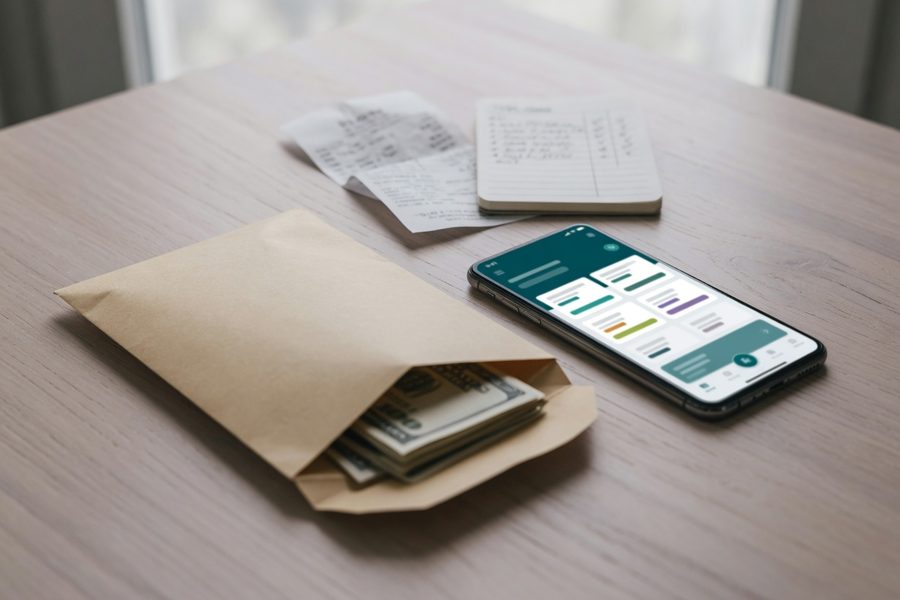
A digital envelope setup offers a practical workaround: use a rewards card for purchases, log the transaction against the correct envelope, and pay the card balance from that envelope’s bank funds before interest accrues. This hybrid approach keeps the budgeting structure intact while capturing rewards. It requires real discipline, you must avoid the credit-building mistake of spending more just to earn points, but for someone vigilant about paying off the card monthly, the approach captures value that cash simply can’t touch.

Action Plan: 6 Steps to Make Your Chosen System Stick
No system survives without a plan. The single most expensive mistake is switching methods every two months. Pick one based on the factors above and follow these six steps to turn it into a lasting habit.
- List every monthly expense category that varies. Groceries, eating out, gas, clothing, entertainment, skip fixed bills like rent.
- Set a target for each category using your last three months of real spending, not a guess.
- If using cash, choose a safe storage spot. A lockbox or hidden drawer beats a kitchen junk drawer. If digital, pick one app and set aside an hour to link accounts.
- Schedule a 20-minute weekly touchpoint. Count cash remaining or check digital balances. Do it the same day each week.
- Create a small “buffer” envelope or category equal to 5% of your monthly income. Use it only when a true emergency hits mid-month, this is the single tactic that prevents quitting.
- After 60 days, adjust category targets based on actual spending, not wishful thinking. This step separates sustainable budgets from short-lived experiments.
When Cash Stuffing Is the Better Choice
Use cash stuffing if any of these profiles match you.
- You struggle with impulse card swipes and need a hard stop when a category is empty.
- Your monthly discretionary spending is under $1,500, above that, carrying large amounts of cash becomes a risk and a chore.
- You’re a visual learner who wants to see the money physically dwindle to reinforce limits.
- You live in an area with many cash-only businesses or farmers’ markets where cards don’t work.
- You’re rebuilding financial trust after a spending blow-up and need absolute, visible boundaries.
When Digital Envelopes Are the Better Choice
Switch to a digital envelope system if these conditions sound familiar.
- Your household income is above $75,000 and missing out on credit card rewards and savings interest costs you real money each year.
- You share finances with a partner who won’t adopt cash, a digital app is the only way to keep both people on the same page.
- Your income is irregular and you need to assign dollars as they arrive rather than all at once on payday.
- You value fraud protection and FDIC insurance and can’t stomach the idea of losing an envelope full of cash.
- You already use a rewards credit card responsibly and want your budget to support, not defeat, your cash-back strategy.
| Criterion | Cash Stuffing | Digital Envelopes |
|---|---|---|
| Spending discipline | 5/5 | 3/5 |
| Convenience | 2/5 | 5/5 |
| Security | 1/5 | 5/5 |
| Irregular income handling | 2/5 | 5/5 |
| Couples compatibility | 3/5 | 4/5 |
| Rewards & interest potential | 1/5 | 4/5 |
| Overall winner | Digital Envelopes (4.2 vs 2.3 avg) |
Kendall Clayborne, Certified Financial Planner at SoFi, has noted that setting aside regular time to review finances, create a budget, and set specific goals is a great habit that cash stuffing can help people develop, particularly those who are newer to budgeting.
Frequently Asked Questions
Is cash stuffing or digital envelopes better for saving money fast?
Cash stuffing usually accelerates short-term savings because the pain of seeing cash leave envelopes suppresses spending on extras. A digital approach can build savings through automated transfers and interest, but that takes discipline to not raid categories. For a sprint, cash has the edge.
Do digital envelope apps cost money?
Some are free with limits, others charge a subscription. Goodbudget’s free version caps you at 10 envelopes; YNAB costs $14.99/month but offers robust goal-tracking and sync. Budget with free options first, then upgrade if you need more envelopes or bank sync.
What happens if I lose a cash envelope?
That money is gone, no fraud protection, no reimbursement. Funds held in an FDIC-insured bank account are protected up to $250,000 and offer chargebacks for unauthorized transactions. This is the biggest risk factor cash stuffing fans often downplay.
Can I use credit cards with digital envelopes?
Yes, and that’s a major advantage. You log each card purchase against the appropriate envelope, then pay the card from that envelope’s bank funds before the statement due date. This keeps you within category limits while still earning rewards.
Does cash stuffing work if most of my bills are paid online?
It gets messy. You can still stuff cash for variable categories like groceries and dining while paying rent and utilities electronically, but you’ll need to track the digital side separately. Many people end up running a hybrid system to avoid missing online payments.
Which system is easier for a couple with different money styles?
Transparency favors digital envelopes. Both partners can check the same app and see real-time balances. Cash requires physical meetings and trust that no one “borrowed” from an envelope without telling the other, which often creates conflict.
How much money do I lose earning no interest by cash stuffing?
On a $3,000 cash float across envelopes, you could miss roughly $120–$135/year if that money sat in a high-yield account earning 4%+ APY. Even at the national average 0.45%, the loss is small, but for people who carry larger cash sums it adds up.
Do I need to go to the bank every week for cash stuffing?
Typically, you withdraw once per pay period. If you’re paid biweekly, that’s two trips a month. Factor in ATM fees if your bank’s network isn’t free, and the time cost of the trip, about 20–30 minutes per withdrawal, which digital tools avoid entirely.
Is cash stuffing or digital envelopes more likely to help me stop using credit cards?
Cash stuffing is the stronger circuit-breaker because you physically can’t swipe when the envelope is empty. A digital envelope budget still permits card use within limits, so you need more self-control to avoid overspending on credit. If your goal is to quit credit cold turkey, go with cash.
Can I combine cash stuffing and digital envelopes?
Absolutely. Many people use cash for the three categories where they overspend most, eating out, groceries, fun money, and run a free digital envelope app for fixed bills and savings goals. This hybrid approach mirrors a wider debate between cash envelopes and zero-based budgeting but gives you the best of both worlds if you can maintain two tracking systems.
Sources
- BuzzFeed, Cash Stuffing Envelope System Explained by Financial Planners
- Bankrate, 2024 Checking Account and ATM Fee Survey
- FDIC, Historical National Rates and Rate Caps
- YNAB, Pricing Page
- Money & Mimosas, Homepage
- Consumer Financial Protection Bureau, Fraud and Security Protections
- IRS, Tax Rules and Refund Timing
- Federal Reserve, 2023 Findings from the Diary of Consumer Payment Choice
- FDIC, Deposit Insurance Overview


