Quick Answer
Leaving savings in a checking account means leaving money on the table. Mid-2025 data shows checking accounts average 0.07% interest. Barely above zero. Savings accounts, by contrast, pay 0.38%. For a $10,000 balance, that’s $7 in a year, $35 over five years. A high-yield savings account (HYSA) at 4.5% would return $225 over the same period, $190 more. That’s not just extra cash. It’s the difference between watching your money stagnate and letting it grow.
Separating savings from checking isn’t just about interest. It’s about behavior. The same account that holds your rent payment also holds your vacation fund. When both live in the same place, spending feels natural. Saving doesn’t.
Updated July 2026
It’s easy to keep savings in checking. The app’s already open, the balance is right there, and moving money elsewhere feels like extra work for no clear reason. But ease doesn’t mean smart. The FDIC reports that average checking account interest rates in mid-2025 sit at 0.07%. Savings accounts, even standard ones, offer 0.38%. That difference isn’t a rounding error. It’s a long-term cost.
Most people don’t think about it like that. They see a few extra dollars and shrug. Over time, though, those dollars compound into something real. And the actual cost isn’t just lost interest. It’s lost potential, quietly, year after year.
Key Takeaways
- Checking accounts earn an average of 0.07% annually; savings accounts pay 0.38%. That’s a fivefold gap in earning power.
- A $10,000 balance in checking instead of a 4.5% HYSA earns $190 less over five years, money that could’ve funded a new laptop or a vacation.
- Over 6% of U.S. adults had no bank account in 2024. For them, savings options are limited. But for the rest, access isn’t the issue, behavior is.
- Despite knowing the math, nearly half of Americans still keep more than half their savings in checking, according to a 2024 Federal Reserve survey.
- FDIC insurance covers up to $250,000 per depositor per bank. For large balances, spreading funds across institutions is necessary for full protection.
In This Guide
The Hidden Price of Doing Nothing
Most checking accounts pay less than a tenth of a percent. The average? Just 0.07%. Not a mistake. It’s by design. These accounts exist for transactions, not growth, and banks have no incentive to change that.
Take $10,000. In checking, it earns $7 a year. After five years, $35 total. In a 4.5% HYSA, it earns $225 over that same stretch. The difference: $190. Not a small sum. That’s the cost of convenience, paid quietly, without a receipt.
Time Turns Small Gaps Into Big Gaps
At first, it’s invisible. Nobody notices $7 versus $225 in year one. But stretch the timeline, and the math turns brutal. A $20,000 balance in checking earns $14 annually. In a 4.5% HYSA, it grows by $900 over five years. The gap: $886. Stretch that to 30 years, and the lost growth exceeds $200,000, per the Federal Reserve’s Economic Well-Being Report (2025). Not a typo. That’s the opportunity cost of parking money somewhere it simply can’t grow.
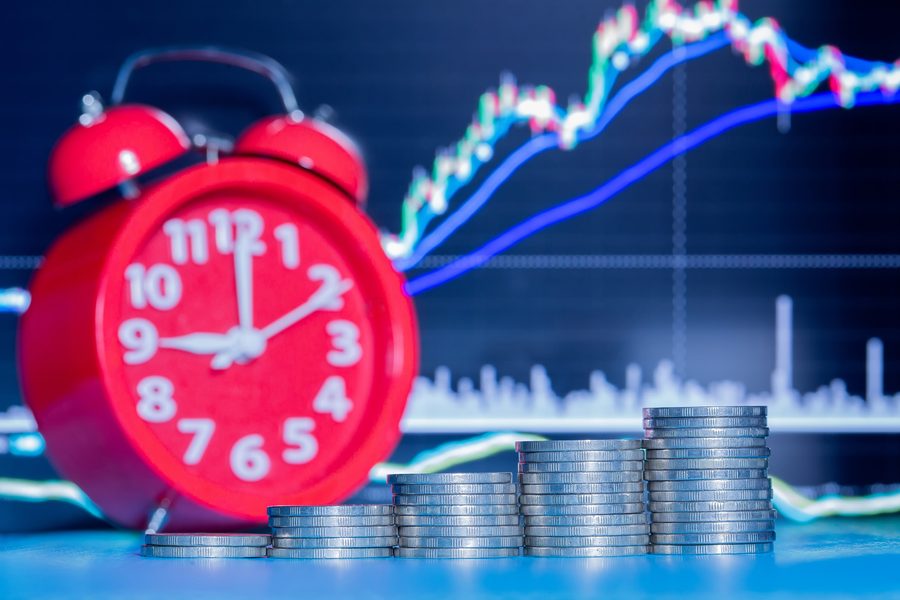
Over five years, a $10,000 balance earns $190 less in a checking account than in a 4.5% HYSA.
Why Inflation Is an Invisible Drain
Inflation isn’t loud. It doesn’t send a notification. It just takes, month after month, without asking. The U.S. saw average inflation of 3.1% in 2024. Early 2025 numbers still hold above 2.5%.
So $10,000 parked in checking loses roughly $300 in purchasing power every year. Even a 0.38% savings account barely keeps pace with that erosion. You’re not earning. You’re just barely holding ground.
Real growth requires returns that outpace inflation. Checking accounts don’t deliver that. Frankly, they don’t even try.
What the Data Says About Real Habits
The median household transaction account balance is $8,000, per the Federal Reserve (2022). Roughly half of that sits in checking. Which means most people aren’t protecting their money from the real enemy here: time, ticking along while cash sits idle.
Saving for a car? A down payment? Something further out? Start by asking where the money actually belongs. Not in checking. Somewhere it can grow.
Set up a recurring transfer, $25, $50, whatever you can manage, each payday. Automate it. Then forget it. That’s how habits form. Not willpower. Not guilt. Just action, repeated.
The Mindset Shift That Actually Works
Money in checking feels like it’s yours to spend right now. That’s not a flaw in willpower. It’s a flaw in design. If cash sits in your checking account, your brain files it as “available.” And available, sooner or later, becomes spent.
Move that same money into a separate account, ideally a different bank, a different app, and the mental weight shifts. It becomes “not mine to touch” by default. A 2024 CFPB study found people with dedicated savings accounts were 43% more likely to reach their goals.
It’s Not Willpower. It’s Environment.
“When we keep savings in checking,” says Scott Cole, CFP, Financial Advisor, Independent Practice, “we’re asking people to resist a system that’s built to encourage spending. It’s not failure. It’s bad setup.”
He adds: “Fix the environment. Move the money. The rest follows.”
Despite knowing better, over 47% of Americans still keep more than half their savings in checking accounts.
What Your Checking Account Should Actually Hold
Your checking account isn’t a vault. It’s a tool for transactions. Use it to pay bills, cover groceries, and buy your coffee.
So how much belongs there? One to two months of essential expenses, generally. A household spending $4,000 a month should keep somewhere between $4,000 and $8,000 in checking. Holding $15,000 in that same account isn’t a buffer. It’s savings wearing a disguise.
Insurance Limits Are Real
FDIC insurance covers $250,000 per depositor, per bank. Go above that, and you’ll want to split funds across institutions. High-income earners, freelancers, or anyone sitting on a large cash cushion need to pay attention here. One bank isn’t always enough.
Where Your Short-Term Cash Should Really Be
High-yield savings accounts are the go-to for money you’ll need within a year. The average 2025 rate sits around 4.5%. Some go over 5.2%. That’s more than 60 times what checking pays, for essentially the same liquidity.
Money market accounts come close, 4.3% to 4.8%, and offer limited check-writing on top. They work well for cash you might need on short notice. Short-term CDs, six or twelve months, hit up to 5.5%, but your money’s locked in for the term. That’s the tradeoff: higher yield in exchange for less flexibility. Only choose a CD if you’re fairly certain you won’t need that cash early.
Transfers Are Instant, Not Slow
Most banks let you move money between checking and savings in seconds. No waiting around. No mysterious delays. Need $2,000 for a car down payment? That transfer clears on your phone before you’ve finished your coffee.
| Account Type | APY (2025) | Minimum Balance |
|---|---|---|
| Interest-Bearing Checking | 0.07% | $100 |
| High-Yield Savings | 4.5% | $1 |
| Money Market Account | 4.3% | $250 |
| 12-Month CD | 5.2% | $1,000 |
Why the Most Common Reasons Don’t Add Up
“I might need it tomorrow.” That’s not a savings strategy. That’s a budgeting gap wearing a disguise. If your cash flow is genuinely that uncertain, the fix is on the spending side, not an excuse to park everything in checking.
Then there’s “it’s too much trouble to open another account.” It really isn’t. Most banks let you open a savings account online in under five minutes. No paperwork, no branch visit. Just a few clicks and you’re done.
The Consumer Financial Protection Bureau (CFPB) recommends setting up automatic transfers from checking to savings. That’s the real discipline. Not willpower. Not guilt. Just automation, running quietly in the background.
Even “Good” Checking Accounts Don’t Compete
Some premium checking accounts pay up to 0.15%, still nowhere near HYSA returns. Chase Total Checking, for instance, offers 0.15% on balances over $20,000. That works out to $30 a year. Compare that to $900 in a 4.5% HYSA on the same balance. The math isn’t close. It never really is.
The Perks You’re Giving Up, And Why They Don’t Matter
Banks dangle rewards: fee waivers, cashback, lower overdraft fees. But these rarely outweigh the cost of lost interest. A $100 annual fee waiver doesn’t come close to covering the $70 in interest you lose by keeping $10,000 in checking instead of an HYSA.
“Don’t keep all your eggs in one basket,” says Gordon Achtermann, CFP, Financial Planning Consultant. “Checking accounts exist for daily use. Saving money there is like storing retirement cash in a lunchbox: easy to grab, poorly protected, and going nowhere.”
The Federal Deposit Insurance Corporation (FDIC) confirms that traditional savings accounts are secure, flexible, and built to help people grow money over time. They don’t come with checks. Banks often cap withdrawals, deliberately, to discourage impulsive spending. Automatic transfers from checking keep your savings separate and your goals protected.
Open a savings account. Set up automatic transfers. Let the money grow where it belongs. That’s really the whole plan. It shields your cash from inflation, builds better habits, and puts your money to work instead of leaving it idle, hidden, or slowly losing value.
Frequently Asked Questions
Can I use my checking account for an emergency fund?
You can, but it’s not the best idea. Checking offers instant access, but nearly zero interest. An emergency fund should grow, not stagnate. A high-yield savings account is far better for long-term protection. The CFPB recommends using a dedicated savings account, even if you keep a small buffer in checking.
Is it safe to move money from checking to savings?
Yes. FDIC-insured savings accounts are as safe as checking, with the same $250,000 insurance limit per institution. The FDIC confirms that savings accounts are a secure way to grow your money over time.
Why do banks pay so little on checking accounts?
Because they’re not meant to grow money. They’re for transactions. Banks make money from fees and loans, not from high interest on deposits. The FDIC reports the average rate is 0.07%, reflecting this role.
How much should I keep in my checking account?
One to two months of essential expenses. If you spend $4,000 monthly, keep $4,000 to $8,000 in checking. Anything above that should be in savings or a growth account.
Can I use my savings account for daily spending?
Most don’t allow checks or debit cards, by design. That helps prevent impulse spending. If you need frequent access, a money market account offers limited check-writing and higher yields.
Do high-yield savings accounts have fees?
Many don’t. The best accounts have no minimum balance and no monthly fees. Always check the terms, but top providers offer zero-fee, high-interest options.
How do automatic transfers help with savings?
They remove the decision. You don’t have to think about it. You just set it and forget it. The CFPB says this is one of the most effective ways to build savings, without relying on willpower.
Is it worth opening a second bank account just for savings?
Yes. It creates a mental and physical barrier. You’re not just moving money, you’re changing your environment. The FDIC notes that a dedicated savings account reduces temptation and supports long-term goals.
Can I lose money in a savings account?
No, if it’s FDIC-insured. Your funds are protected up to $250,000 per institution. Non-insured accounts or investments can lose value, but standard savings accounts do not.
What’s the fastest way to grow my savings?
Use a high-yield savings account with automatic transfers. Even small, consistent deposits add up. The FDIC recommends starting small and increasing over time, using automation to build discipline.
Sources
- FDIC National Deposit Rates (2026)
- FDIC: Saving for Unexpected Events and Your Future
- CFPB: An Essential Guide to Building an Emergency Fund
- Bureau of Labor Statistics: Consumer Price Index (CPI)
- Morgan Stanley: 5 Ways to Save More
- Saving for College: Guide to Savings Accounts
- American Association of Home Appliance Manufacturers: Financial Wellness