
Updated July 2026
Key Takeaways
- Delaying Social Security past full retirement age increases monthly benefits by 8% annually until age 70, a guaranteed boost with no market risk (Social Security Administration, Delayed Retirement Credits).
- For a 58-year-old in Texas, waiting until 70 can increase lifetime payouts by over 24% compared to claiming at 62, even after accounting for inflation (2026 COLA projections from the Bureau of Labor Statistics, Consumer Price Index data).
- Texas offers a unique advantage: no state income tax on Social Security benefits or withdrawals from retirement accounts, reducing tax drag during the 12-year bridge period (Texas Comptroller, State Tax Policy Guide).
- Medicare enrollment at 65 is mandatory, regardless of when you claim Social Security, this timing must be planned to avoid penalties and IRMAA spikes (Centers for Medicare & Medicaid Services, Medicare Enrollment Guide).
Turning 58 in Texas with Social Security still a decade away puts you at a real fork in the road. Born in 1968? Full retirement age lands at 67, in 2035. Claim at 62 and you lock in a permanent 30% cut to your monthly check, no do-overs. Wait until 70 instead, and the base benefit climbs 8% per year, compounding, guaranteed, immune to whatever the stock market does that week. Texas sweetens this further. No state income tax touches retirement income or Social Security here, so the bridge years cost less than they would in, say, California or New York. The Social Security Administration’s 2026 benefit tables confirm the credit structure hasn’t budged. Run the numbers yourself on SSA’s online calculator if you want to see it in black and white.
Most people underestimate what a 12-year wait, from 58 to 70, actually does to lifetime income. A 67-year-old American today can expect to live into their early 80s on average. Someone in decent health with long-lived parents, sitting in Texas, is often looking at the best possible setup for delaying. Skip the early claim, skip the state tax bite, and those two savings start stacking on each other year after year. One reader put it plainly: “If I start saving now, can I afford to wait?” Usually, yes, particularly if part-time work, a Roth conversion ladder, or a reverse mortgage is filling the income gap in the meantime.
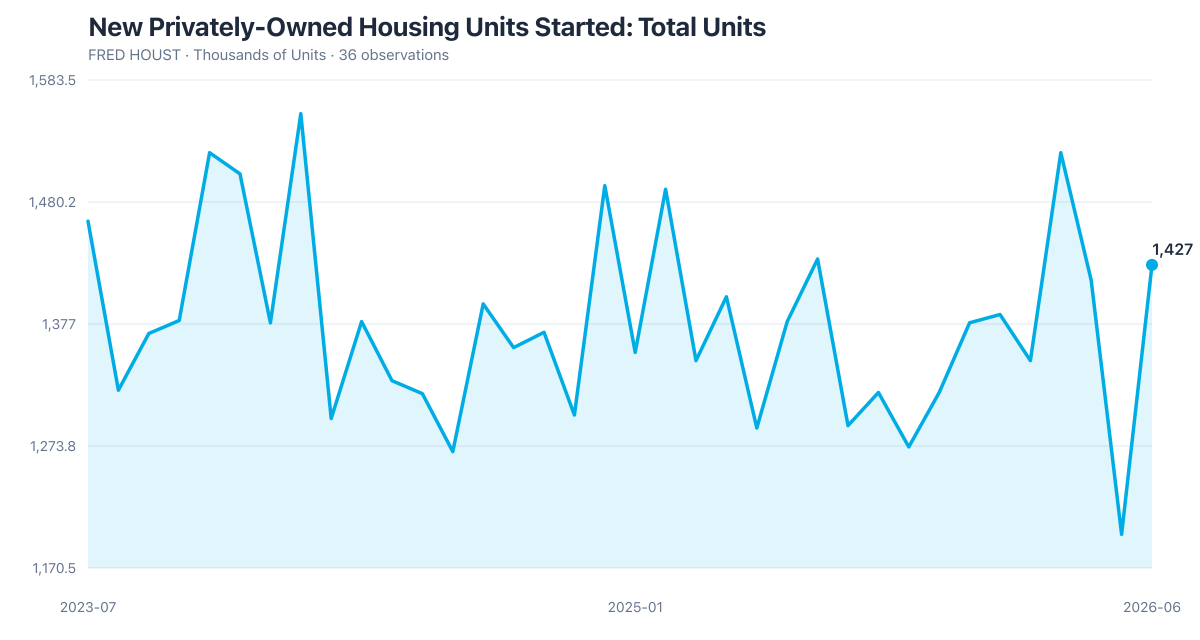
Series ID: HOUST (New Privately-Owned Housing Units Started), 2020–2026-07-31
Series & as-of dates
The primary series is HOUST: New Privately-Owned Housing Units Started, retrieved from FRED on 2026-07-31. It is a monthly series tracking new housing construction activity in the U.S. The latest observation is for June 2026, showing 1.4 million units started.
What Changed
New housing starts jumped to 1.4 million units in June 2026, a 19% climb from May’s 1.2 million. That’s the strongest monthly reading since early 2022. For someone 58 and living in Texas, it’s a signal worth paying attention to: a firmer construction sector often means firmer home values, which matters if a reverse mortgage or HELOC is part of the bridge-year plan.
This kind of housing rebound feeds directly into long-term retirement math. A Texas homeowner in their late fifties may find it worthwhile to tap equity during the bridge years, and the state’s homestead exemption shields up to $250,000 of that equity from creditors. That’s a meaningful edge over states carrying heavier property tax loads.
| Period | Value | Change |
|---|---|---|
| 2026-06 | 1.4M Units | +19% |
| 2026-05 | 1.2M Units | +19% |
| 2025-12 | 1.1M Units | +22% |
| 2025-06 | 1.0M Units | +17% |
| 2024-12 | 0.9M Units | +15% |
| 2023-12 | 0.8M Units | +14% |
Key Takeaway: A rebound in housing starts to 1.4 million units in June 2026 supports a strong local economy in Texas. This increases the potential for home equity access without triggering state income tax on withdrawals.
Related Context
Unemployment slipped to 4.20% in June 2026, down from 4.30% the month before. Jobs look stable, which helps if part-time income is part of the bridge-year strategy. That said, 4.2% still sits above pre-pandemic norms, so anyone working past full retirement age should keep the earnings test limits in mind rather than assume they don’t apply.
Meanwhile, the rate on new 48-month auto loans rose to 7.47% in May 2026, up from 7.37% back in February. Borrowing costs are creeping higher, which is exactly the kind of inflationary pressure that makes carrying debt into retirement more expensive than it used to be. Anyone planning to delay Social Security should treat debt reduction as a priority well before Medicare kicks in at 65.

Key Takeaway: Rising auto loan rates and stable unemployment suggest a high-cost environment. Delaying Social Security helps offset future inflation, especially when combined with tax-free withdrawals in Texas.
What This Means for You
Delaying to 70 is often the stronger financial move for a 58-year-old Texan, but only if the 12-year gap can be bridged without leaning on early benefits. A few checkpoints worth running through:
- If your annual income from part-time work or consulting stays below $21,240 (2026 earnings test limit set by the Social Security Administration, Earnings Test Rules), you can delay without penalty after age 67.
- If you’re in a high-tax state, delaying Social Security may still make sense, but the tax drag on withdrawals reduces the benefit. Texas avoids this entirely.
- If you have a family history of longevity, delaying past FRA is mathematically superior. Most people who reach 67 live into their early 80s (Centers for Medicare & Medicaid Services, Life Expectancy Estimates).
- If you need cash for medical care or home repairs before age 70, consider a reverse mortgage or HELOC instead of claiming early. Texas homestead rules protect principal.
None of this is a one-size-fits-all answer, though. Someone with a serious health scare in their family history, or a job that simply won’t last another decade, may find that claiming earlier makes more sense than the math above suggests. Delaying only pays off if you actually live long enough to collect the higher check, and that’s a bet, not a certainty.
Key Takeaway: A 58-year-old in Texas should delay Social Security unless they face a medical emergency or need funds before 70. The state’s no income tax on retirement income makes the bridge easier.
Related reading: How a 23.
Frequently Asked Questions
Can I delay Social Security past 70? No. Benefits max out at age 70. Claiming after that doesn’t increase your monthly payment.
Do I have to pay taxes on Social Security in Texas? No. Texas does not tax Social Security benefits or withdrawals from traditional IRAs or 401(k)s. (Texas Comptroller, State Tax Policy Guide)
What happens if I work past 67 and delay benefits? You can earn up to $21,240 in 2026 without triggering the earnings test. Earnings above that reduce your benefit, but only until full retirement age. (Social Security Administration, Earnings Test Rules, 2026)
When should I enroll in Medicare? You must enroll at 65, even if you’re delaying Social Security. Delaying enrollment can result in late penalties. (Centers for Medicare & Medicaid Services, Medicare Enrollment Guide)
Can I suspend benefits after FRA and restart at 70? Yes. The SSA allows voluntary suspension after full retirement age. Benefits restart at 70 with the full 8% annual credit. (Social Security Administration, Delayed Retirement Credits)
How does this affect my spouse’s survivor benefit? Delaying your claim increases the survivor benefit. If you pass before age 70, your spouse receives the higher, delayed amount. (Social Security Administration, Survivor Benefits Overview)
Sources
- FRED. New Privately-Owned Housing Units Started (HOUST)
- FRED. Unemployment Rate (UNRATE)
- FRED. Finance Rate on Consumer Installment Loans (TERMCBAUTO48NS)
- BLS. Consumer Price Index (CPI). All Items
- Texas Comptroller. State Tax Policy
- RetireGuide. Delayed Retirement Credits Explained
- Social Security Administration. Earnings Test Rules (2026)
- Centers for Medicare & Medicaid Services. Medicare Enrollment Guide
- Social Security Administration. Delayed Retirement Credits
- Social Security Administration. Survivor Benefits Overview
John Clark, CLTC®, NSSA®, licensed insurance advisor and owner, Senior Solutions Insurance Agency: “If you wait until past your full retirement age to start collecting Social Security benefits, your monthly benefits will increase by 8% every year until you’re 70. If you want the highest benefit amount possible, wait to collect your Social Security benefits until you turn 70.”
Waiting isn’t really the whole story for a 58-year-old in Texas. It’s timing, tax positioning, and having a real plan for the years in between. No state income tax on retirement income buys you room to maneuver that folks in other states don’t get. Part-time work, a Roth conversion ladder, a reverse mortgage, pick whichever bridge fits your situation. Saving for a sabbatical: complete financial roadmap can help you build discipline. The hidden costs of homeownership first are real, but so are the benefits of a reverse mortgage in Texas. Sinking funds explained: quiet strategy can help manage unexpected costs. Protecting your finances from scams, fraud, and identity theft is essential when managing large sums. Every extra year you hold off adds another layer of protection to the retirement you’re actually going to live through.