
Fact-checked by the The Credit Scout editorial team
Quick Answer
At least 7 legitimate methods exist to check your credit score at no cost, including AnnualCreditReport.com, credit card issuer portals, and apps like Credit Karma, all with zero fees and no impact on your credit score.
Every American consumer has the legal right to check their credit score free through multiple government-mandated and industry-supported channels. The Fair Credit Reporting Act (FCRA) guarantees free annual credit reports from all three major bureaus, Experian, TransUnion, and Equifax, and dozens of banks, credit unions, and fintech apps now offer free score access as a standard feature.
According to the Consumer Financial Protection Bureau (CFPB), roughly 26 million Americans are “credit invisible,” meaning they have no scoreable credit file (CFPB, 2022). Yet millions more who do have files rarely check them, leaving errors, fraud, and score-dragging mistakes undetected for months or years. The Federal Trade Commission (FTC) estimates that 1 in 5 consumers has at least one material error on their credit report (FTC, 2021).
This guide breaks down every legitimate method to check your credit score free, what each source actually shows you, and how to use the information to take concrete action on your financial health.
Key Takeaways
- AnnualCreditReport.com now provides weekly free credit reports from all three bureaus, Experian, TransUnion, and Equifax, permanently extended from the original annual limit (CFPB, 2023).
- Roughly 1 in 5 consumers has at least one verified error on their credit report that could negatively affect their score (Federal Trade Commission, 2021).
- More than 200 million Americans are eligible to receive a free FICO Score or VantageScore through their bank, credit card issuer, or a free credit monitoring app (Consumer Financial Protection Bureau, 2024).
- Credit Karma, which uses the VantageScore 3.0 model from TransUnion and Equifax, had over 130 million registered users as of 2024 (Intuit, 2024).
- Checking your own credit score is a “soft inquiry” and has zero impact on your credit score, regardless of how often you check (FICO, 2024).
- The average American’s FICO Score reached 717 in 2024, the highest level ever recorded, according to annual data from Experian (Experian State of Credit, 2024).
In This Guide
- What Is a Credit Score and Why Does It Matter?
- Does Checking Your Credit Score Hurt Your Credit?
- How Do You Get Your Free Credit Report From AnnualCreditReport.com?
- Which Banks and Credit Card Issuers Offer Free Credit Score Access?
- What Free Apps Let You Check Your Credit Score Without Paying?
- Can You Check Your Credit Score Directly With the Credit Bureaus?
- What Is the Difference Between a FICO Score and a VantageScore?
- How Do You Read and Understand Your Credit Report?
- What Should You Do If You Find an Error on Your Credit Report?
- How Often Should You Check Your Credit Score?
What Is a Credit Score and Why Does It Matter?
A credit score is a three-digit number, typically ranging from 300 to 850, that summarizes your creditworthiness based on data in your credit report. Lenders use this number to decide whether to approve you for loans, credit cards, mortgages, and even rental housing.
Five primary factors drive your score: payment history (35%), amounts owed (30%), length of credit history (15%), credit mix (10%), and new credit inquiries (10%), according to the FICO scoring model. A single missed payment can drop a score by 60 to 110 points, according to FICO data published in 2023.
How Your Score Affects Real Money
The difference between a “good” score (670–739) and an “exceptional” score (800+) can mean thousands of dollars in interest over the life of a loan. On a $300,000 30-year mortgage, a borrower with a 760+ FICO Score might qualify for a rate of 6.8%, while a borrower at 620 could face 8.5% or higher, a difference of more than $100,000 in total interest paid (CFPB Mortgage Calculator data, 2024).
Understanding what qualifies as a good credit score is the essential first step before you start monitoring your number regularly.
The average American FICO Score hit 717 in 2024, an all-time high, driven by pandemic-era savings habits and improved payment behavior, according to Experian’s annual State of Credit report (Experian, 2024).
Who Generates Your Credit Score?
No single agency controls your credit score. FICO (Fair Isaac Corporation) and VantageScore Solutions each produce widely used scoring models. The three major credit bureaus, Experian, TransUnion, and Equifax, collect the underlying data. Because each bureau may have slightly different information, your score can vary by bureau.
Does Checking Your Credit Score Hurt Your Credit?
No. Checking your own credit score never hurts your credit. All personal score checks are classified as soft inquiries, which are invisible to lenders and have no effect on your score whatsoever.
Only hard inquiries, triggered when you apply for new credit, can lower your score, typically by 5 to 10 points per inquiry, and only temporarily (FICO, 2024). Hard inquiries remain on your report for two years but only affect your score for about 12 months.
Checking your credit score free every single day will never affect your score. The “checking hurts your credit” myth is one of the most persistent misconceptions in personal finance, according to a 2023 survey by NFCC (National Foundation for Credit Counseling), in which 40% of respondents believed checking their own score would lower it.
Soft vs. Hard Inquiries: A Clear Distinction
Soft inquiries include your own score checks, pre-approval screenings by lenders, and background checks by employers. Hard inquiries occur when you formally apply for a mortgage, auto loan, student loan, or credit card. Rate shopping for a mortgage or auto loan within a 14- to 45-day window typically counts as a single hard inquiry under most FICO scoring versions (FICO, 2023).
How Do You Get Your Free Credit Report From AnnualCreditReport.com?
AnnualCreditReport.com is the only federally mandated free credit report website, authorized by the FTC, CFPB, and all three major bureaus. As of 2023, weekly free reports from all three bureaus are permanently available, up from the original one-per-year limit.
To access your reports, visit AnnualCreditReport.com and provide your name, address, Social Security number, and date of birth. You will then be routed to each bureau’s secure portal to download or view your report. This process takes roughly 10 minutes and requires no credit card.
What AnnualCreditReport.com Does and Does Not Provide
Your free report from AnnualCreditReport.com contains your full credit history, open and closed accounts, payment history, balances, and inquiries, but it does not include your actual three-digit credit score. To get the score alongside the report, use one of the methods described in the sections below, or purchase your FICO Score directly from the bureau.

Pull your report from one bureau at a time, for example, Experian in January, TransUnion in May, and Equifax in September. This gives you near-continuous monitoring for errors throughout the year at no cost.
Which Banks and Credit Card Issuers Offer Free Credit Score Access?
Dozens of major banks and credit card issuers now provide free credit score access as a standard benefit for cardholders. This is one of the fastest and easiest ways to check your credit score free without creating a new account anywhere.
The following institutions provide free score access to eligible customers, often updated monthly and available directly within online banking or mobile apps.
| Institution | Score Type Provided | Bureau Used | Update Frequency | Who Qualifies |
|---|---|---|---|---|
| Discover | FICO Score 8 | TransUnion | Monthly | Any U.S. adult (no account required via Discover Scorecard) |
| Chase | VantageScore 3.0 | TransUnion | Weekly | Chase credit card holders |
| American Express | VantageScore 3.0 | TransUnion | Monthly | Amex cardholders |
| Bank of America | FICO Score 8 | TransUnion | Monthly | BofA credit card or checking account holders |
| Capital One | VantageScore 3.0 | TransUnion | Weekly | Any adult via CreditWise (no account required) |
| Citi | FICO Score 8 | Equifax | Monthly | Citi cardholders |
| Wells Fargo | FICO Score 9 | Experian | Monthly | Wells Fargo account holders |
Two options stand out for people who are not current customers: Discover’s Scorecard and Capital One’s CreditWise both offer genuinely free credit score access to any U.S. adult, even without an existing account with either company.
One honest limitation of bank-provided scores: most institutions pull from only one bureau. That means a negative item sitting exclusively on a different bureau’s file won’t show up in your bank app at all. Relying solely on your bank’s score tool is convenient for routine tracking, but it is not a substitute for pulling full reports from all three bureaus periodically.
What Free Apps Let You Check Your Credit Score Without Paying?
Several independent apps allow ongoing credit score monitoring with no hidden fees. The most widely used platforms are Credit Karma, Credit Sesame, and WalletHub, each offering a different combination of score models and bureau coverage.
Credit Karma
Owned by Intuit, Credit Karma is the largest free credit monitoring service in the U.S. The app provides VantageScore 3.0 scores from both TransUnion and Equifax, updated weekly. As of 2024, the platform had over 130 million registered members (Intuit Annual Report, 2024). There are no subscription fees, the business model relies on targeted financial product recommendations instead.
That revenue model is worth understanding before you sign up. Every loan offer or credit card recommendation on the platform is financially motivated. The score data itself is legitimate and useful; the product suggestions are advertisements, not neutral advice.
Credit Sesame
Credit Sesame provides a free VantageScore 3.0 from TransUnion and includes a free monthly credit report summary. The platform emphasizes credit improvement recommendations and debt analysis tools alongside score monitoring.
WalletHub
WalletHub is notable because it offers daily score updates using TransUnion data, the most frequent free refresh available among consumer apps. Full TransUnion credit report access and alerts for any changes detected on your report are included at no cost.
Credit Karma users collectively received over $2.5 billion in tax refunds processed through the platform in 2023 (Intuit, 2024), illustrating the scale at which free financial tools have penetrated everyday American financial life.
These apps are legitimate tools for ongoing monitoring. Be aware, though, that their primary revenue model is recommending financial products, so expect targeted offers for credit cards and loans based on your profile. This does not diminish their usefulness for tracking your score.
Can You Check Your Credit Score Directly With the Credit Bureaus?
Yes. Each of the three major credit bureaus offers some form of free score access, though the scope and features differ significantly between them. Here is what each bureau provides at no cost.
Experian Free Membership
Experian offers a free membership tier at Experian.com that provides your FICO Score 8 based on Experian data, updated monthly. This is one of the rare places where consumers can get an actual FICO Score, not just a VantageScore, at no cost. The free tier also includes Experian credit report access and basic dark web scanning.
TransUnion and Equifax
TransUnion provides free score access through its TransUnion.com portal, including a VantageScore 3.0. Equifax’s free tier at Equifax.com includes one free Equifax credit report and score per year, with paid options for more frequent access. Both bureaus offer credit monitoring subscription services, but these are optional and not required to access the free tools.
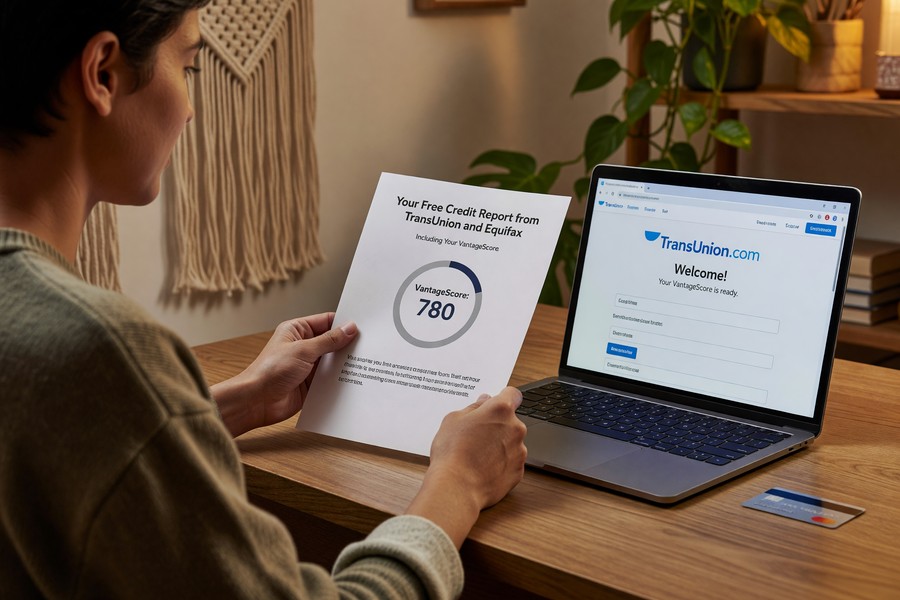
All three bureaus prominently advertise paid subscription services, including credit monitoring and identity theft protection, on pages where free tools are also available. You are never required to enter payment information to access your free annual credit report at AnnualCreditReport.com. If a site asks for a credit card to access your “free” report, leave immediately.
What Is the Difference Between a FICO Score and a VantageScore?
FICO Scores and VantageScores are both legitimate credit scoring models, but they use different algorithms and are not directly interchangeable. Knowing which type you are looking at helps you interpret your score accurately.
FICO Scores, developed by Fair Isaac Corporation, are used in 90% of lending decisions in the United States (FICO, 2024). There are dozens of FICO versions, FICO Score 8 is the most widely used, while FICO Score 9 and the newer FICO Score 10 series are increasingly adopted by lenders. VantageScore was developed collaboratively by Experian, TransUnion, and Equifax in 2006 and is used more widely in free consumer tools and educational contexts.
| Feature | FICO Score 8 | VantageScore 3.0 | VantageScore 4.0 |
|---|---|---|---|
| Score Range | 300–850 | 300–850 | 300–850 |
| Lender Adoption | 90% of U.S. lenders | Limited, growing | Used by some mortgage lenders |
| Minimum Credit History Required | 6 months, 1 account | 1 month, 1 account | 1 month, 1 account |
| Treats Medical Debt | Counts as negative | Reduced weight | Excluded if under $500 |
| Free Access Options | Experian, Discover, several banks | Credit Karma, Capital One, Chase | Fannie Mae/Freddie Mac mortgage tools |
| Rental Payment Inclusion | No (standard) | No (standard) | Yes (if reported) |
For most everyday monitoring purposes, either score type is useful for tracking trends and catching problems. Preparing to apply for a mortgage or major loan? Ask the lender which specific score version they use, then focus your monitoring on that version. The gap between what a free app shows and what a lender actually pulls can be 10 to 40 points, not because either number is wrong, but because different models weight the same data differently.
Working to build your credit from a low starting point? The full process of building credit from scratch will help you make the most of whichever score tool you choose.
“Consumers often get confused when their Credit Karma score differs from the score their mortgage lender pulls. The discrepancy is almost always due to different scoring models — not because one score is wrong. Both are accurate snapshots of the same underlying data, just weighted differently.”
How Do You Read and Understand Your Credit Report?
Your credit report contains four main sections: personal information, account history, public records, and credit inquiries. Understanding each section helps you spot errors, fraud, and opportunities to improve your score quickly.
Account History: The Core of Your Report
This section lists every credit account you have or have had, including credit cards, mortgages, student loans, and auto loans. For each account, the report shows the current balance, credit limit, payment history (month by month), and account status (open, closed, delinquent, etc.).
Payment history is the single largest factor in your credit score at 35% of your FICO Score calculation. Even one 30-day late payment can remain on your report for 7 years (FCRA, as interpreted by CFPB, 2024). For a detailed breakdown, see our guide on how long a late payment stays on your credit report.
Inquiries Section
This section is divided into hard inquiries (visible to lenders) and soft inquiries (visible only to you). Hard inquiries from the past 12 months can affect your score. Any hard inquiries you do not recognize should be investigated immediately, they are a common early indicator of identity theft.
Understanding Credit Utilization in Your Report
Your credit report shows the balance-to-limit ratio on each revolving account. This ratio, known as your credit utilization rate, accounts for 30% of your FICO Score. Experts recommend keeping it below 30%, though utilization under 10% is associated with the highest scores (Experian, 2024). Learn more in our in-depth guide to credit utilization ratio and how to optimize it.
The Public Records section of your credit report used to include tax liens and civil judgments, but the three major bureaus removed these items from credit reports starting in 2018 following a National Consumer Assistance Plan agreement. Today, only bankruptcies appear in the public records section.
What Should You Do If You Find an Error on Your Credit Report?
Finding an error on your credit report triggers a legal right to dispute it for free, both with the credit bureau reporting the error and the company that furnished the information. The bureau must investigate and respond within 30 days of receiving your dispute under the FCRA.
Common errors include accounts that do not belong to you, incorrect payment status (marked late when paid on time), duplicate accounts, and wrong credit limits or balances. The FTC found that 5% of consumers had errors significant enough to affect their credit score by 25 points or more (FTC, 2021).
How to File a Dispute
Disputes can be filed online, by mail, or by phone with each bureau. Online portals are available at Experian.com, TransUnion.com, and Equifax.com. Filing by certified mail creates a paper trail and is recommended for complex disputes. Include copies, never originals, of supporting documents such as payment confirmation, account statements, or identity records.
For a complete step-by-step strategy on winning credit report disputes, including specific templates and escalation tactics, read our guide on how to dispute a credit report error and actually win.
What Happens After You Dispute
The bureau notifies the data furnisher (typically your lender or collection agency) of your dispute. When the furnisher cannot verify the information within 30 days, the item must be corrected or removed. You receive written notification of the outcome and a free updated copy of your report if a change was made.
Consumers who successfully disputed and removed a negative error from their credit report saw an average score improvement of 25 points within 30 days, based on FTC study data (Federal Trade Commission, 2021).
How Often Should You Check Your Credit Score?
Check your credit score at a minimum once per month for routine monitoring, and review your full credit reports from all three bureaus at least four times per year. More frequent checks are appropriate when you are actively working to improve your score or preparing to apply for major credit.
Monthly monitoring allows you to catch errors, unauthorized accounts, and score fluctuations before they cause real financial damage. Given that weekly free reports are now permanently available through AnnualCreditReport.com, there is no logistical reason to check less frequently than quarterly.
When to Check More Frequently
- Three to six months before applying for a mortgage, auto loan, or other major credit product
- Immediately after receiving a data breach notification from any company you do business with
- When you suspect identity theft or notice unfamiliar accounts or inquiries
- When actively working on a credit improvement plan, monthly checks let you track progress
- After paying off a large debt or closing an old account
For anyone planning a major purchase, our detailed breakdown of what credit score you need to buy a house in 2026 covers exactly what lenders are looking for at each score tier.
Signing up for free credit monitoring alerts through Experian, TransUnion, or Credit Karma means you receive a notification, often within 24 hours, if a new account is opened in your name, your balance changes significantly, or a hard inquiry hits your report. This real-time detection is one of the fastest ways to catch identity theft early.
Real-World Example: How Monthly Score Checks Saved Marcus $4,200
Marcus, 41, a small business owner in Atlanta, checked his credit score free through Credit Karma in March 2025 and noticed it had dropped 47 points, from 742 to 695, without any action on his part. Alarmed, he pulled his full Experian report through AnnualCreditReport.com and found a collection account from a medical bill he had paid two years prior, incorrectly listed as unpaid by a third-party collections agency.
Marcus filed an online dispute with Experian and submitted his payment confirmation as documentation. Within 22 days, Experian completed its investigation and removed the erroneous collection. His score rebounded to 748 within the next billing cycle, 6 points above his pre-error baseline, likely because other positive account data had also updated.
The practical impact: Marcus had been planning to refinance a commercial vehicle loan at the time. With his corrected score of 748 versus the erroneous 695, he qualified for a rate of 7.2% instead of 9.8% on a $38,000 auto loan over 60 months. The difference in total interest paid was approximately $4,200 over the loan term. None of this would have been possible if he had not been monitoring his score monthly.
Your Action Plan
-
Pull your free credit reports from all three bureaus today
Visit AnnualCreditReport.com and request your free reports from Experian, TransUnion, and Equifax. Weekly access is now permanent. This takes about 10 minutes and requires no payment information.
-
Set up a free ongoing score tracker
Download the Credit Karma app or sign up at Capital One CreditWise for VantageScore coverage from two bureaus. For a free FICO Score specifically, create a free account at Experian.com or use Discover Scorecard (available to all U.S. adults, no Discover account required).
-
Check your bank or credit card issuer’s mobile app
Log into your existing bank or credit card app (Chase, Bank of America, Citi, Wells Fargo, American Express, and others all offer free score access to account holders). Enable score monitoring in account settings if it is not already active.
-
Review your credit report section by section for errors
Go through your account history, personal information, inquiries, and public records on each bureau’s report. Flag any account you do not recognize, any incorrect payment status, or any balance that does not match your records.
-
Dispute any errors immediately
Use the online dispute portals at Experian.com, TransUnion.com, or Equifax.com to file disputes with supporting documentation. For complex cases, send a certified letter. The bureau has 30 days to investigate and respond under the FCRA. Follow the step-by-step process in our guide to disputing credit report errors effectively.
-
Enable real-time credit monitoring alerts
Turn on email or push notification alerts through your chosen monitoring platform (Credit Karma, Experian, TransUnion, or your bank’s app). This ensures you learn within 24 hours if a new account is opened in your name or your score changes significantly.
-
Schedule quarterly full-report reviews
Set a recurring calendar reminder every three months to pull a full credit report from a different bureau. Rotating through Experian, TransUnion, and Equifax gives you near-continuous coverage across all three files throughout the year.
-
Use your score data to set a credit improvement goal
Once you know your current score, identify the primary factors dragging it down, typically late payments, high utilization, or a short credit history. Our 90-Day Credit Score Improvement Action Plan provides a structured roadmap with specific monthly targets.
Related reading: FHA Loans 2026: How First.
Frequently Asked Questions
Is AnnualCreditReport.com the only legitimate free credit report site?
Yes, AnnualCreditReport.com is the only federally mandated free credit report site authorized by the FTC and all three major bureaus. Other sites claiming to offer “free” credit reports are often commercial services that charge after a trial period. The official URL is AnnualCreditReport.com, be wary of sites with similar names.
How often can I check my credit score for free?
Daily checks are possible through platforms like WalletHub, which refreshes TransUnion data every 24 hours. Weekly updates are available through Credit Karma and Capital One CreditWise. AnnualCreditReport.com now offers weekly free full credit reports from all three bureaus permanently, since the CFPB made the expanded access permanent in 2023.
Does Credit Karma show my real credit score?
The score Credit Karma displays is real and legitimate, specifically the VantageScore 3.0 model from TransUnion and Equifax. It is not a FICO Score. Your FICO Score may differ by 10–40 points in either direction. Both are accurate reflections of your credit health, but lenders most commonly use FICO when making credit decisions.
What credit score do I need to get a good mortgage rate?
Most conventional mortgage lenders require a minimum FICO Score of 620, but the best rates are typically reserved for scores of 760 or above, according to CFPB mortgage data from 2024. FHA loans allow scores as low as 500 with a 10% down payment, or 580 with a 3.5% down payment. See our full breakdown of credit score requirements for buying a house.
Can I get my credit score for free if I have no credit history?
Without a credit history, most scoring tools will return no score at all, you simply have no scoreable file yet. The CFPB estimates 26 million Americans are in this “credit invisible” category (CFPB, 2022). VantageScore 4.0 can score some consumers with as little as one month of history, which is more inclusive than FICO Score 8’s six-month minimum. Starting with a secured credit card or becoming an authorized user on another account is the fastest way to establish a scoreable file.
Is my free credit score on Credit Karma safe and private?
Credit Karma uses 128-bit SSL encryption and follows standard data security practices. Like most free services, the business model involves sharing anonymized user data with financial product partners for targeted advertising. The company’s full privacy policy is available at creditkarma.com/privacy. None of the financial products recommended on the platform are required.
Will signing up for multiple free credit score services hurt my credit?
No. Signing up for any number of free credit monitoring services, Credit Karma, Experian, WalletHub, Capital One CreditWise, or any other, only triggers soft inquiries, which do not affect your credit score. Multiple services can be used simultaneously with no credit impact.
How do I get my credit score if I am not a U.S. citizen?
Non-U.S. citizens with a Social Security number or Individual Taxpayer Identification Number (ITIN) can access free credit scores through the same channels available to citizens. Without either, your credit history may not yet exist in U.S. bureau systems. Some credit card issuers, including American Express and Deserve, offer programs designed to help new-to-country consumers start building a U.S. credit history.
What is the difference between a credit score and a credit report?
Your credit report is the full document detailing your credit accounts, payment history, balances, inquiries, and personal information. Your credit score is the three-digit number calculated from that report data. AnnualCreditReport.com provides the report but not the score. Free apps and bank portals typically provide the score with a summary, but not always the full report.
Can I check my credit score at a credit union for free?
Many credit unions provide free credit score access to members as a standard benefit, often including FICO Scores. Contact your credit union directly or log into online banking to see what is available. The National Credit Union Administration (NCUA) encourages credit unions to offer financial education tools including score monitoring, though availability varies by institution.
Why does my credit score differ between bureaus?
Each bureau collects data independently, and not every lender reports to all three. A creditor might report a balance to Experian but not to TransUnion, or a delinquency might appear on one file before it is updated on the others. Score variation between bureaus is normal and expected, differences of 20 to 50 points are common. That gap is also why checking reports from all three bureaus matters, not just the one your bank happens to show you.
Our Methodology
The Credit Scout evaluated free credit score access methods based on the following criteria: score model provided (FICO vs. VantageScore), bureau data source, update frequency, account requirements, data security disclosures, and ease of access for consumers with varying credit histories. All information was verified against official bureau websites (Experian.com, TransUnion.com, Equifax.com), the CFPB’s consumer education database, and published terms from each institution or app as of March 2026. We do not accept payment from any credit bureau, bank, or app in exchange for ratings or recommendations in this article. Free tool availability and features are subject to change, we recommend verifying directly with each provider before relying on any specific feature.