Updated July 2026
Quick Answer: You can dispute a credit report error for free under the Fair Credit Reporting Act. File online, by mail, or by phone with Equifax, Experian, or TransUnion. The bureau must investigate within 30 days and correct any verified error. If rejected, you can appeal with new evidence or file a complaint with the CFPB.
Key Takeaways
- One in five Americans has at least one error on their credit report, according to the FTC, and 27% of participants in a 2024 Consumer Reports study found errors serious enough to affect their creditworthiness.
- You have the legal right under the Fair Credit Reporting Act (FCRA) to dispute any inaccurate or incomplete information at no cost.
- Credit bureaus are required by law to investigate your dispute within 30 days of receiving it, 45 days if you provide additional information.
- Correcting a single error can improve your credit score by 25 points or more, depending on the nature of the mistake.
- The Consumer Financial Protection Bureau received 430,600 credit reporting complaints in 2023, highlighting how widespread the issue remains.
- Disputing an error does not hurt your score and may improve it if the correction is made.
- Errors often stem from data mix-ups, outdated information, or identity theft, common issues that can be resolved with proper documentation and follow-up.
How Credit Report Errors Happen
Credit reports get built from data that lenders, creditors, and collection agencies feed into the system. Billions of entries move through that pipeline every year. Somewhere in that volume, mistakes slip through. A name match with a stranger, a payment reported late by accident, an old negative mark that should’ve dropped off years ago. All of it can land on your report without you ever knowing.
Identity theft accounts for a good chunk of these problems. Someone else runs up debt, and it shows up under your name instead of theirs. A 2024 Consumer Reports study found that 27% of participants found errors serious enough to potentially affect their creditworthiness. That’s not a rounding error. That’s a systemic problem.
Common Types of Errors
Review your report with these red flags in mind:
- Incorrect personal information (wrong address, name spelling, or Social Security number)
- Accounts that don’t belong to you
- Duplicate accounts listed more than once
- Wrong account status (e.g., marked “open” when it’s closed)
- Incorrect payment history (on-time payments marked late)
- Negative items that are past the 7-year reporting limit
None of this is just paperwork trivia. These mistakes cost real money. A single inaccurate late payment can knock 60 to 80 points off your score. That’s often enough to bump you into a worse interest rate tier, and over the life of a loan, that gap can add up to thousands of dollars.
How to Get Your Free Credit Reports
AnnualCreditReport.com is the only source authorized by the federal government to hand out free credit reports, full stop. Visit AnnualCreditReport.com and you can pull your file from Equifax, Experian, and TransUnion every single week now, not once a year like the old rule. The FTC made that change permanent, and it’s a big deal if you’re actively hunting for errors.
Pull all three and lay them side by side. Errors don’t always show up uniformly. One bureau might have a mistake the other two don’t, which means you’ll need to file separate disputes with each one. They don’t compare notes or share outcomes between themselves.

How to Dispute a Credit Report Error
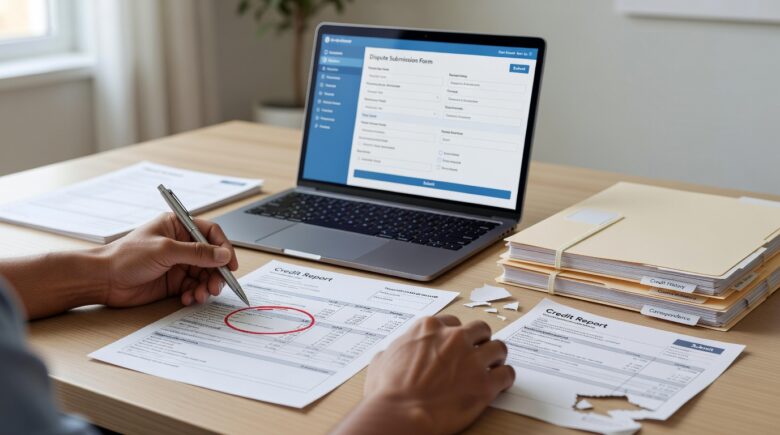
The mechanics aren’t complicated. Getting it right the first time is what matters, because sloppy disputes get rejected. Here’s the process broken down.
Step 1: Identify the Error and Gather Evidence
Mark every discrepancy you find. For each one, pull together proof, bank statements, an account closure letter, payment confirmations, whatever backs up your claim. Vague complaints get ignored. Specific evidence gets acted on.
Step 2: File a Dispute with the Credit Bureau
You’ve got three options: online, mail, or phone. Online moves fastest. Use the official portals below:
If you go the mail route, send it certified. That gives you a paper trail if things get contested later. Include your full name, address, account number, a clear written explanation, and copies (never originals) of your supporting documents.
Step 3: Dispute Directly with the Creditor (Furnisher)
The FCRA also lets you go straight to the creditor who reported the bad information, and you can do this at the same time as your bureau dispute. Send it to their billing dispute address specifically, not the general customer service line. A lot of creditors move faster when you contact them directly instead of waiting on the bureau to relay everything.
Step 4: Track the Investigation Timeline
Bureaus have 30 days to investigate once they receive your dispute. Add new evidence after filing, and that window stretches to 45 days. Behind the scenes, they reach out to the creditor, who has to either verify the data or fix it. When it’s resolved, you get a written notice.
Step 5: Review the Results
A win means the error gets corrected or deleted outright. You can also ask the bureau to notify anyone who pulled your report in the past six months, so the correction actually reaches the people who matter. If they side against you, you’re not out of options: add a 100-word consumer statement to explain your position, re-file with new evidence, or escalate to the Consumer Financial Protection Bureau (CFPB).

What If Your Dispute Is Rejected?
A rejection isn’t the end of the road. Read the bureau’s response line by line. They’re required to explain why they verified the item as accurate. Got new proof that contradicts that? File again.
You can also take it to the CFPB. In 2023, the CFPB received 430,600 credit reporting complaints, which tells you this isn’t a rare hiccup, it’s a persistent problem across the industry. For serious cases, particularly identity theft situations that keep dragging on, a consumer law attorney can be worth the call. Plenty of them work on contingency, so you’re not paying anything upfront.
While you’re cleaning up your report, it helps to know what you’re actually aiming for. Our guide on what a good credit score looks like lays out realistic targets.
How Errors Affect Real Financial Decisions
One wrong late payment. That’s all it takes to lose 60 to 80 points. And that drop can shove you into a pricier interest rate tier, especially on big-ticket loans like a mortgage or a car.
Say a 75-point drop pushes your car loan rate from 4.5% to 6.5%. Over 60 months, that’s an extra $3,600 in interest for the exact same car, the exact same loan amount. Small score differences translate into real dollars when you’re comparing offers.
We break this down further in our guide on the credit score you need to buy a car, where even a 20-point swing can bump you into a different rate tier entirely. And if you’re actively shopping, our roundup of the best auto loan rates for 2026 shows just how much is riding on getting your report clean first.
How to Prevent Future Errors
Once your report’s clean, don’t just walk away from it. Check back a few times a year through AnnualCreditReport.com. Free monitoring tools can flag new accounts or sudden score drops before they snowball into bigger problems.
Hang onto paperwork, closed account letters, paid-off loan confirmations, copies of every dispute you’ve ever filed. Good records mean you’re not scrambling from scratch if this happens again.
| Dispute Method | Time to Resolution | Best For |
|---|---|---|
| Online dispute (bureau portal) | Within 30 days | Fastest processing; ideal for most users |
| Mail with certified tracking | 30–45 days | Those who need a paper trail or have complex cases |
| Direct dispute with creditor | Varies (usually 30–60 days) | Parallel process that can speed up resolution |
| CFPB complaint | Up to 60 days for initial review | When the bureau rejects your dispute or fails to act |
How to Know If This Approach Is Right for You
Disputing errors works, but it’s not magic, and it’s not for every situation. Skip it entirely if the information on your report is actually accurate. Disputing something true isn’t the same as challenging a real mistake, and bureaus can tell the difference. When you’re not sure which category you’re in, pull your own records first and compare them line by line.
Be honest with yourself about the limits here, too. Some errors, especially ones tied to old data or a genuine identity mix-up between two people with similar names, can be stubborn no matter how much documentation you throw at them. The process takes time. Not every dispute ends in your favor on the first try, and sometimes not on the second either.
Frequently Asked Questions
How long does a credit dispute take?
Credit bureaus must complete their investigation within 30 days of receiving your dispute. If you provide additional information after the initial filing, they have up to 45 days. They are required to notify you in writing once the process is complete.
Does disputing a credit report error hurt my credit score?
No, filing a dispute does not affect your credit score. The process is administrative, not financial. If the error is corrected in your favor, your score may improve once the updated information is reflected.
Can I dispute a credit report error for free?
Yes. The Fair Credit Reporting Act guarantees your right to dispute inaccurate information at no cost. You never need to pay a third-party service, do it yourself via each bureau’s website, mail, or phone.
What if the same error appears on all three credit reports?
You must file a separate dispute with each bureau, Equifax, Experian, and TransUnion. They do not share dispute information. This ensures the correction appears across all reports, which is critical since different lenders pull from different bureaus.
How do I dispute a credit report error caused by identity theft?
Start by placing a fraud alert or credit freeze on your reports through each bureau. Then file a dispute for each fraudulent account, attaching an identity theft report from the FTC at IdentityTheft.gov. The FCRA gives identity theft victims additional rights, including blocking fraudulent accounts entirely.
Can I add a consumer statement if my dispute is rejected?
Yes. If the bureau upholds the original information, you have the right to include a 100-word consumer statement explaining your side of the story. This statement appears on your report and may be seen by lenders.
What if the creditor never responds to my dispute?
If the creditor fails to respond during the investigation, the credit bureau must treat your dispute as verified and delete or correct the information. The bureau is required to follow up with the furnisher and cannot ignore the request.
Is there a limit to how many times I can dispute an error?
No. You can file multiple disputes with new evidence. The FCRA allows you to keep challenging inaccurate data until it’s corrected or you’ve exhausted all legal remedies.
What should I do if I’m unsure whether an account is mine?
Verify the account details, date opened, original creditor, payment history, and account number. Compare these with your records. If you don’t recognize it, file a dispute immediately and consider placing a fraud alert.
How can I track my dispute progress?
Most bureaus provide online tracking tools. Check your dispute status directly on the bureau’s website. If you filed by mail, keep your certified tracking number and follow up via phone or email if no update is received within 30 days.
Sources
- Consumer Reports, Serious Mistakes Found in Credit Reports (2024)
- Consumer Financial Protection Bureau, How to Dispute a Credit Report Error
- Federal Trade Commission, Fair Credit Reporting Act (Full Text)
- AnnualCreditReport.com, Free Official Credit Reports
- IdentityTheft.gov, FTC Identity Theft Recovery Steps
- Equifax, Credit Dispute Center
- Experian, Online Dispute Center
- TransUnion, Dispute Portal
- Consumer Financial Protection Bureau, File a Complaint