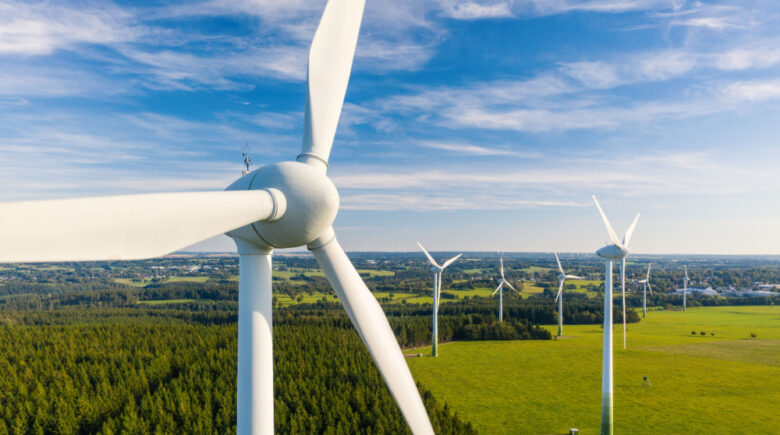
Wind farms generate sustainable electricity by capturing the kinetic energy of wind to rotate turbines, which produce electricity through magnetic fields created by moving electric currents. This article examines how wind farms work and what goes into building one.
For a wind farm to be economically feasible, it needs prime conditions: stable winds year-round and sufficient land space for standing towers and transmission lines. The time between initial installation and first energy harvest runs about five years. Still, a well-sited farm can produce power until its scheduled decommissioning after 40 years. The right wind farm can generate up to 100 megawatts of power, so funds for maintenance and turbines are much less than the value of generated energy, according to the U.S. Department of Energy’s wind energy overview.
Given the ideal conditions, massive amounts of data must be gathered from meteorological information, atmospheric conditions, wind speed, turbulence intensity, and temperature, to determine whether a specific location fits a wind farm. The general location is picked from satellite images and then validated with tower data so that once the turbines are installed, they can capture as much energy as possible.
Key Takeaways
- Wind energy is one of the cheapest sources of new electricity generation, with costs falling over 70% in the last decade, according to IRENA’s 2023 Renewable Power Generation Costs report.
- A single modern wind turbine can generate enough electricity to power 400 to 500 homes per year, per the U.S. Department of Energy.
- Wind energy produces zero direct carbon emissions during operation, making it one of the cleanest energy sources available, as noted by the IPCC Sixth Assessment Report.
- The U.S. wind energy sector supports more than 120,000 jobs and is one of the fastest-growing employment sectors in the country, according to the Wind Energy Technologies Office.
- Wind turbines require maintenance only every three to five years, making them far less labor-intensive than conventional fossil fuel power plants.
- Global wind power capacity surpassed 1 terawatt in 2023, a milestone reported by the Global Wind Energy Council (GWEC).
Advantages of Wind Energy
1. Cheap
Among all forms of alternative energy, wind ranks near the bottom for operating cost. A turbine doesn’t need much to spin, a modest wind speed is enough to produce meaningful output. The structural materials (steel and concrete) are inexpensive, and turbines only need to be checked every three to five years. The Lazard Levelized Cost of Energy Analysis (2023) confirms that onshore wind is now among the lowest-cost sources of new electricity generation, with a levelized cost as low as $24 per megawatt-hour. When fuel costs are factored in, which for wind are zero, the long-term economics outperform natural gas and coal on most time horizons.
2. Environmentally Friendly
The biggest draw toward using wind energy is that it does not pollute. Wind farms are built in rural areas, so they don’t disrupt nearby communities in the way an industrial plant would. The only operational byproduct is excess heat, which can warm nearby buildings, a small benefit that reduces heating demand in an already rural area. No dangerous emissions are released, which makes wind considerably safer than coal and other fossil fuels. The U.S. Environmental Protection Agency (EPA) estimates that replacing a single coal plant with wind energy can eliminate hundreds of thousands of tons of CO₂ annually.
That said, wind farms are not without environmental concerns. Turbine blades pose documented collision risks for birds and bats, and the U.S. Fish and Wildlife Service has worked with developers on siting guidelines to reduce those impacts. Noise and visual effects on rural communities are also real considerations, not dealbreakers, but factors that require honest planning.
3. Renewable Source
Unlike coal or natural gas, wind is a fuel source that will not run out. Output scales directly with the number of turbines installed, and generation does not consume water or release greenhouse gases. The International Energy Agency (IEA) World Energy Outlook 2023 projects that wind and solar together will account for nearly 25% of global electricity generation by 2030, a trajectory that reflects how quickly scalable renewables are displacing fossil-fuel capacity on grids worldwide.
4. Zero Carbon Emissions
Wind energy produces no greenhouse gases during operation. The turbine blades are made of steel and fiberglass composites, and the generator produces no combustion byproducts, only a small amount of heat. Water consumption is negligible. According to the IPCC Sixth Assessment Report, wind power generates just 7 to 15 grams of CO₂ equivalent per kilowatt-hour over its full lifecycle, a fraction of the emissions from coal or natural gas. That figure accounts for manufacturing, installation, and eventual decommissioning, so it reflects the real-world footprint, not just the operational phase.
One persistent misconception worth clearing up: some critics cite the carbon cost of manufacturing turbine blades as a significant liability. In practice, the emissions payback period for a modern turbine is typically less than a year, after which it generates clean power for two decades or more.
5. Easy to Install
Compared to nuclear plants or large hydroelectric dams, wind farms are straightforward to build. The core requirements are sufficient land and a connection to an existing power grid. The U.S. Wind Energy Technologies Office notes that a typical utility-scale wind project can move from site assessment to full operation in as little as two to three years, a timeline that makes wind an attractive option for grid operators trying to add capacity quickly. That speed is one reason states like Texas and Iowa have been able to expand their wind fleets rapidly.
6. Low Maintenance
Servicing a wind farm every three to five years stands in sharp contrast to the annual or near-annual maintenance schedules required by coal plants and natural gas facilities. Modern turbines from manufacturers such as Vestas and Siemens Gamesa incorporate predictive maintenance technology and remote monitoring sensors, which further cut the need for on-site inspections. The National Renewable Energy Laboratory (NREL) reports that operation and maintenance costs for onshore wind have dropped to approximately $10 to $15 per megawatt-hour, one of the lowest figures among all power generation types.
7. Portability
Turbines can be repositioned or scaled up by adding units or swapping in larger models, an option that coal or nuclear plants simply do not offer. Offshore wind platforms developed by companies such as Ørsted and Equinor demonstrate how modular turbine systems can be repositioned or expanded as grid demands shift, offering a degree of flexibility that no thermal generation technology can match. That modularity also makes it easier to finance incremental expansions rather than committing to one massive capital outlay upfront.
8. Efficient
Modern large-scale turbines can achieve a capacity factor of 35% to 45% onshore and up to 50% or more offshore, according to IEA’s Offshore Wind Outlook. Fossil fuels, by contrast, require refining and combustion before usable energy is produced, steps that introduce losses and costs at every stage. One limitation worth acknowledging: wind farms built in high-density demand areas may underperform if the surrounding terrain doesn’t offer adequate wind exposure, so siting decisions directly affect how efficiently a project delivers on its capacity.
9. View from Above
Wind turbines have become tourist attractions in their own right. Some rural communities in the U.S. and Europe have built wind farm tourism programs, with sites in Iowa and Texas drawing thousands of visitors annually. From above, the towers look like giant blades cutting slow arcs across flat land, a visual that has turned into a draw rather than a deterrent in many farming communities. Turbines typically generate noise levels of only 35 to 45 decibels at a standard residential distance, comparable to a quiet library, as documented by the American Clean Power Association.
10. Local Job Creation
Remote rural areas, deserts, open plains, forested ridgelines, are often the best sites for wind farms, and those same areas tend to have limited economic activity. Pairing wind development with high-voltage direct current (HVDC) transmission lines lets operators move large amounts of power over long distances while maintaining grid reliability, opening up locations that were previously too remote to connect. The U.S. Bureau of Labor Statistics projects wind turbine technician to be among the fastest-growing occupations in the country, with employment expected to grow 60% through 2032, driven largely by the expansion of both onshore and offshore wind projects.
Taken together, these advantages make wind a strong addition to any power grid. It installs faster than nuclear, costs less to run than coal, and produces none of the emissions that natural gas plants release every hour of operation.
The honest caveat: wind is not dispatchable. When the air is calm, the turbines stop, and the grid needs another source to fill the gap. That intermittency is why wind projects are increasingly paired with battery storage or grid backup from hydroelectric reserves and natural gas peaker plants. It also means wind alone cannot replace baseload generation, it works best as part of a diversified grid, not as a standalone solution. The Global Wind Energy Council (GWEC) reported that the world added a record 117 gigawatts of new wind capacity in 2023 alone, reflecting accelerating global investment in this technology, but that investment is happening alongside storage and grid upgrades, not instead of them.
| Energy Source | Avg. Levelized Cost ($/MWh) | Lifecycle CO₂ (g/kWh) | Capacity Factor (%) | Typical Maintenance Interval | Water Usage (gal/MWh) |
|---|---|---|---|---|---|
| Onshore Wind | $24 – $56 | 7 – 15 | 35 – 45 | Every 3 – 5 years | ~1 |
| Offshore Wind | $72 – $140 | 8 – 18 | 45 – 55 | Every 2 – 3 years | ~1 |
| Utility-Scale Solar PV | $24 – $60 | 20 – 50 | 22 – 32 | Annual cleaning/inspection | ~20 |
| Natural Gas (Combined Cycle) | $39 – $74 | 410 – 650 | 50 – 60 | Annual to bi-annual | ~170 |
| Coal | $65 – $150 | 820 – 1,050 | 40 – 55 | Annual | ~530 |
| Nuclear | $80 – $185 | 4 – 12 | 90 – 93 | Every 18 – 24 months | ~700 |
Frequently Asked Questions
What are the main advantages of wind energy?
Wind energy is clean, renewable, cost-competitive, and creates local jobs. It produces zero direct carbon emissions during operation, requires minimal water, and has one of the lowest levelized costs of any new electricity source, as low as $24 per megawatt-hour according to Lazard’s 2023 analysis. It also supports long-term energy independence by reducing reliance on imported fossil fuels.
How much does it cost to build a wind farm?
The upfront cost of a utility-scale onshore wind project typically ranges from $1.2 million to $2.6 million per megawatt of installed capacity, according to the American Clean Power Association. Offshore wind projects are more expensive, ranging from $3 million to $5 million per megawatt, but they benefit from stronger and more consistent wind resources.
How long does a wind turbine last?
Most modern wind turbines are designed to operate for 20 to 25 years, though many wind farms are being repowered, replacing older turbines with newer, larger models, to extend site life to 40 years or more. The U.S. Department of Energy has documented multiple repowering projects that have significantly increased energy output from existing sites.
Are wind turbines bad for the environment?
Wind turbines have a very small environmental footprint compared to fossil fuel plants. Their primary concerns include potential impacts on birds and bats, land use, and noise. The U.S. Fish and Wildlife Service and wind developers have established siting guidelines and mitigation measures to reduce wildlife impacts. Lifecycle carbon emissions are just 7 to 15 grams of CO₂ per kilowatt-hour, among the lowest of any energy source.
How much of the U.S. electricity comes from wind energy?
As of early 2023, wind energy accounts for approximately 10% of total U.S. electricity generation, according to the U.S. Energy Information Administration (EIA). States like Texas, Iowa, and Oklahoma lead the country in wind power capacity, with Iowa generating more than 60% of its electricity from wind.
Do wind turbines work when there is no wind?
No. Wind turbines require a minimum wind speed of approximately 7 to 9 miles per hour (the “cut-in speed”) to begin generating electricity. They shut down automatically at very high wind speeds, typically above 55 mph, to prevent mechanical damage. This intermittency is why wind energy is usually paired with battery storage systems or grid backup sources such as natural gas peaker plants or hydroelectric reserves.
What is the capacity factor of a wind turbine?
The capacity factor measures how much electricity a turbine actually produces versus its theoretical maximum. Onshore wind turbines average a capacity factor of 35% to 45%, while offshore turbines can reach 50% or higher due to stronger, more consistent ocean winds. This figure has improved significantly over the past decade as turbine technology has advanced.
How many homes can a single wind turbine power?
A single modern utility-scale wind turbine with a capacity of 2 to 3 megawatts can generate enough electricity to power approximately 400 to 500 average U.S. homes per year. Larger offshore turbines, some now exceeding 15 megawatts, can power several thousand homes each, according to the U.S. Department of Energy.
What jobs does wind energy create?
The U.S. wind energy industry supports more than 120,000 jobs across manufacturing, installation, operations, and maintenance. Wind turbine service technician is one of the fastest-growing occupations in the country, with the Bureau of Labor Statistics projecting 60% job growth through 2032. These are predominantly well-paying, local jobs in rural communities that host wind farms.
How does wind energy compare to solar energy?
Both wind and solar are cost-competitive renewable sources, but they differ in key ways. Wind energy generally has a higher capacity factor (35–45%) compared to utility-scale solar (22–32%), meaning wind turbines produce power more consistently throughout the day and night. Solar is typically easier to deploy at small scales (rooftop), while wind is more suited to large utility-scale projects. Both the IEA and NREL recommend deploying a mix of both to maximize grid reliability and reduce storage requirements.
Is wind energy a good fit for every region?
No. Wind development is a poor match for densely populated urban areas, heavily forested regions with low average wind speeds, or locations without access to transmission infrastructure. A project that works in the Texas Panhandle or the North Sea may be economically unviable in a low-wind corridor. The U.S. Wind Energy Technologies Office publishes wind resource maps that help developers and regulators identify where investment is likely to pay off, and where it is not.
Sources
- U.S. Department of Energy – How Do Wind Turbines Work?
- Lazard – Levelized Cost of Energy Analysis, Version 16 (2023)
- U.S. Energy Information Administration (EIA) – Wind Explained
- U.S. Bureau of Labor Statistics – Wind Turbine Service Technicians Occupational Outlook
- U.S. Environmental Protection Agency (EPA) – Greenhouse Gas Equivalencies Calculator
- Intergovernmental Panel on Climate Change (IPCC) – Sixth Assessment Report, Working Group III
- U.S. Wind Energy Technologies Office – Wind Energy Jobs
- American Clean Power Association – Wind Facts at a Glance
- Union of Concerned Scientists – How Wind Energy Works
- National Renewable Energy Laboratory (NREL) – Land-Based Wind Market Report 2021