Fact-checked by the The Credit Scout editorial team
You check your bank balance on a Tuesday and somehow, it’s already gone, again. Despite a decent salary, $47,000 in average household consumer debt hangs over millions of Americans like a financial fog that no app notification seems to lift. Physical cash in labeled envelopes forces you to stop spending when the money runs out. That brutally simple system is called the envelope budgeting method, and it was supposed to be the antidote. But most people today haven’t touched cash in weeks.
The numbers paint a troubling picture of modern spending habits. According to the Federal Reserve’s consumer credit data, Americans collectively carry over $1.14 trillion in credit card debt as of 2024, a record high. A separate study by the National Foundation for Credit Counseling found that 58% of Americans live paycheck to paycheck, and 73% report feeling anxiety about their finances at least once a week. Digital payments have made spending frictionless, and that frictionless quality is costing people an average of $1,497 more per year than they planned to spend, per a 2023 Intuit survey.
This guide cuts through the noise. You will learn exactly how the envelope budgeting method works, why it still produces measurable results even in a cashless world, and how to adapt it with modern digital tools without losing the psychological edge that makes it so effective. You will also see real comparison data, specific implementation steps, and honest warnings about where the system breaks down.
Key Takeaways
- Americans carry a record $1.14 trillion in credit card debt as of 2024, making a disciplined budgeting system more urgent than ever.
- Studies show people spend up to 83% more when paying by credit card compared to cash, the core psychological mechanism the envelope method exploits.
- The average household that sticks with the envelope budgeting method for 90 days reports reducing discretionary spending by 15–25%.
- Digital envelope apps like YNAB ($14.99/month) and Goodbudget (free tier available) replicate the cash-stuffing structure without requiring physical currency.
- Cash stuffing generated over 750 million TikTok views in 2023, pulling a new generation into the method.
- Households using zero-based budgeting frameworks (which envelope budgeting is a subset of) saved an average of $4,800 more per year than non-budgeters in a 2022 NFCC study.
In This Guide
- What Is the Envelope Budgeting Method?
- The Psychology Behind Cash and Spending Behavior
- Cash Stuffing: A Social Media Revival With Real Results
- Traditional Envelopes vs. Digital Envelope Budgeting
- Who the Envelope Method Works Best For
- How to Set Up Your Envelope Budget Step by Step
- Common Pitfalls That Derail Envelope Budgeters
- Envelope Budgeting, Debt Payoff, and Credit Health
- The Best Digital Tools for Envelope Budgeting in 2025
What Is the Envelope Budgeting Method?
At its core, the envelope budgeting method is a zero-based cash allocation system. At the start of each pay period, you divide your take-home income into physical envelopes, each labeled for a specific spending category. When an envelope is empty, spending in that category stops until the next pay period.
Financial educator Dave Ramsey popularized the system in the United States, but its origins predate him by decades. Working-class families in the early 20th century routinely used envelopes or jars to manage household cash before banks were widely accessible. The core logic has never changed: give every dollar a job before it enters your wallet.
The Core Categories Most Budgeters Use
There is no universal list of envelopes. Most practitioners start with 6–10 categories and refine over time. Common envelopes include groceries, dining out, gas, entertainment, clothing, and a personal “blow money” category for guilt-free spending.
Fixed expenses such as rent, utilities, and insurance are typically paid first from a checking account and excluded from the envelope system. Envelopes target the discretionary spending where most budget leaks occur. That targeted focus is what makes the system efficient rather than exhausting.
How It Differs From General Budgeting
Most budgets are retrospective: you review what you spent. This method is prospective and physical, you pre-commit spending limits with tangible money. That pre-commitment is the critical differentiator.
Unlike a spreadsheet budget, you cannot accidentally overspend a category without physically noticing the empty folder. The friction is built in. That friction is exactly why the method works when spreadsheets and apps fail people who struggle with abstract numbers.
The envelope budgeting method is technically a subset of zero-based budgeting, a framework where income minus all allocated expenses equals exactly zero. Every dollar has a destination before the month begins.
The Psychology Behind Cash and Spending Behavior
Why does this method work? Not discipline, neuroscience. Paying with cash activates a measurable pain response in the brain. A landmark 2008 study from MIT’s Sloan School of Management found that participants bid up to 83% more for the same item when paying by credit card compared to cash. The physical act of handing over bills triggers what researchers call the “pain of paying.”
Digital payments and cards decouple the emotional experience of spending from the transaction itself. Tap-to-pay, auto-reload, and one-click purchasing have systematically removed every speed bump between impulse and purchase. Physical envelopes re-insert those speed bumps deliberately.
The “Pain of Paying” in Practice
Neuroeconomist Drazen Prelec, who co-authored the MIT credit card study, describes credit cards as “decoupling” the pleasure of acquisition from the pain of payment. When you hand over a $50 bill from your grocery envelope, your brain registers the loss immediately. When you tap a card, it registers much later, if at all.
“The coupling between purchase and payment is what makes cash so effective as a self-control device. The pain is immediate and real, which slows spending in a way that card payments simply cannot replicate.”
This is not a willpower failure. It is an architectural one. Rebuilding the architecture of spending decisions is what makes the method durable, not a demand for more discipline from imperfect humans.
Mental Accounting and Category Constraints
Behavioral economists use the term mental accounting to describe how people treat money differently depending on its source or label. Research by Nobel laureate Richard Thaler showed that people are far less likely to overspend money that has been mentally assigned to a specific purpose.
Physical envelopes formalize mental accounting into reality. The grocery envelope isn’t “money”, it’s groceries. That reframing changes spending behavior at a cognitive level, making the system more durable than willpower-dependent approaches.
MIT research found credit card users bid up to 83% more for the same item compared to cash payers, demonstrating the measurable “pain of paying” that envelope budgeting leverages.
Cash Stuffing: A Social Media Revival With Real Results
Cash stuffing is the TikTok-era rebranding of the envelope budgeting method, and it has introduced millions of younger Americans to the concept with startling effectiveness. The trend involves creators filming themselves dividing cash into decorated envelopes or binders at the start of each pay period. It’s visually satisfying, deeply personal, and intensely practical.
By early 2024, the hashtag #cashstuffing had accumulated over 750 million views on TikTok alone. Accompanying products, budgeting binders, pre-printed cash envelope sets, and clear zip pouches, turned the method into a $200 million niche market on platforms like Etsy and Amazon. What started as a budgeting technique became a lifestyle aesthetic.
Is the Trend Producing Real Financial Outcomes?
The viral format raises a legitimate question: is this entertainment, or does it actually change spending behavior? Early survey data suggests the latter. A 2023 survey by LendingClub found that 71% of respondents who tried cash stuffing reported sticking to their grocery budget more consistently than before.
More importantly, the demographic reach is significant. Practitioners skew between 18 and 34, a group with median credit card balances of $3,100 and the lowest rates of emergency savings. If the aesthetic entry point leads to sustained behavioral change, the long-term financial impact could be substantial.
Cash stuffing accessories have become a legitimate product category. Top-selling budget binder sets on Etsy generate over $10,000 per month for individual sellers, signaling just how mainstream the envelope method revival has become.
The Gap Between Trend and Long-Term Practice
Critics point out that trending behaviors rarely produce long-term financial change. The average TikTok finance trend sustains active participation for fewer than 60 days before engagement drops. Envelope budgeting requires monthly repetition, and the novelty of cash stuffing videos may not survive a second utility bill cycle.
Honest assessment: this trend is an on-ramp, not a destination. Its value lies in introducing the concept of pre-allocated spending to people who have never budgeted before. Whether they sustain it depends on how well the system is set up from the start, which the rest of this guide addresses directly.
Traditional Envelopes vs. Digital Envelope Budgeting
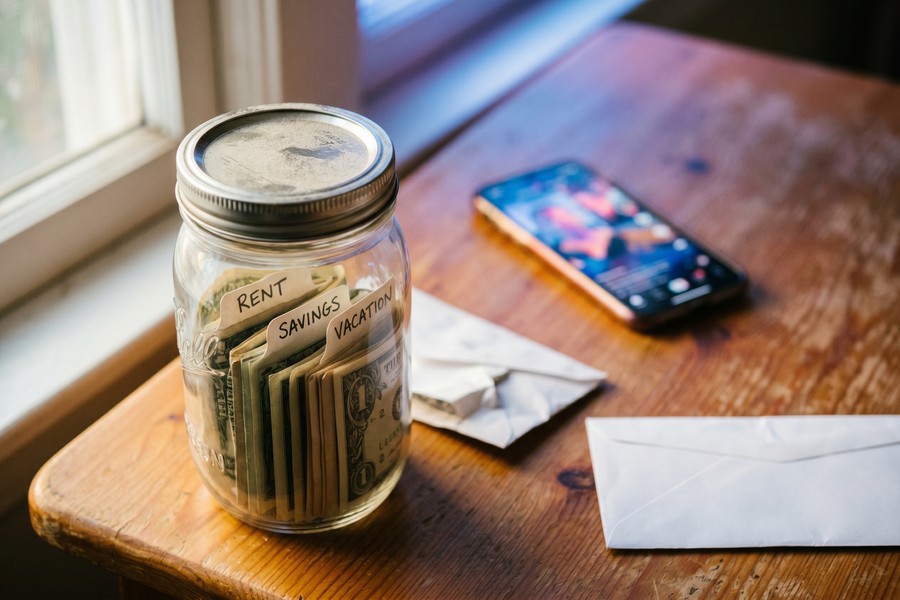
For most people, the practical question isn’t whether this approach works, it’s which format to use. Physical cash envelopes and digital envelope apps both replicate the core allocation logic, but they differ significantly in convenience, security, and psychological impact.
Side-by-Side Comparison
| Feature | Physical Cash Envelopes | Digital Envelope Apps |
|---|---|---|
| Psychological friction | Very high, cash is finite and tangible | Moderate, digital limit warnings |
| Setup time | 20–30 min per pay period (ATM + sorting) | 5–10 min per pay period |
| Security risk | High, cash lost or stolen is unrecoverable | Low, bank-level encryption |
| Online/bill payments | Requires hybrid approach | Fully compatible |
| Cost | Free (plus ATM fees if applicable) | $0–$14.99/month depending on app |
| Partner visibility | Shared only if both access envelopes | Real-time shared access possible |
Physical envelopes win on raw psychological impact. Digital envelopes win on practicality for modern spending. Most financial experts now recommend a hybrid approach: use cash envelopes for the two or three categories where you most frequently overspend, and digital envelopes for everything else.
When Physical Cash Still Outperforms Digital
For discretionary categories with high impulse-spend risk, dining out, personal shopping, entertainment, physical cash envelopes consistently outperform digital equivalents in behavior change studies. A 2022 study published in the Journal of Consumer Research confirmed that tangible payment methods reduce spending by an average of 12–18% compared to digital equivalents, even when the spender knows the category limit.
Don’t choose one format entirely. Use cash where your specific weaknesses live, and let digital tools handle the administrative categories where discipline is less of an issue.
Identify your top two “leak” categories, the ones where you consistently overspend, and use physical cash envelopes only for those. Use a digital app for all remaining categories. This hybrid approach captures 80% of the psychological benefit with 20% of the logistical friction.
Who the Envelope Method Works Best For
This is not a universal solution. It produces exceptional results for specific financial profiles and struggles in others. Understanding whether it fits your situation before committing saves time and frustration.
Ideal Candidates for the Envelope System
| Profile | Why It Works | Expected Outcome |
|---|---|---|
| First-time budgeters | Tangible, easy to understand | Spending awareness within 30 days |
| Emotional/impulse spenders | Physical barrier slows decisions | 15–25% reduction in discretionary spend |
| People paying off debt | Forces hard spending limits | Accelerated debt paydown timeline |
| Couples managing joint finances | Shared physical categories create transparency | Fewer money arguments, aligned goals |
| Variable income earners | Scales to each pay period’s actual income | Consistent savings despite income swings |
Who May Struggle With the System
Heavy travelers who rely on corporate credit cards, people with significant automatic bill payments, and high-earners with complex investment income may find the cash-based format impractical. The system assumes most of your spending is discretionary and transaction-based, which isn’t true for everyone.
Freelancers and gig workers with highly variable income can still use envelope budgeting, but they need to base their allocations on a conservative income floor rather than an average. If you work with irregular paychecks, our guide on building a spending plan with irregular income walks through how to adapt the method effectively.
Do not use the envelope method as your only financial system if you have significant automatic payments, investment accounts, or business expenses. The envelope method handles discretionary spending, it needs a complementary system for fixed obligations and long-term savings goals.
How to Set Up Your Envelope Budget Step by Step
The difference between envelope budgeting that transforms your finances and envelope budgeting that gets abandoned in week three usually comes down to setup quality. Most failures happen before the first envelope is even filled.
Step 1: Calculate Your True Take-Home Income
Start with net income only, what actually hits your account after taxes, insurance, and retirement contributions. Using gross income is one of the most common setup errors and leads to consistently empty envelopes by mid-month. If your income varies, use the lowest monthly amount from the past six months as your baseline.
Step 2: List Every Fixed Obligation First
Before you create a single envelope, subtract every non-negotiable fixed expense: rent or mortgage, utilities, insurance premiums, minimum debt payments, subscriptions. These come off the top. What remains is your discretionary pool, the only money that goes into envelopes.
Most people are surprised to find their discretionary pool is significantly smaller than they imagined. That surprise is valuable data. It reframes what’s actually negotiable in your spending before a single decision is made.
Step 3: Assign Envelope Categories Based on Your Actual Spending History
Pull 60–90 days of transaction history from your bank or credit card. Categorize every transaction manually, yes, manually. The act of categorization builds awareness that automated tools skip. You will notice patterns you genuinely did not know existed.
Aim for 6–10 envelope categories maximum. More than that creates decision fatigue and system abandonment. If your list runs longer, combine smaller categories (for example, coffee plus restaurants equals “dining out”).
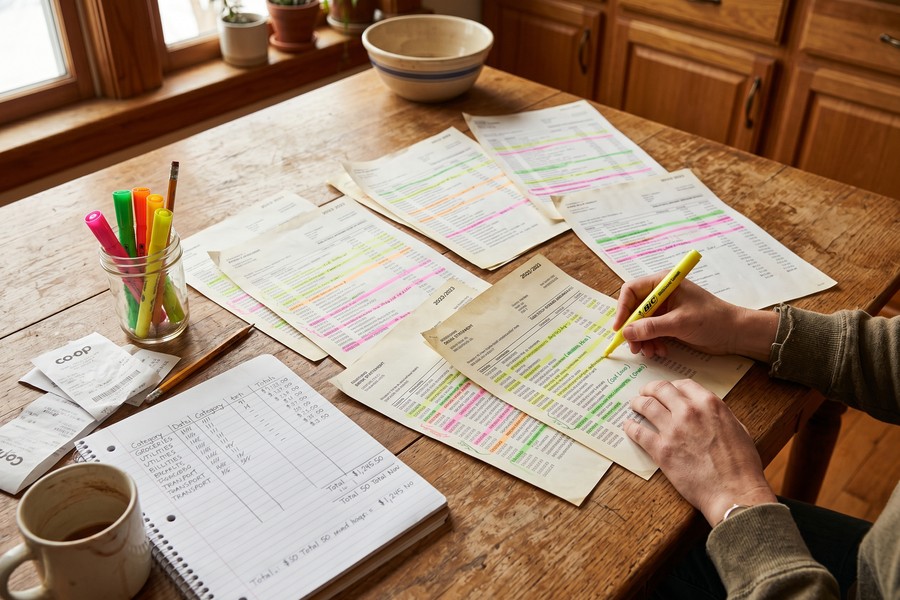
Households that review 90 days of transaction history before setting up a budget are 2.3x more likely to stick with that budget for six months or more, according to a 2021 behavioral finance study from Duke University’s Common Cents Lab.
Start Small: The 3-Envelope Starter Method
Overwhelmed by a full system? Start with just three envelopes: groceries, dining/entertainment, and personal spending. These three categories account for the majority of discretionary budget leaks in most households. After 30 days of consistent practice, add more categories.
Progressive rollout dramatically reduces the failure rate. Financial behavior research consistently shows that systems introduced incrementally have higher 6-month adherence rates than systems launched all at once.
Common Pitfalls That Derail Envelope Budgeters
Even people who understand this method intellectually make predictable mistakes in execution. Recognizing these traps before you fall into them is the difference between a 30-day experiment and a lasting financial habit.
The “Borrowing” Problem
The most common failure mode is borrowing from one envelope to cover another. You run out of dining money, so you “borrow” $30 from the clothing envelope. This feels harmless once. But it undermines the core constraint that makes the system work. Within two months, most people who borrow regularly abandon the system entirely.
The solution is not willpower, it’s a rule. Establish a firm policy: an empty envelope means stop spending, not borrow. If a category runs out consistently, that’s a signal to either adjust the allocation or change the behavior, not to raid other envelopes.
Under-Allocating Emergency and Irregular Expenses
Annual expenses, car registration, holiday gifts, medical copays, ambush budgeters who only plan monthly. A $400 car registration in October will destroy your October budget if you haven’t been setting aside $33/month since January. These irregular expenses require a dedicated “sinking fund” envelope.
List every irregular annual expense you can anticipate. Divide the total by 12 and fund a sinking fund envelope with that amount monthly. This single adjustment prevents the majority of budget-blowout events.
“The biggest envelope budgeting mistake I see is treating it as a monthly system when life is actually annual. You have to plan for the irregular and infrequent — car repairs, medical, holiday spending — or one surprise expense wipes out six weeks of discipline.”
Forgetting Partner Alignment
In households with two earners, a system built by one partner and ignored by the other fails quickly. Both partners need to understand the categories, agree on the amounts, and have equal access to the envelopes. This requires a monthly 20-minute budget meeting, which research from the American Psychological Association identifies as one of the strongest predictors of financial relationship satisfaction.
Shared budgeting also reduces the financial arguments that are a leading cause of relationship stress. Couples who budget together report 22% higher financial confidence than those who manage money separately, per a 2023 Fidelity Investments study.
| Common Pitfall | What It Looks Like | The Fix |
|---|---|---|
| Envelope borrowing | Moving cash between categories mid-month | Establish a no-borrow policy; revisit allocations instead |
| Ignoring irregular expenses | Surprise $500 vet bill crashes the budget | Create a monthly sinking fund envelope |
| Partner exclusion | One person sets up, other ignores it | Monthly joint budget review (20 min minimum) |
| Too many categories | 15+ envelopes create decision fatigue | Cap at 6–10 categories; combine small ones |
| Not tracking “free” money | Gift cards and windfalls spent unaccounted | Deposit windfalls to checking; reallocate intentionally |
Envelope Budgeting, Debt Payoff, and Credit Health
Debt elimination and this budgeting method have a natural synergy. By capping discretionary spending, you consistently free up cash that can be redirected to debt paydown. But the relationship between envelope budgeting and your credit score is more nuanced, and worth understanding before you start redirecting cash aggressively.
How the Envelope Method Accelerates Debt Paydown
Stopping the overspend by $200–$400 per month, a realistic outcome for most new practitioners, frees up real money for debt acceleration. Applied to a $5,000 credit card balance at 24% APR, an extra $300 per month reduces payoff time from 42 months to 19 months and saves approximately $1,850 in interest.
Pre-allocation also prevents the new debt accumulation that undermines most payoff efforts. When your entertainment envelope is empty, you don’t charge dinner to a card, you eat at home. That behavioral shift stops the “two steps forward, one step back” pattern that traps many people in debt cycles. If you’re weighing whether to direct extra cash to debt or savings first, our analysis of whether to pay off debt or build an emergency fund provides a clear framework for that decision.
The Credit Score Relationship
Paying down credit card balances improves your credit utilization ratio, the second most important factor in FICO scoring, accounting for 30% of your total score. Every $1,000 reduction in revolving balances can improve your score by 20–40 points, depending on your total available credit.
There is a real caveat here. If you switch entirely to cash and stop using credit cards, your score may temporarily dip due to reduced credit activity. The recommended approach is to keep at least one credit card active for a small recurring purchase, paid in full each month, while the envelope system handles your discretionary cash spending. For more on protecting your score while paying down debt, see our guide on common credit-building mistakes that harm your score.
Credit utilization below 30% is generally recommended, but FICO high-scorers, those above 800, maintain an average utilization of just 7%. Using the envelope method to reduce spending and redirect cash to card payoffs can meaningfully close that gap within 6–12 months.
The Best Digital Tools for Envelope Budgeting in 2025
If physical cash isn’t practical for your lifestyle, a strong digital envelope app can replicate the method’s core logic with added convenience. The best apps preserve the pre-allocation discipline while accommodating digital payments, shared access, and automatic transaction import.
Top Apps Compared
| App | Cost | Best For | Key Limitation |
|---|---|---|---|
| YNAB (You Need a Budget) | $14.99/month or $99/year | Serious budgeters; debt paydown | Steep learning curve; cost |
| Goodbudget | Free (10 envelopes); $10/month unlimited | Couples; beginners | No bank sync on free tier |
| EveryDollar | Free basic; $17.99/month premium | Dave Ramsey followers; zero-based budgeting | Bank sync requires premium |
| Copilot | $13/month or $95/year | iOS users; data visualization | iOS only; no Android |
| Monarch Money | $14.99/month or $99.99/year | Comprehensive household finance tracking | No pure envelope interface |
For most people new to digital envelope budgeting, Goodbudget’s free tier provides enough functionality to test the method without financial commitment. YNAB is the gold standard for those ready to invest in the system long-term, its methodology aligns closely with traditional envelope principles. For freelancers, we’ve covered the best budgeting apps specifically designed for variable income earners.
What to Look for in an Envelope Budgeting App
Prioritize apps that require manual transaction entry or confirmation rather than just automatic import. The moment of manual recording provides the psychological “pain of paying” that makes the system behaviorally effective. Apps that auto-categorize everything remove that friction and reduce the method’s impact.
Also look for roll-over functionality, the ability to carry unused funds from one month to the next within a category. This prevents the “use it or lose it” mentality that leads to end-of-month splurges to empty envelopes.
Fully automated budgeting apps that categorize and track without requiring your active input may feel convenient, but they undercut the behavioral mechanism that makes envelope budgeting work. Choose an app that keeps you engaged in the process, not one that does the thinking for you.
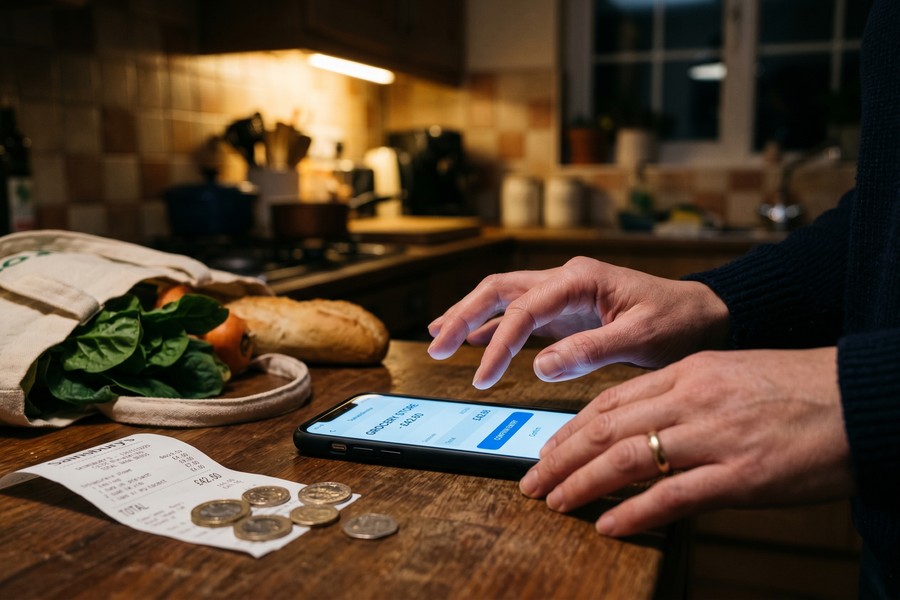
Real-World Example: How Maria Eliminated $11,200 in Credit Card Debt Using Envelope Budgeting
Maria, a 34-year-old healthcare administrator in Atlanta earning $58,000 per year, had accumulated $11,200 across three credit cards by late 2022. She had tried budgeting apps twice before and abandoned both within six weeks. Her core problem wasn’t awareness, she knew she overspent on dining and online shopping. Her problem was that awareness alone never changed behavior.
In January 2023, Maria switched to a hybrid envelope system: physical cash envelopes for groceries ($400/month), dining out ($150/month), and personal shopping ($100/month). She used Goodbudget’s free tier for everything else, gas, utilities, household supplies. In month one, she had $73 left in her grocery envelope and $42 remaining in dining. For the first time in two years, she didn’t carry a new balance into February. The physical cash had created a spending ceiling she couldn’t mentally override the way she could a phone notification.
By month three, Maria had redirected an average of $380 per month toward her highest-interest card, a $4,200 balance at 27.99% APR. That card was paid off by September 2023. She continued the system and paid off the second card ($3,800 at 22% APR) by March 2024. By December 2024, after 23 months, the remaining $3,200 balance was cleared. Total interest paid during the payoff period was approximately $1,100, compared to an estimated $3,900 if she had made only minimum payments over the same timeframe.
Maria’s credit score moved from 618 in January 2023 to 741 by December 2024, driven primarily by reduced utilization and on-time payments. She attributes the system’s success to the hybrid format: “The cash envelopes made it real. Watching the grocery money physically shrink every week changed how I thought about a $12 salad at lunch.” She now maintains a three-month emergency fund and contributes 8% to her 401(k), habits she credits directly to the financial confidence the envelope system built.
Your Action Plan
-
Gather 90 days of spending data before setting up a single envelope
Pull bank and credit card statements for the last three months. Manually categorize every transaction, do not rely on auto-categorization. This exercise will reveal your actual spending patterns, which almost always differ significantly from your perceived patterns. It also makes your envelope allocations evidence-based rather than aspirational.
-
Calculate your real discretionary pool
Subtract all fixed, non-negotiable expenses from your net monthly income. What remains is your discretionary pool, the only money going into envelopes. Many people discover their discretionary pool is 20–30% smaller than expected. That’s not a problem; it’s the system working exactly as intended by revealing the true scope of your choices.
-
Choose your format: physical, digital, or hybrid
Based on your spending patterns and lifestyle, decide whether physical cash envelopes, a digital app, or a hybrid approach fits best. If dining out and impulse purchases are your biggest leaks, use physical cash for those categories. If you travel frequently or rarely use cash, lean digital. Most people benefit from the hybrid approach described in this guide.
-
Start with 3–5 envelopes and add more after 30 days
Resist the urge to build a perfect 12-category system on day one. Start with your top three overspending categories. Master those for a full month before adding complexity. Progressive implementation increases your 6-month adherence rate dramatically compared to launching a full system all at once.
-
Create a sinking fund envelope for irregular expenses
List every non-monthly expense you can anticipate over the next 12 months: car registration, insurance renewals, holiday gifts, annual subscriptions, medical costs. Total those amounts and divide by 12. Fund a dedicated sinking fund envelope with that amount monthly. This single step prevents the majority of mid-year budget emergencies.
-
Establish a firm no-borrow policy between envelopes
Before you start, decide in advance: when an envelope is empty, spending in that category stops. No borrowing, no “I’ll pay it back next month.” If a category runs out consistently in the first two weeks, that’s a signal to either adjust the allocation or examine the behavior, not to raid other envelopes. Write this rule down and keep it visible near your envelopes or saved in your app notes.
-
Schedule a monthly 20-minute budget review
At the end of each month, review what each envelope looked like at close, overspent, underspent, or exactly right. Adjust allocations based on evidence. If you share finances with a partner, do this review together. Monthly calibration is what transforms a rigid system into a responsive one that actually fits your evolving life.
-
Connect envelope savings to a specific debt or savings goal
Maximum motivation comes when the money freed up has a clear destination. Whether you’re building a $1,000 emergency fund, paying off a credit card, or saving for a home down payment, name the goal and track it visibly. Connecting behavioral change to a tangible outcome is the strongest predictor of system longevity.
Frequently Asked Questions
Does the envelope budgeting method still work if I rarely use cash?
Yes, with adaptation. The core principle is pre-allocation of spending by category, not the use of physical currency. Digital envelope apps like YNAB, Goodbudget, and EveryDollar replicate the same category constraint logic using bank accounts and virtual envelopes. The psychological impact is somewhat reduced compared to physical cash, but studies show digital envelope systems still reduce overspending by 10–15% compared to unstructured spending.
How many envelope categories should I start with?
Start with 3–5 categories focused on your highest-risk discretionary spending areas. This almost always includes groceries, dining out, and personal/entertainment spending. Launching with more than 10 categories is a common setup mistake that leads to system abandonment within 30 days due to decision fatigue. Add categories in monthly increments once the initial system feels natural.
What happens if I run out of money in an envelope before the month ends?
That is the system working correctly. An empty envelope is not a failure, it is real-time feedback that your allocation for that category is either too low or your spending behavior in that category needs adjustment. Review which trigger it is: if the allocation was genuinely too low for your actual needs, adjust it next month. If spending behavior was the issue, that’s the behavior to examine. Under no circumstances should you borrow from other envelopes as a routine solution.
Can I use the envelope method if I have irregular income?
Yes, but base your envelope allocations on a conservative income floor rather than an average or optimistic projection. Use the lowest monthly income you received in the past six months as your baseline. In months when you earn more, allocate the excess to savings or debt paydown before distributing it to envelopes. This conservative baseline prevents the overspending that derails variable-income budgeters during slow months.
Is envelope budgeting the same as zero-based budgeting?
They are closely related but not identical. Zero-based budgeting is the broader philosophy: every dollar of income is allocated a specific purpose until income minus allocations equals zero. The envelope budgeting method is a specific implementation of zero-based budgeting that uses physical or digital envelopes to enforce category-level spending limits. All envelope budgeting is zero-based budgeting, but not all zero-based budgets use the envelope method. For a detailed comparison, see our breakdown of cash envelope systems versus zero-based budgeting.
Will switching to cash envelopes hurt my credit score?
Switching to cash for discretionary spending does not directly hurt your credit score. If you stop using credit cards entirely, your score may see a small temporary dip due to reduced credit activity. The recommended approach is to keep at least one credit card active for a small recurring charge, like a streaming subscription, paid in full each month. This maintains credit activity while your envelope system operates primarily in cash.
How is cash stuffing different from traditional envelope budgeting?
Mechanically, the two are identical. What separates cash stuffing is the aesthetic and social dimension: practitioners use decorated binders, colored envelopes, and visible cash organization, then share the process online. That cultural layer has attracted a younger demographic (18–34) to a method that previously skewed toward older users, largely through the motivational power of community accountability on platforms like TikTok and YouTube.
Can couples use the envelope method together?
Couples who use the envelope method together consistently report better financial outcomes than those managing money separately. The keys to success are joint category decisions, equal access to envelopes, and a regular monthly review meeting. Digital envelope apps like Goodbudget and YNAB offer shared account access, making real-time transparency easier for households where both partners spend throughout the month. Both partners must also agree on the no-borrow rule, otherwise the system collapses when one partner dips into other envelopes.
What should I do with leftover money in envelopes at the end of the month?
You have three solid options: roll it over to the same envelope next month (building a buffer for higher-spending months), transfer it to a sinking fund for irregular expenses, or apply it directly to a savings goal or debt. Grocery envelope leftovers often roll well as a seasonal buffer. Entertainment envelope leftovers can be powerful accelerators for a debt payoff goal. What you should not do is treat leftover envelope money as “free money” for impulse spending, that undermines the allocation discipline the system builds.
How long does it take to see results from the envelope budgeting method?
Most people notice a change in spending awareness within the first two weeks. Measurable reductions in discretionary overspending typically appear within the first 30–60 days. Significant financial outcomes, debt reduction, emergency fund growth, improved credit utilization, are typically visible within 90–180 days of consistent practice. The system compounds over time: the longer you use it, the more calibrated your allocations become, and the less effort it requires to maintain. For those also working to build their credit while budgeting, our guide on building a strong credit score from scratch pairs well with the financial discipline this method develops.
“Budgeting isn’t about restriction — it’s about intention. The envelope system works because it forces you to be intentional before the spending happens, not regretful after. That timing difference is everything.”
Households that maintain a written or structured budget for 12 or more consecutive months are 3x more likely to report financial security and 2.5x more likely to have three or more months of emergency savings, per the 2023 NFCC Financial Literacy Survey.
A century of economic change, the rise of credit cards, the digital payments revolution, and the TikTok attention economy have all failed to make the envelope budgeting method obsolete, not because it’s nostalgic, but because it addresses the actual mechanism behind overspending: the psychological disconnect between desire and consequence. Whether you use physical envelopes stuffed with twenties or a digital app on your phone, the discipline of pre-allocation remains one of the most powerful financial tools available to anyone who wants to stop wondering where the money went.
Sources
- Federal Reserve, Consumer Credit Outstanding (G.19 Release)
- American Psychological Association, Stress in America: Financial Stress Data
- Fidelity Investments, Couples and Money: 2023 Financial Harmony Study
- Experian, 2024 Consumer Debt and Credit Utilization Study
- myFICO, Understanding Credit Score Factors and Utilization Rates
- National Bureau of Economic Research, Mental Accounting Matters (Richard Thaler)
- YNAB, The Four Rules of Zero-Based Envelope Budgeting
- U.S. Bureau of Labor Statistics, Consumer Expenditure Survey