Fact-checked by the The Credit Scout editorial team
Quick Answer
You see different credit scores on each site because two competing scoring brands (FICO and VantageScore) each have multiple versions, and all of them draw from three separate bureau files that don’t always contain the same data. FICO alone has 16 active score versions, while VantageScore used 42 billion scores in 2024, meaning most consumers have dozens of valid, simultaneous scores at any moment.
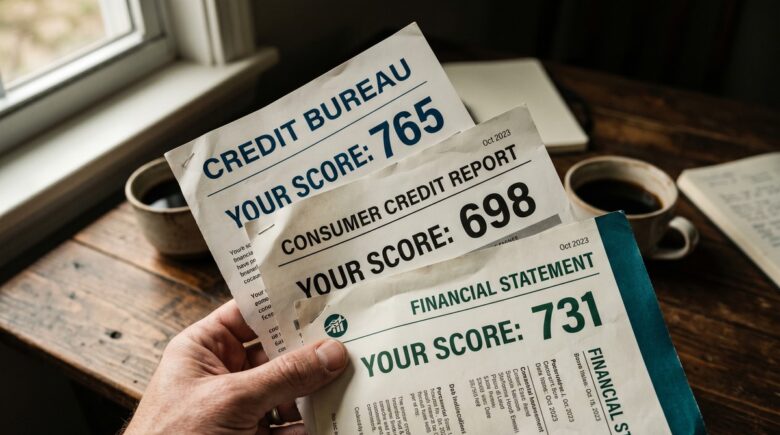
The number you see on Credit Karma is not the number your mortgage lender will pull. That isn’t a glitch; it’s how the system is built. Getting different credit scores on each site you visit is the expected result of a two-layer architecture: the scoring model (which company built the formula and which version they’re using) sits on top of the bureau file (which of Equifax, Experian, or TransUnion supplied the underlying data). Change either layer and you change the output. According to Experian’s breakdown of FICO score versions, there are currently 16 distinct FICO Score versions in active use by creditors and other authorized users.
For most everyday decisions, the variation is background noise. For a mortgage application, it can mean tens of thousands of dollars. Knowing which score matters, and when, is the practical goal here.
Key Takeaways
- FICO has 16 active score versions in use by creditors, according to Experian, so two sites showing “FICO” may not be showing the same model at all.
- About 90% of top U.S. lenders use FICO models for lending decisions, while most free monitoring apps show VantageScore 3.0.
- Mortgage lenders pull FICO 2, 4, and 5 from all three bureaus and qualify borrowers on the median of the three middle scores, not the highest.
- VantageScore recorded 42 billion scores used in 2024, a 55% jump from the prior year, and VantageScore 4.0 can score 33 million additional consumers that traditional models cannot reach.
- On a $350,000 30-year mortgage, the difference between a 620 and a 700 FICO score adds roughly $50,000 in total interest over the life of the loan.
- As of fall 2025, certain FICO models began factoring in Buy Now, Pay Later (BNPL) loans, a category previously invisible to credit scoring that can now affect your score if payments are missed.
The Two Competing Score Brands Most Sites Use
FICO and VantageScore are rivals with genuinely different formulas, and which one a site shows you shapes the number you see. Most free monitoring apps, Credit Karma, Credit Sesame, and several bank portals, display a VantageScore 3.0, while roughly 90% of top U.S. lenders use FICO models when making lending decisions. That gap between what you track and what lenders pull is where most consumer confusion originates.
The formulas differ in ways that matter. VantageScore 3.0 assigns roughly 40% weight to payment history; FICO 8 assigns 35%. They also treat medical debt and collections differently. VantageScore 4.0 ignores paid collections entirely and gives less weight to medical collections, while older FICO models count them fully. For someone carrying a resolved medical bill, that single policy difference can shift a score by 20 or more points.
One difference that rarely gets mentioned: FICO requires six months of credit history and at least one account reported within the past six months to generate a score at all. VantageScore can score someone after just one month of activity. If you’re building credit for the first time after college, you may already have a VantageScore when no FICO score exists yet.
Key Takeaway: Free monitoring apps typically show VantageScore 3.0, but about 90% of major lenders use FICO, so the score you track daily is often not the score a lender sees. VantageScore weighs payment history at roughly 40% versus FICO 8’s 35%, producing real numerical differences from identical credit behavior.
Why the Same Brand Still Shows Different Numbers
Even when two sites both claim to show a “FICO score,” they may not be showing the same one. FICO 8 is the dominant model for credit card decisions, but mortgage lenders specifically use FICO 2 (fed by Experian data), FICO 4 (TransUnion), and FICO 5 (Equifax), versions that are decades older and weigh revolving debt less heavily than FICO 8. A consumer who monitors only FICO 8 is watching a number their mortgage lender will never pull.
The Mortgage Tri-Merge Process
When you apply for a conforming mortgage, the lender pulls all three bureaus and requests those older FICO versions from each. That produces six scores total. The lender then takes the middle score from each bureau and uses the median of those three middle scores as the qualifying number. Not the highest. Not the average, the median. If your scores are 718 (Equifax), 694 (TransUnion), and 731 (Experian), you’re qualifying at 718, not 731.
Auto lenders add another wrinkle. They often use FICO Auto Scores, which run on a 250–900 scale instead of the standard 300–850, and they weight vehicle loan repayment history more heavily. A score that reads 720 on a standard FICO 8 may produce a meaningfully different Auto Score if your credit file shows a past auto delinquency.
There’s also a structural reason scores differ even between sites showing the “same” model. FICO builds bureau-specific variants: FICO Score 9, for instance, is actually three slightly different models, one trained on Equifax data, one on Experian data, and one on TransUnion data. Even identical credit behavior can produce different numbers once each bureau-specific algorithm processes its own file.
Key Takeaway: Mortgage lenders use FICO 2, 4, and 5 from all three bureaus and qualify borrowers on the median of the three middle scores, not the highest. Tracking only FICO 8 leaves you blind to the specific numbers that determine your mortgage rate and approval.
Three Bureaus, Three Different Files
Equifax, Experian, and TransUnion are entirely separate companies. They collect data independently, they don’t share files with each other, and lenders are not legally required to report to all three, or even to any of them. Some creditors report to only one bureau. Some report to two. A credit card opened five years ago might appear on your Experian report but not your TransUnion report, and the resulting score difference is structural, not a mistake anyone needs to fix.
Timing compounds this. Creditors typically report balances to bureaus once a month, but not on the same calendar date across all three. If you paid off a $4,000 card balance last week, that payoff may already be reflected in one bureau’s file while the other two still show the old balance. The score gap that creates is real, and temporary. It usually resolves within 30 to 45 days once all bureaus receive the updated report.
Credit report errors are a separate, more stubborn problem. A misreported late payment, a duplicate account, or a balance that wasn’t updated after payoff creates a score gap that good credit behavior alone won’t close. Under the Fair Credit Reporting Act (FCRA), you have the right to dispute inaccuracies with each bureau separately, at no cost, and disputing a verified error doesn’t hurt your score. Removing a misreported late payment can produce a significant score jump. If you suspect an error is driving a persistent gap, the DIY credit repair process walks through exactly how to file and follow up on bureau disputes.
| Score Variable | FICO 8 | VantageScore 3.0 | VantageScore 4.0 |
|---|---|---|---|
| Score Range | 300–850 | 300–850 | 300–850 |
| Payment History Weight | 35% | ~40% | ~41% |
| Minimum Credit History | 6 months | 1 month | 1 month |
| Data Window | Point-in-time | Point-in-time | 24-month trended |
| Paid Collections | Counted | Ignored | Ignored |
| Medical Debt Weight | Full weight | Reduced | Significantly reduced |
| Mortgage Use | No (FICO 2/4/5 used) | No (until 2026 rollout) | Limited rollout (2026) |
Key Takeaway: Lenders aren’t required to report to all three bureaus, so an account may exist on one bureau’s file and not another’s. Under the FCRA, disputing a verified error at each bureau separately is free, doesn’t damage your score, and can close gaps that no amount of on-time payments would fix.
When Score Differences Actually Matter
A 10 to 20 point spread across monitoring sites is normal; ignore it. The gap becomes consequential when it pushes you across a lender’s pricing tier. The difference between a 699 and a 701 on a mortgage application isn’t two points; it’s a rate tier change that compounds over 30 years. On a $350,000 30-year fixed mortgage, the difference between a 620 and a 700 FICO score translates to roughly $138 more per month and nearly $50,000 more in total interest. That’s the real cost of watching the wrong score.
The scoring environment for mortgages is also changing. On April 22, 2026, the Federal Housing Finance Agency confirmed a limited lender rollout permitting the use of VantageScore 4.0 alongside Classic FICO for Fannie Mae and Freddie Mac conforming loans, the first time in decades that a non-Classic-FICO score is permitted in that underwriting process. HUD has separately adopted both FICO 10T and VantageScore 4.0 for FHA loans. The practical effect for borrowers: if you have rent payment history or a consistent 24-month pattern of paying down balances, a lender using the newer models may score you higher than one still running FICO 2.
Trended Data and the Pre-Application Timing Trick
VantageScore 4.0 and FICO 10T analyze 24 months of credit behavior rather than a single snapshot. That changes practical strategy. The old advice, pay down your cards the month before applying to spike your utilization score, is less effective for lenders using these models. They can see whether you consistently carry low balances or whether you briefly paid down and then spiked back up. Steady, sustained paydown behavior is rewarded. A one-month sprint before closing is no longer invisible.
VantageScore’s expanding reach reflects genuine adoption. VantageScore reported 42 billion scores used in 2024, a 55% increase from 26.9 billion the prior year. And VantageScore 4.0 can score 33 million additional consumers compared to traditional models, primarily people with thin files or short credit histories. For those consumers, the model change isn’t academic; it may be the difference between qualifying and not.
One additional change worth noting: as of fall 2025, certain FICO models have begun factoring in Buy Now, Pay Later (BNPL) loans. That category of debt was previously invisible to credit scoring. Consumers who use BNPL regularly and miss a payment may now see score impact that didn’t exist a year ago. If you’re carrying BNPL balances, check whether they appear on any of your bureau reports. Understanding which credit behaviors are quietly hurting your score matters more now that the models are expanding what they count.
Key Takeaway: A score gap becomes financially material when it crosses a lender’s rate tier, the spread between a 620 and a 700 FICO can add nearly $50,000 in total mortgage interest on a standard loan. With VantageScore 4.0 now entering mortgage underwriting, which score lenders pull is actively changing for home buyers in 2026.
Frequently Asked Questions
Why is my Credit Karma score so much higher than what my lender sees?
Credit Karma shows VantageScore 3.0, while most lenders pull a FICO score, and for mortgages, they use older FICO versions (2, 4, and 5) that weight factors differently than current models. VantageScore’s formula, looser treatment of medical debt, and different collection policies often produce a higher number than the FICO score your lender actually uses to price your loan.
Can two sites showing “FICO 8” give me different scores?
Yes. FICO builds bureau-specific variants of each model, so “FICO 8 from Experian” and “FICO 8 from TransUnion” are technically different algorithms trained on different data sets. If your credit file isn’t identical at both bureaus, which it rarely is, the two scores will differ even under the same model name.
How many credit scores do I actually have?
Dozens. FICO alone has 16 active versions in use, each potentially running on data from three separate bureaus. Add VantageScore versions and industry-specific scores (auto, mortgage, bankcard), and most consumers have well over 20 simultaneous, valid scores at any given time.
Does checking my score on multiple sites hurt my credit?
No. Viewing your own credit score, on any site, as many times as you want, is a soft inquiry and has no effect on any scoring model. Only hard inquiries, generated when a lender pulls your file during an application, can affect your score.
Which score should I monitor before applying for a mortgage?
For a conventional loan, focus on FICO 2, 4, and 5, the versions mortgage lenders actually use. You can access them through myFICO.com or by asking your lender directly which model they pull. Free apps showing VantageScore give a useful general read on credit health but won’t tell you where you stand in a lender’s pricing tier. If you’re rebuilding before applying, the steps for rebuilding credit ahead of a major application still apply regardless of which model your lender uses, because the core behaviors that improve every score version are the same.
Sources
- Experian, How Many FICO Score Versions Are There?
- Empower / National Mortgage Professional, Mortgage Credit Scoring Options
- VantageScore, VantageScore 4.0 vs. Classic FICO: 42 Billion Scores Used in 2024
- VantageScore, VantageScore 4.0 Scores 33 Million Additional Consumers
- Consumer Financial Protection Bureau, Credit Reports and Scores
- FICO, About the FICO Score
- myFICO, Understanding Your FICO Scores