Reviewed by the The Credit Scout Editorial Team
Our Take
For most U.S. households spending near the average $519 per month on groceries, the highest-ROI change is not couponing or store-switching, it is eliminating food waste and resisting in-store psychology traps. Households that combine waste reduction, store-brand switching in staple categories, and a reverse meal-planning system can realistically cut their bill by 20–30% without changing what they eat. The case against this approach: households with very limited time for planning and batch cooking may find the prep overhead outweighs the savings, and for them, a single store-brand swap and grocery pickup order is the better starting point.
Grocery costs are not returning to 2019 levels. Food-at-home prices have risen roughly 23–28% since 2020 according to Bureau of Labor Statistics CPI tracking, and tariff-related increases are projected to layer an additional 2.6–3.7% on top of baseline inflation through 2026. That is a structural shift, not a blip, and it is why smart grocery spending habits have moved from a nice-to-have into a genuinely necessary part of household financial management. According to NIQ’s 2025 grocery trends report, 86% of consumers have already changed how they shop in response to higher prices, deploying an average of 3.9 cost-saving strategies each.
This article is written for households that want a durable system, not a list of micro-tips that saves three dollars and requires twenty minutes of coupon sorting. What makes the recommendation work is combining behavioral changes (pre-empting in-store psychology) with structural ones (planning and waste reduction). What makes it fall short is covered honestly later.
Key Takeaways
- The average U.S. household spent $519 per month on groceries in 2024, up 3% year over year, according to The Motley Fool’s analysis of the BLS Consumer Expenditure Survey.
- The average American wasted $762 worth of food in 2024, per ReFED’s 2026 U.S. Food Waste Report, making waste reduction the single highest-ROI grocery saving lever available to most households.
- Switching to store brands can save 25–40% per item, according to smart-shopping expert Trae Bodge writing for Kiplinger, with blind taste tests consistently showing no detectable quality difference for staples like pasta, rice, and canned beans.
- After roughly 23 minutes inside a supermarket, shoppers shift from rational to emotional decision-making, according to Bangor University fMRI research, which is why time-in-store directly predicts unplanned spending.
- From what we see in reader behavior at The Credit Scout, households that set a written grocery budget and track it monthly spend an average of 12–18% less than those who manage by feel, even before changing a single purchasing habit.
Why Your Grocery Bill Is So High Right Now (And It Is Not Just Inflation)
The honest answer is that you are fighting at least three separate forces, not one. Standard food-price inflation is the one everyone discusses. The other two, shrinkflation and pre-emptive price hikes tied to tariff uncertainty, are the forces that most saving guides skip entirely, and they matter.
Shrinkflation is the practice of reducing package size while holding price steady, effectively raising the cost per unit without changing the number on the sticker. Roughly one-third of commonly purchased consumer products have already shrunk in size since the pandemic began. If you are comparing this week’s receipt to last year’s, price alone does not tell the full story; net weight does.
The tariff dimension is newer. Several major food manufacturers raised prices pre-emptively ahead of 2025 trade policy changes to protect profit margins, not to offset actual input-cost increases. USDA Economic Research Service data shows that food-at-home spending consumed 4.9% of disposable personal income in 2024, and the trajectory for 2025–2026 points upward, not down.
The point is not to depress you. Passive shopping, going to the store and buying what looks good, is now actively expensive in a way it was not five years ago. Smart grocery spending habits are a defense, and they work best when you understand what you are defending against.
What I see in practice: Readers who audit their receipts for just two weeks are almost always surprised by the gap between what they think they spend and what they actually spend. The culprit is rarely the deliberate purchases. It is the ambient ones: the end-cap display, the pre-sliced fruit, the prepared meal that felt like a shortcut.
Smart Spenders Treat the Store as an Opponent, Not a Service
Supermarket design is not neutral. Every element of the layout, from where produce sits to how wide the aisles are, is engineered to maximize time in store and purchase volume. Acknowledging this is not paranoia; it is the foundation of every effective grocery budget.
The Cart, the Clock, and the Layout
Cart size is a direct manipulation of perceived need: research has shown that doubling cart size can increase purchases by up to 40%. Flowers and fresh produce are positioned at store entrances specifically to trigger mood uplift, which loosens spending discipline before you have touched a single item on your list. Bangor University’s fMRI studies show that the shift from rational to emotional purchasing happens at around the 23-minute mark inside a store, which is why short, purposeful trips are a functional savings mechanism, not just a preference.
Grocery pickup is one of the most underrated tools in this category. A $4–5 pickup fee eliminates in-store browsing entirely, and for most households the fee pays for itself in reduced impulse purchases on the first order. What we tell readers who resist this: run the experiment once and compare your pickup receipt to your last in-store receipt for an equivalent week. The data usually makes the case on its own.
The List Is Non-Negotiable
Rutgers NJAES consumer guidance on reducing food shopping expenses is direct on this point: a written list made before you leave home is one of the most consistently effective single behaviors for keeping grocery spending in check. It also notes that end-cap displays, the items at the end of each aisle that appear to be on promotion, are not always bargains, and that cheaper items are placed on upper and lower shelves while premium-priced products occupy eye level.

Before You Leave the House: The Planning System That Actually Saves
Reverse meal planning, checking what is on sale and what is already in your pantry before deciding what to cook, rather than after, is the behavioral habit that most consistently separates disciplined grocery spenders from everyone else. It sounds simple because it is. Almost no one does it by default.
The standard approach is: decide on meals, write a shopping list, then go buy everything at full price. The reverse approach is: open the store circular and your pantry at the same time, identify the discounted proteins and produce, then build four or five meals around those ingredients. The savings come from buying what is cheap, not from hunting coupons on things you already decided to buy.
A Framework for the Cart
One practical planning structure is the 6-to-1 method: six vegetables, five fruits, four proteins, three starches, two sauces or condiments, and one treat. It is a rough template, not a rigid rule, but it produces a versatile cart that minimizes overbuying in any single category and reduces the chance of perishables going unused.
For solo shoppers and small households, there is an honest modification worth making: buy fresh produce for three days rather than seven. A full week’s worth of fresh food looks economical on the receipt and wasteful in the trash. Buying less, more often, eliminates a significant portion of the $762 in annual food waste the average American consumer generates.
Where this gets tricky: Households with unpredictable schedules, shift workers, parents with young children, freelancers, find weekly meal plans fall apart by Wednesday. For them, the more realistic version is planning just three dinners with flexible ingredients that can swap roles across meals rather than committing to seven specific recipes.
If you are working to build a more deliberate household budget alongside your grocery strategy, the approach we outline in our guide to cash envelope versus zero-based budgeting maps well onto grocery categories specifically.
Decoding Price Tags, Shrinkflation, and the Store-Brand Decision
Unit price, cost per ounce, per pound, or per count, is the only number worth comparing at the shelf. Sticker price is largely meaningless for comparison purposes because package sizes differ intentionally. Most U.S. grocery stores are required to display unit pricing on shelf tags, but the formatting is inconsistent; you sometimes have to look twice to find it.
When Bulk Buying Wins and When It Loses
Warehouse clubs like Costco and Sam’s Club offer genuine per-unit savings on shelf-stable and freezable items: paper goods, canned goods, frozen proteins, oils, and dry pasta. The math works reliably in those categories. It does not work for fresh produce, dairy, or bread for a one- or two-person household, where spoilage typically erases the discount.
There is also a card-compatibility issue that almost no competitor article addresses. Most premium grocery cash-back credit cards, including popular options from issuers like Chase and SoFi, explicitly exclude warehouse clubs and big-box stores like Walmart from their elevated reward categories. If you are earning 6% cash back at traditional supermarkets but buying bulk staples at Costco with that same card, you are likely earning 1–2% there instead. The right approach is matching your card to your primary shopping channel, not assuming one card covers everything. Your FICO Score determines which premium rewards cards you can access in the first place, so our breakdown of secured versus unsecured card options is a good starting point if you are building or rebuilding your credit profile.
The Store-Brand Decision, Category by Category
“From my research, you can save between 25% and 40% just by buying the store brand. Often, name-brand and store-brand items are made in the same factories using the same ingredients.”
The honest concession: store brands are not universally equivalent. Specialty sauces, patented personal-care formulas, and some cultured dairy products are categories where the name brand frequently delivers a meaningfully different product. The goal is not a blanket swap. It is a deliberate, category-by-category decision made once and then automated.
| Category | Typical Name-Brand Price | Typical Store-Brand Price | Estimated Savings | Quality Parity |
|---|---|---|---|---|
| Canned beans (15 oz) | $1.29 | $0.79 | 39% | High |
| Dry pasta (16 oz) | $1.89 | $1.09 | 42% | High |
| Frozen vegetables (12 oz) | $2.49 | $1.49 | 40% | High |
| Shredded cheese (8 oz) | $3.99 | $2.79 | 30% | High |
| Specialty hot sauce | $4.99 | $2.49 | 50% | Variable |
| Name-brand shampoo | $7.99 | $3.49 | 56% | Low–Variable |
“Stores are savvy in offering ready to cook as well as prepared foods that are time savers for consumers. But the labor you employ in the kitchen can help save you money. Try to avoid the temptation of buying prepared foods which cost more because of the labor required by the store selling it.”
The Food Waste Problem: The Biggest Savings Lever Most Guides Ignore
Food waste is the primary savings opportunity for most American households, not coupons. That sentence is backed by data, and it changes how the rest of the conversation should be structured.
ReFED’s 2026 U.S. Food Waste Report puts the average individual consumer loss at $762 per year. Scale that to a four-person household and you are looking at roughly $1,500 annually, food that was purchased, never eaten, and thrown away. That is money that required no change in diet quality to recover, no store switching, and no coupon clipping. You just stop buying food you do not use.
Practical Anti-Waste Systems That Work
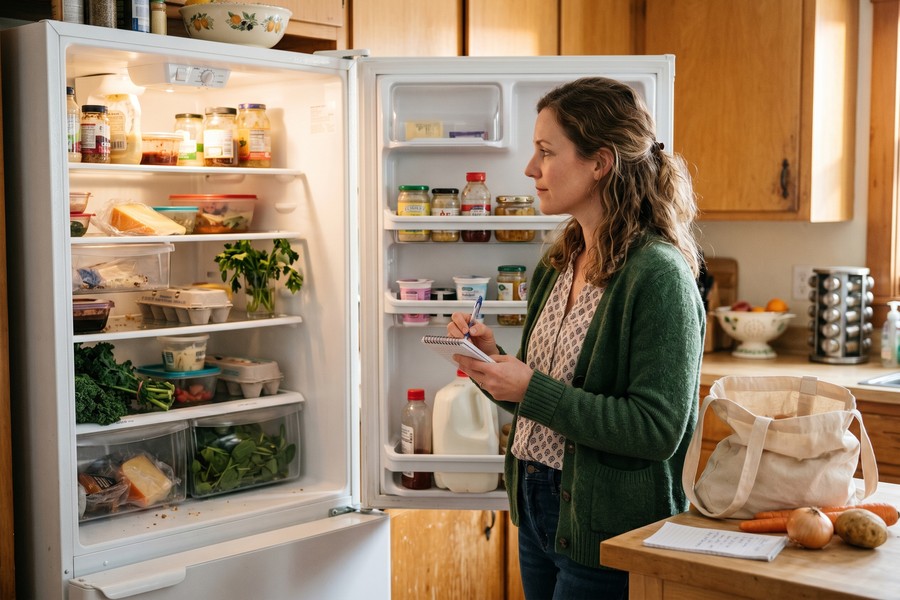
The most reliable anti-waste behavior is also the most boring: auditing the refrigerator and pantry before every shopping trip. As professional organizer Takilla Combs, cited by AARP, puts it:
“It won’t take you more than five minutes to straighten up the pantry and fridge and get rid of old food, so when you come home it’s clean and has the space you need to store new items.”
Beyond the five-minute audit, three structural habits consistently reduce waste: buying fresh produce in three-day quantities rather than seven-day quantities; using a vacuum sealer and a chest freezer for bulk meat and batch-cooked grains; and understanding that “Best By” dates describe quality, not safety. The USDA is explicit on this: most food past its Best By date is safe to consume. A vacuum sealer and a modest chest freezer convert perishables into shelf-stable items and can pay for themselves within a few months for households buying proteins in bulk.
Waste reduction connects directly to broader financial stability. If you are also working on building an emergency fund or paying down high-APR debt, plugging a $1,500-per-year food waste leak is a faster win than almost anything else on the list. Our piece on whether to pay off debt first or build an emergency fund covers how to think about that sequencing, including how your debt-to-income ratio (DTI) affects the calculus.
Stacking Loyalty Programs, Cash-Back Cards, and Apps Without the Overwhelm
The most effective grocery savers use layered savings, not single tactics. The principle is straightforward: combine a loyalty program’s digital coupons with a cash-back card optimized for your primary shopping channel, and add one aggregator app for price comparison. None of the three layers requires significant time once set up.
Premium grocery cash-back cards can return 6% at supermarkets on up to $6,000 in annual spending. On a $500-per-month grocery budget, that is $360 per year before any other savings. Cards from issuers like Chase and American Express have their own category definitions, so confirm that your primary store qualifies before applying. Warehouse clubs and Walmart typically do not. Your FICO Score and credit history, factors that Experian, Equifax, and TransUnion each report on separately, determine whether you can qualify for the top-tier cards at all. The CFPB’s credit card comparison tools are a useful starting point for evaluating APR and rewards terms side by side.
Discount grocers deserve more credit than they get in most personal finance articles. Stores like Aldi consistently price 20–30% below conventional grocery chains on comparable items, with a private-label model that forces quality parity at lower prices. Apps like Flipp aggregate weekly store circulars for price comparison without requiring you to visit five stores. Platforms like Misfits Market and Imperfect Foods offer cosmetically imperfect produce at reduced prices, a niche but genuinely useful channel for households that cook from scratch frequently.
What clients often miss: The loyalty program digital coupon is almost always better than the paper coupon, and in many cases it stacks on top of a cash-back card transaction. The setup takes about four minutes in the store’s app. The readers who skip this step are leaving the easiest money on the table.
As Trae Bodge summarizes it well: “You don’t need to become an extreme couponer or do anything complicated to save. There are lots of little steps you can take that can be quite impactful over a year of shopping.”
Getting a handle on your full financial picture, including the credit profile that determines which reward cards you can access, is part of the longer-term system. Our guide to money management mistakes people are still making in their 30s covers several relevant overlaps.
Where This Recommendation Falls Short
The tradeoff is real, and it is worth stating plainly: the system described in this article, reverse meal planning, waste audits, store-brand category mapping, loyalty app stacking, takes planning time and kitchen time. For households already operating near the edge of their capacity, that overhead is not free.
The USDA’s Thrifty Food Plan, the federal government’s lowest-cost nutritionally adequate eating benchmark, costs a family of four approximately $950–$1,000 per month in 2026. Hitting that floor requires scratch cooking for virtually every meal, buying primarily from loss leaders and marked-down categories, and having both the time and the skill to execute it consistently. That is not a realistic target for a dual-income household with two kids and 45-minute commutes. The goal should be eliminating waste and overpaying, not achieving subsistence-level frugality.
There is also a geography problem. Food access is not uniform. In areas with limited grocery options, food deserts, rural communities with a single nearby store, the competitive-pricing strategies and store-switching recommendations in this article may simply not apply. A household with one grocery store within 20 miles cannot comparison-shop across chains. The most actionable guidance here (waste reduction, store brands, list-based shopping) still applies regardless of location, but the savings ceiling is lower without competitive market access.
The drawback of leaning heavily on loyalty program digital coupons is that these programs are designed to gather behavioral data and steer you toward specific purchases. Used passively, they can create new spending on items you would not have bought otherwise, the opposite of their stated purpose. Used deliberately (activating only coupons for items already on your list), they are valuable. The discipline required is the same discipline the rest of this article asks for: intention before the trip, not reaction during it.
Finally, for readers dealing with financial stress that goes beyond groceries, high-interest debt, credit damage, or irregular income, the grocery bill is rarely the primary problem. Our guide on grocery shopping on a tight budget addresses the lower-income scenario more directly, with strategies calibrated for households where the margin is genuinely thin.
How We Sourced This
This article draws primarily from the USDA Economic Research Service food price and spending data (2024–2025), FMI, The Food Industry Association’s U.S. Grocery Shopper Trends 2026 report, ReFED’s 2026 U.S. Food Waste Report, NIQ (NielsenIQ) 2025 grocery trends research, and the Bureau of Labor Statistics 2024 Consumer Expenditure Survey as aggregated by The Motley Fool. Behavioral claims about in-store psychology reference Bangor University fMRI research on grocery decision-making. Consumer guidance on shopping behavior was sourced from Rutgers NJAES (New Jersey Agricultural Experiment Station), Bankrate, Kiplinger Personal Finance, and AARP. All verified expert quotes are attributed verbatim as provided. Data was verified against original source pages as of May 2026. Statistics from sources dated before May 2026 are cited as the most recent available at time of publication.
Frequently Asked Questions
What are the most effective smart grocery spending habits for reducing monthly costs?
The highest-impact habits are eliminating food waste, switching to store brands in staple categories, and planning meals around what is already discounted before building a shopping list. These three changes can realistically reduce a household’s grocery bill by 20–30% without altering diet quality or requiring extreme couponing. Grocery pickup and a loyalty-program digital coupon habit layer additional savings on top with minimal ongoing effort.
How much does the average U.S. household spend on groceries per month?
The average U.S. household spent $519 per month on groceries in 2024, according to the Bureau of Labor Statistics Consumer Expenditure Survey. A family of four on the USDA’s moderate-cost food plan spends considerably more, in the range of $1,100–$1,300 per month as of 2026. Your personal benchmark depends on household size, location, and dietary needs, not a single national average.
Is buying store brands actually worth it, or do you sacrifice quality?
For the majority of staple categories, store brands are worth it. Private-label products typically cost 25–40% less than name brands, and blind taste tests consistently show consumers cannot distinguish them from national brands for items like pasta, canned goods, frozen vegetables, and dairy. The exception applies to specialty products, certain personal-care items, and patented formulas, where the name brand may genuinely differ in formulation.
What is reverse meal planning and how does it save money?
Reverse meal planning means checking store sales circulars and your existing pantry inventory before deciding what meals to cook for the week, rather than planning meals first and then shopping for ingredients at whatever price they happen to be. This approach captures discounts on proteins and produce while reducing the likelihood of buying duplicates of items you already own. Over the course of a year, it is one of the behavioral habits that most reliably separates methodical grocery spenders from impulsive ones.
How does food waste connect to grocery savings?
Food waste is the single most underutilized lever in household grocery savings. The average American loses $762 per year to food waste according to ReFED’s 2026 data, meaning a four-person household wastes roughly $1,500 annually. Reducing waste requires no change in diet, no store switching, and no coupon clipping, making it a higher-ROI starting point than most tactics that get more attention.
Do grocery cash-back credit cards actually save money at warehouse clubs?
Usually not at the elevated rate. Most premium grocery cash-back cards, including cards offering 6% back at supermarkets, explicitly exclude warehouse clubs like Costco and Sam’s Club from their elevated reward categories. Shoppers who use a single grocery card across all channels may earn only 1–2% at warehouse stores. Matching your rewards card to your primary shopping channel is as important as having a rewards card at all.
What is a realistic grocery budget target as a percentage of income?
A reasonable target is 10–15% of after-tax monthly income for total food costs (groceries plus dining), with groceries fitting inside the broader 50% “needs” allocation of a standard 50/30/20 budget framework. If your grocery spending consistently runs above 12–15% of take-home pay, that is a signal worth investigating, though it may reflect regional cost differences or household size rather than inefficiency alone. The FMI U.S. Grocery Shopper Trends 2026 report shows the average household spends $169 per week, which gives a useful national comparison point.
Sources
- The Motley Fool, Average Monthly Expenses in the U.S. (2025, citing BLS Consumer Expenditure Survey)
- USDA Economic Research Service, Food Prices and Spending (2025)
- ReFED, 2026 U.S. Food Waste Report
- NIQ (NielsenIQ), Grocery Trends and Consumer Behavior (2025)
- FMI, The Food Industry Association, U.S. Grocery Shopper Trends 2026
- Kiplinger Personal Finance, How to Save on Groceries According to an Expert (Trae Bodge)
- Bankrate, Ways to Save Money on Groceries (Mark Hamrick)
- Rutgers NJAES, Smart Ways to Reduce Food Shopping Expenses
- AARP, Smart Guide to Grocery Shopping (featuring Takilla Combs)
- U.S. Bureau of Labor Statistics, Consumer Price Index Historical Data