Fact-checked by the The Credit Scout editorial team
Quick Answer
Building an emergency fund on a single income is achievable in under two years by calculating your bare-bones monthly expenses, opening a high-yield savings account paying around 4.0–4.1% APY, automating contributions as a fixed bill, and directing every windfall (tax refunds, child support, overtime) straight into the fund before it touches your checking account. Most single moms can reach a 6-month fund by hitting phased milestones: $1,000 first, then one month, then three, then six.
Building an emergency fund on a single income is harder than most personal-finance advice admits, and that’s exactly why the standard playbook needs to be rewritten for single mothers. Only 55% of single parents save for emergencies at all, compared to nearly two-thirds of all U.S. households, according to FDIC research on single-parent financial resilience. That gap isn’t a motivation problem. It’s a systems and information problem, and a plan built for one income can close it faster than you might expect.
The urgency has only grown. As of early 2026, 59% of Americans don’t have enough savings to cover an unexpected $1,000 expense, according to Bankrate data reported by CBS News. For a household with no second paycheck and a child depending on it, that $1,000 shortfall isn’t a financial inconvenience, it’s a crisis. High-yield savings rates near 4% APY and an expanded Child and Dependent Care Tax Credit starting in 2026 create a real opportunity to move faster than most competing articles suggest is possible.
This guide is written for single mothers earning a moderate income who want a step-by-step, milestone-based plan to reach a fully funded 6-month emergency reserve. By the end, you’ll know exactly how much to save, where to keep it, and how to get there in under 24 months, including what to do when life interrupts the plan along the way.
Key Takeaways
- Only 55% of single parents save for emergencies, compared to nearly two-thirds of all U.S. households, per FDIC data, making a deliberate savings system, not willpower, the critical variable.
- The median annual income for single-mother households is $41,305, less than one-third of the $132,959 median for married couples, according to Single Mother Guide citing U.S. Census Bureau data, which means every dollar in the fund has to work harder.
- Childcare costs single mothers an average of $13,128 per year, or up to 35% of the average single-family income, per Child Care Aware of America data, requiring a fundamentally different budget framework than standard 50/30/20 advice.
- Top high-yield savings accounts pay around 4.0–4.1% APY, roughly ten times the national average of 0.38%, meaning a $10,000 fund earns approximately $400 per year in interest with zero additional effort.
- Filing as Head of Household unlocks a $23,625 standard deduction for 2025, and the expanded Child and Dependent Care Tax Credit starting in 2026 covers up to 50% of qualifying childcare expenses for lower-income filers, two tax tools that can funnel hundreds of dollars directly into an emergency fund.
- In 2024, only 55% of U.S. adults had set aside three months of expenses in an emergency fund, per the Federal Reserve’s 2024 Economic Well-Being of U.S. Households report, meaning reaching a 6-month fund puts a single mother well ahead of most American families.
In This Guide
- Why does a single mom need more emergency savings than a two-income household?
- How do I calculate my 6-month emergency fund number on one income?
- How do I build a budget that actually creates savings room on a single income?
- Where should I keep my emergency fund to earn the most interest?
- What is a realistic month-by-month plan to build a 6-month emergency fund in under 2 years?
- How do I cut costs and boost income without burning out as a single mom?
- What do I do after I hit 6 months in my emergency fund?
- Frequently Asked Questions
Step 1: Why Does a Single Mom Need More Emergency Savings Than a Two-Income Household?
A single-income household carries a structural risk that two-income families simply don’t face: if the one earner loses a job, gets sick, or faces a pay cut, there is no fallback. The entire financial system rests on one point, and that point can fail.
How to Think About This
Two-income couples can often absorb a job loss on one salary while the other covers essentials. A single mother has no such cushion. This is why financial institutions consistently recommend that single-income households prioritize the higher end of the 3-to-6-month range, per Vanguard’s emergency fund guidance, which distinguishes between “spending shocks” (smaller, short-term) and “income shocks” (full income loss) requiring three to six months of living expenses. For a single mother, an income shock isn’t a hypothetical. It’s the category of risk she’s most exposed to.
The data reinforces how exposed single parents actually are. Nearly one in three families (30.6%) headed by single women with children were living in poverty in 2024, according to National Women’s Law Center calculations from U.S. Census Bureau CPS data. Single mothers are also disproportionately employed in volatile sectors, hospitality, retail, home care, where layoffs can arrive with little warning and unemployment benefits replace only a fraction of income.
What to Watch Out For
The most common mistake at this stage is accepting the generic “3-month fund” as sufficient. For a household with dependents and one income, a 3-month fund covers a manageable setback. A 6-month fund covers a real crisis: a serious illness, a layoff in a tough hiring market, or a childcare disruption that forces you off work temporarily. The FDIC explicitly recommends six months of living expenses in a federally insured account for households facing income risk, and single-parent households face more income risk than most.
In 2024, only 55% of U.S. adults had saved enough to cover three months of expenses, according to the Federal Reserve’s Report on the Economic Well-Being of U.S. Households. Building a full 6-month fund puts a single mother well ahead of the national median, and materially changes her financial security in a crisis.
Step 2: How Do I Calculate My 6-Month Emergency Fund Number on One Income?
Your emergency fund target is not based on your full monthly spending. It’s based on your bare-bones survival budget: the minimum you need to keep the household running if income stopped tomorrow.
How to Do This
Start by listing only the non-negotiable monthly expenses: rent or mortgage, utilities, groceries, childcare, transportation to work, health insurance premiums, and minimum debt payments. Leave out dining out, subscriptions, clothing, and entertainment. This stripped-down number is your monthly survival baseline.
Here’s why this matters more than national averages: a 6-month fund in a mid-size Midwestern city might land between $14,000 and $18,000, while the same fund for a single mother in New York City or Los Angeles can exceed $30,000. Using a national average instead of your local number either under-saves or makes the goal feel impossibly large. Neither outcome helps.
Once you have your monthly baseline, multiply by six. That is your full target. Then break it into phases so the number never feels paralyzing:
- Phase 1: $1,000 (covers most spending shocks, a car repair, a medical copay)
- Phase 2: One full month of bare-bones expenses
- Phase 3: Three months of bare-bones expenses
- Phase 4: Six months of bare-bones expenses (fully funded)
The Consumer Financial Protection Bureau advises setting a specific savings goal and making consistent contributions via automatic transfers, noting that even a small amount provides meaningful financial security. Starting with $1,000 before targeting the full six months is consistent with that guidance, and it gives you an early win that keeps momentum going.
What to Watch Out For
Don’t include your full take-home pay as the “income to replace.” The fund only needs to replace the essential expenses, not every dollar you currently spend. Using your full income inflates the target and can cause people to give up before starting. If you are also thinking through the debt-versus-savings question, whether to pay down credit cards first or build the fund, the answer is covered in Step 3, and there is a defensible specific answer rather than a vague “it depends.”
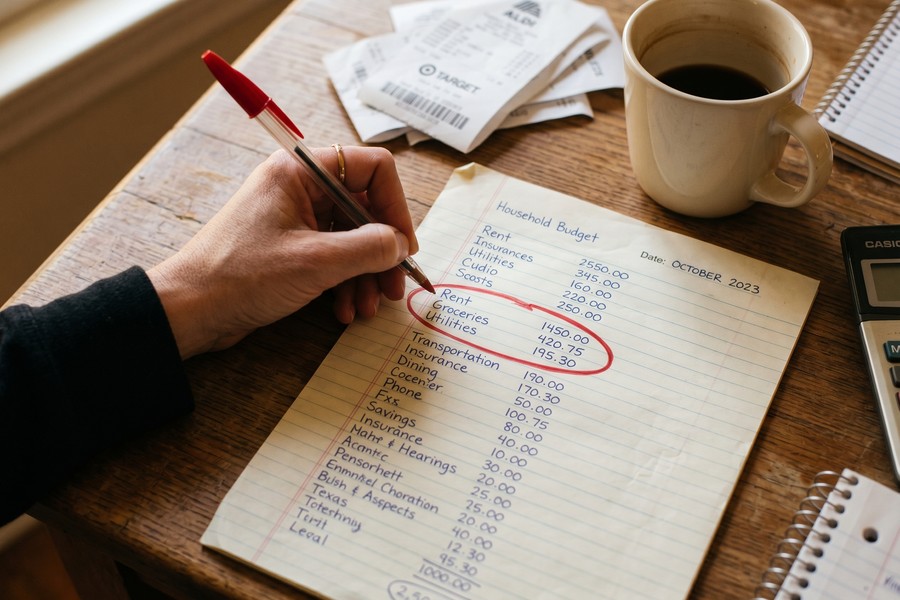
Use your most recent three months of bank statements to calculate an accurate survival baseline, rather than estimating from memory. Most people underestimate fixed expenses by 15–20% when guessing, which leads to an underfunded emergency fund that runs out too early.
Step 3: How Do I Build a Budget That Actually Creates Savings Room on a Single Income?
The standard 50/30/20 budget, 50% needs, 30% wants, 20% savings, breaks down immediately for most single mothers. With childcare alone consuming an average of 35% of single-family income, there is often no mathematical room for a 20% savings allocation without structural changes first.
How to Do This
The modification that works: treat your emergency fund contribution as a fixed bill, not a leftover. Before deciding what you can “afford to save,” automate a transfer, even $75 or $100, to your savings account on payday. Then budget everything else around what remains. This approach, sometimes called “paying yourself first,” is backed by behavioral economics research showing that automatic savings significantly outperforms manual, intention-based savings over time.
On the debt-versus-savings question, here is a concrete answer: build your $1,000 starter fund first, without exception. Then, once that buffer exists, split your next available dollar, direct 50% toward high-interest debt (anything above 8–10% APR) and 50% toward growing the emergency fund. This matters because paying down debt while carrying zero savings means any small surprise sends you straight back to the credit card. The starter fund breaks that cycle. For a fuller treatment of this tradeoff, see our guide on whether to pay off debt first or build an emergency fund.
The second major lever most articles miss entirely: tax strategy. Filing as Head of Household gives single mothers a $23,625 standard deduction for 2025, substantially higher than the $15,000 single-filer deduction. Combined with the Earned Income Tax Credit (EITC), which can deliver a refund of several thousand dollars for lower-income filers with children, and the expanded Child and Dependent Care Tax Credit (CDCTC), which starting in 2026 covers up to 50% of qualifying childcare expenses for lower-income filers, a single mother’s annual tax refund can become one of the most powerful single injections into her emergency fund each year. Our detailed breakdown of who qualifies for the Earned Income Tax Credit explains how to confirm your eligibility and maximize the credit. You should also review the current Child Tax Credit rules and income limits to ensure you’re claiming everything available.
What to Watch Out For
Resist the urge to apply blanket cuts across every budget category at once. The people who sustain long-term savings success tend to make two or three high-impact changes rather than trying to cut everything simultaneously and burning out within 60 days. Also: if you are currently in a pattern of common money management mistakes, addressing those alongside budget restructuring will accelerate your timeline considerably.
The childcare cost paradox is real: cutting childcare hours to save money can directly reduce your earning capacity if it forces you to work fewer hours or turn down shifts. For many single mothers, the smarter move is accessing childcare subsidies through programs like the federal Child Care and Development Fund (CCDF), state voucher programs, or an employer-sponsored Dependent Care Flexible Spending Account (DCAP), rather than reducing care. Reducing care to cut costs can cost more in lost wages than it saves.
| Savings Strategy | Monthly Contribution Range | Months to $1,000 | Months to 3-Month Fund ($6,000) | Best For |
|---|---|---|---|---|
| Bare Minimum Auto-Transfer | $75–$100/month | 10–14 months | 60–80 months | Households with no current slack in budget |
| Starter Savings Plan | $150/month | 7 months | 40 months | Single income, tight budget, no windfalls yet |
| Accelerated Plan | $300/month | 4 months | 20 months | After one expense cut or small income boost |
| Windfall-Boosted Plan | $200/month + $1,500 tax refund annually | 4 months | 14 months | Filers maximizing EITC and CDCTC refunds |
| Full-Speed Plan | $400/month | 3 months | 15 months | After subsidy, income boost, or debt payoff frees up cash |
Step 4: Where Should I Keep My Emergency Fund to Earn the Most Interest?
Keep your emergency fund in a high-yield savings account (HYSA) at an FDIC-insured online bank, separate from the checking account you use daily. The best HYSAs are paying around 4.0–4.1% APY, compared to the national average savings rate of 0.38%. On a $10,000 balance, that difference is roughly $400 per year versus $38, with zero additional effort on your part.
How to Do This
Open the HYSA at a different institution than your primary checking account. This is not a technicality, it is deliberate psychological friction. When the emergency fund is one tap away in the same banking app, it gets raided for non-emergencies. When it requires a two-to-three-day transfer from a separate bank, withdrawals become a considered decision rather than an impulse. The FDIC specifically recommends keeping emergency savings in a separate FDIC-insured savings account and using automatic payroll direct deposit to build savings consistently over time.
When comparing HYSAs, look for these specific features:
- No minimum balance requirement to earn the advertised APY
- No monthly maintenance fees
- FDIC insurance (confirmed at FDIC.gov’s BankFind tool)
- No requirement for a minimum number of monthly transactions
Well-known options worth comparing include Marcus by Goldman Sachs, Ally Bank, and SoFi, all of which have offered competitive no-minimum HYSAs. Rates change, so always verify the current APY directly on the bank’s website before opening an account.
What to Watch Out For
Promotional rate traps are common. Some banks advertise a high APY that only applies for the first three months, or requires a minimum balance of $5,000 or a monthly direct deposit to qualify. Read the fine print on any introductory offer. An unconditional 4.0% APY on a $500 balance is more valuable than a promotional 5.0% APY that drops to 0.5% once the promotional period ends or your balance fluctuates below a threshold that is hard to maintain on a single income.
The Federal Reserve Bank of St. Louis recommends saving 3–6 months of essential expenses in an accessible account, citing 2024 Federal Reserve SHED survey data showing only 55% of Americans had achieved even a 3-month emergency savings cushion, which means that reaching a fully funded 6-month goal puts you ahead of the vast majority of American households.
Step 5: What Is a Realistic Month-by-Month Plan to Build a 6-Month Emergency Fund in Under 2 Years?
A concrete milestone map built around a real single-income budget is what separates a motivating plan from vague encouragement. Here is a framework built on a take-home income of $3,800 per month after taxes and childcare costs, a figure consistent with a single mother earning close to the $41,305 median single-mother household income.
How to Do This
Assume a bare-bones monthly expense figure of $2,800 (rent, utilities, groceries, transportation, minimum debt payments). The 6-month target is therefore $16,800. Here is how the timeline looks under two contribution scenarios, with a $1,500 tax refund windfall applied each year around month 4 and month 16:
Saving $150/month plus annual tax refund windfall:
- Month 4: Hit $1,000 starter fund ($600 saved + $1,500 refund deposited = $2,100; redirect excess above $1,000 to debt, then resume at $150/month to fund)
- Month 10: Reach $1,900 (one month’s bare-bones expenses)
- Month 28: Reach $5,700 (approximately three months), this scenario takes closer to 30 months total for the full goal
Saving $300/month plus annual tax refund windfall:
- Month 4: Hit $1,000 starter fund within the first 4 months; add $1,500 refund = fund jumps to roughly $2,700
- Month 8: Reach $2,800 (one full month of expenses)
- Month 16: Reach approximately $8,700 (three months), boosted again by second tax refund
- Month 20–22: Reach $16,800 (six full months)
The $300/month scenario is the realistic path to hitting 6 months in under two years. Getting from $150 to $300 is often achievable through one targeted expense cut or a single income-boosting action, both addressed in Step 6.
The windfall protocol is critical to this plan: any money that was not budgeted for expenses goes directly to the emergency fund before it hits your checking account. This includes tax refunds, child support arrears payments, birthday money, overtime pay, and any side income. Because this money was never factored into your spending plan, depositing it into savings doesn’t feel like a sacrifice, and it can shave months off your timeline. According to Bankrate’s guidance on starting an emergency fund, directing windfalls to savings before they reach your checking account is one of the most effective behavioral strategies for accelerating fund growth on a tight budget.
What to Watch Out For
At some point during the build, an emergency will likely drain part of the fund. This is not failure, it is the system working exactly as designed. When it happens, treat the withdrawal as proof the fund did its job, then resume contributions at the same rate to rebuild to the prior milestone first before targeting the next one. The psychological key is to never measure progress from the fully funded target after a setback; measure it from the nearest milestone you previously achieved, then work forward from there.
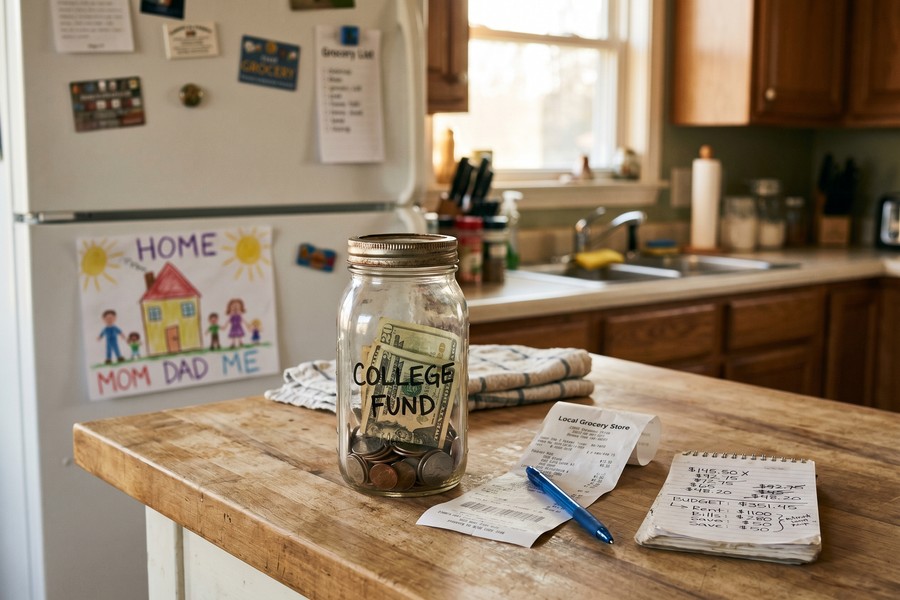
Set up a separate automatic transfer that moves money into your HYSA on the same day your paycheck deposits, not a few days later. Every day the money sits in your checking account, it is exposed to spending. Automating on payday removes that exposure entirely, and the CFPB identifies automatic transfers as the single most effective savings behavior for households with tight cash flow.
Step 6: How Do I Cut Costs and Boost Income Without Burning Out as a Single Mom?
Generic cost-cutting advice, cancel streaming, skip lattes, will not move the needle on a $16,000 savings goal. The cuts that actually matter on a single-mom budget target the largest expense categories, and the income boosts that work fit around school hours, bedtime, and existing childcare.
How to Do This
Start with a spending audit week: track every transaction for seven consecutive days using a free budgeting app or your bank’s transaction history. Most people identify two or three recurring expenses they had forgotten about and one or two categories where spending is substantially higher than they estimated. Cutting those specific leaks beats applying blanket deprivation across every category, which tends to collapse within 30 to 60 days.
High-leverage cost reductions specific to single-mom budgets include:
- Childcare subsidies: Apply for CCDF vouchers through your state agency, check employer DCAP accounts (which allow up to $5,000 in pre-tax childcare dollars annually), and confirm eligibility for Head Start programs if your child is under five.
- Utility assistance: The federal Low Income Home Energy Assistance Program (LIHEAP) provides heating and cooling bill relief for qualifying households. Many utility companies also have their own hardship programs with shorter wait times.
- Grocery spending: Confirm SNAP eligibility (a family of two earning under $2,311/month gross may qualify income limits) and review grocery strategies that reduce weekly spend without sacrificing nutrition. Our guide on grocery shopping on a tight budget covers approaches most people overlook.
- Subscription audit: Check for duplicate or unused subscriptions through your bank statement. Even $40–$60 per month freed here adds $480–$720 annually to your savings rate.
On the income side, a single mother managing a full-time job and childcare has fewer discretionary hours than almost any other demographic. The side hustle has to fit the schedule, not the other way around. Low-time, flexible options worth considering include selling unused items on Facebook Marketplace or Poshmark (a one-time income burst that can fund the Phase 1 $1,000 goal quickly), cashback stacking through apps like Rakuten for purchases you are already making, and renting a parking spot or storage space if you have one available.
Frame any income-boosting effort as a sprint with a defined end date, not a permanent second job. The goal is to accelerate the fund from three months to six months in a defined 4-to-6-month window, then reassess. Permanent exhaustion is not a savings strategy.
What to Watch Out For
Avoid cutting childcare as a cost-reduction strategy without calculating the full income impact first. For many single mothers, every dollar cut from childcare costs two dollars in lost wages. Before reducing care hours, exhaust every subsidy option available. For budgeting tools that work with variable income or irregular schedules, see our roundup of budgeting apps built for non-traditional income situations, several of which apply equally well to single mothers with shifting work schedules.

The financial stress of being a sole decision-maker in a household is not just an emotional burden, it has measurable cognitive effects. Research on financial scarcity consistently shows that chronic money stress consumes working memory and impairs decision-making quality, sometimes called the “mental tax” of financial insecurity. Reaching a fully funded emergency fund does not just change your balance sheet; it materially reduces this cognitive load, which is part of why the return on the effort extends well beyond dollars.
Step 7: What Do I Do After I Hit 6 Months in My Emergency Fund?
Once your fund is fully funded, the work shifts from building to protecting and redirecting. The 6-month target is not a fixed finish line, it is a living number that needs to be recalculated whenever a major life change occurs.
How to Do This
Recalculate your bare-bones monthly expenses any time one of these happens: a raise or income change, a move to a new city or apartment, a change in childcare costs, or a child aging out of a care arrangement. Each event shifts your monthly survival baseline, which means your fund’s real coverage changes even if the dollar balance stays the same.
Once the fund is stable, redirect the contribution you were making to the emergency fund toward the next financial priority. For most single mothers, the strongest next step is opening a Roth IRA. Contributions (not earnings) to a Roth IRA can be withdrawn at any time without penalty, which means the account functions as a legal secondary emergency backstop while simultaneously building tax-free retirement wealth. In 2026, the annual contribution limit is $7,000 (or $8,000 if you are 50 or older). If you are starting later in your career and want guidance on structuring retirement savings efficiently, our guide on building a retirement fund in your 40s addresses exactly this situation.
An honest concession: reaching a 6-month emergency fund in under 24 months is achievable but not guaranteed for everyone. It requires consistent execution, at least one income-boosting or expense-cutting action, and the good fortune of not facing a major setback that drains progress in the middle of the plan. Reaching even a 3-month fund puts you ahead of nearly half of all American adults, and that is worth naming as a real milestone, not a consolation prize.
What to Watch Out For
The most common post-milestone mistake is gradual lifestyle creep: spending rises to absorb the savings contribution that was just freed up. Once the automatic transfer to the emergency fund stops, that money will go somewhere. Direct it explicitly to the Roth IRA or a debt payoff plan before it disappears into daily spending. Also, resist the temptation to invest the emergency fund itself in the market in search of higher returns. The fund’s value is its guaranteed availability, not its yield. Market volatility can turn a $16,000 emergency fund into $12,000 exactly when you need it most.
After you hit your 6-month target, keep the automatic transfer running at a reduced amount, say, $50 per month, to offset the natural erosion of inflation. A fund that covers 6 months of expenses today may only cover 5.5 months in two years if it never grows. This small ongoing contribution also preserves the savings habit without requiring any new behavioral effort.
Frequently Asked Questions
How much should a single mom have in an emergency fund?
A single mother should target at least six months of bare-bones living expenses in her emergency fund, more than the three-month standard often cited for two-income households. Because there is no partner’s paycheck to absorb an income loss, the full six-month cushion is the appropriate target. Calculate your monthly survival expenses (rent, utilities, groceries, childcare, transportation, minimum debt payments) and multiply by six to get your specific number. Vanguard’s emergency fund guidance specifically recommends the higher end of the range for single-income households facing income-shock risk.
Should I pay off debt first or build an emergency fund as a single mom?
Build a $1,000 starter fund before aggressively paying down any debt, then split your available dollars between debt and savings. Without any emergency fund, the first car repair or medical bill sends you straight back to your credit card, undoing the payoff progress. Once you have $1,000 in place, direct 50% of your extra cash toward high-interest debt (above roughly 8–10% APR) and 50% toward growing the emergency fund. This dual-track approach is slower than going all-in on debt, but it prevents the cycle of savings-destruction that trips up most single-income households. For a full comparison of the two approaches, see our guide on paying off debt versus building an emergency fund.
What is the best savings account for a single mom’s emergency fund?
A high-yield savings account (HYSA) at an FDIC-insured online bank is the best place to keep an emergency fund. The top HYSAs offer around 4.0–4.1% APY with no minimum balance requirements, compared to the national average of 0.38% at traditional banks. Keep the account at a separate institution from your checking account to reduce the temptation to spend it on non-emergencies. The FDIC recommends a separate FDIC-insured savings account with automatic transfers from your paycheck as the most reliable structure for building emergency savings.
How can I save money for an emergency fund on a low income with kids?
Automate a small, consistent transfer to your HYSA on payday, even $50 or $75 per month, so saving happens before spending decisions are made. Then layer in windfalls: your annual tax refund (especially if you qualify for the EITC and Child and Dependent Care Tax Credit), any child support payments beyond your budgeted amount, and proceeds from selling unused items. Also confirm eligibility for childcare subsidies through your state’s CCDF program and utility assistance through LIHEAP, which can free up $100 to $200 per month in existing expenses without requiring any additional income. The CFPB confirms that automatic transfers are the most effective savings mechanism for households with tight cash flow.
Can I really build a 6-month emergency fund in under 2 years on one income?
Yes, but it requires consistent execution and at least one income-boosting or expense-reducing action. It is a realistic stretch goal, not a guaranteed outcome. A single mother saving $300 per month and depositing a $1,500 annual tax refund can reach a $16,800 six-month fund in approximately 20 to 22 months. Saving $150 per month at the same windfall rate extends the timeline to 28 to 32 months. The primary levers are contribution consistency, windfall discipline, and accessing available tax credits and subsidies. For a real-world example of this path, see our detailed case study on how a single mom on $45,000 a year built a 6-month emergency fund.
What counts as an emergency for my emergency fund and what doesn’t?
A true emergency is an unexpected, necessary expense that threatens your household’s financial stability: job loss, major car repair needed to keep working, an emergency medical bill, or a sudden home repair. It is not a predictable annual expense (car registration, school supplies) or a discretionary purchase you simply didn’t plan for. Keep a separate “sinking fund” savings bucket for predictable irregular expenses. This protects your emergency fund from being drained by events that were never true emergencies. A good rule of thumb: if you could have planned for it six months ago, it is not an emergency.
What happens if I have to use my emergency fund before it’s fully built?
Using the fund for a genuine emergency is the system working correctly, not a failure. After a withdrawal, rebuild to the nearest prior milestone first, not all the way to the full target, before pushing toward the next phase. Resume your regular automatic contributions immediately, and if the withdrawal was large, consider directing the next available windfall entirely to replenishment before resuming debt payments. Treating a drawdown as evidence the fund did its job, rather than as a setback, is the behavioral shift that keeps people from abandoning the plan entirely after their first real-life test.
Does my emergency fund affect my eligibility for SNAP or other benefits?
For most SNAP applicants, liquid assets like savings accounts are not counted as resources in the eligibility determination. Most states have eliminated asset tests for SNAP, though a few retain them. Check your specific state’s rules at benefits.gov or your state’s SNAP agency. For programs like TANF that do have asset limits, some states exclude a designated emergency savings account from the calculation. Building an emergency fund is generally compatible with receiving need-based benefits, but verifying your state’s specific asset rules before saving aggressively is worth doing to avoid any eligibility surprises.
How do I stay motivated to keep saving for an emergency fund when progress feels slow?
Track progress against milestones, not the full goal. Watching a balance climb from $500 to $1,000 feels like achievement; watching it crawl from $1,000 toward $16,800 can feel discouraging by comparison. Name each milestone explicitly in your savings app, “Phase 1: $1,000,” “Phase 2: one month,” and treat each one as a discrete win. The behavioral research on financial goal achievement consistently shows that visible, near-term milestones outperform distant large-number goals for sustained motivation, particularly under conditions of financial stress where cognitive bandwidth is already constrained.
Sources
- Federal Deposit Insurance Corporation (FDIC), Single Parents, Financial Resilience, Banking and Mobile Technology
- Federal Reserve Board, Report on the Economic Well-Being of U.S. Households in 2024: Savings and Investments
- Consumer Financial Protection Bureau (CFPB), An Essential Guide to Building an Emergency Fund
- Federal Deposit Insurance Corporation (FDIC), Saving for the Unexpected and Your Future
- Federal Deposit Insurance Corporation (FDIC), Starting Small Can Lead to Big Savings
- Federal Reserve Bank of St. Louis, When the Unexpected Happens: Be Ready with an Emergency Fund
- Vanguard, Emergency Fund: How Much Should You Save?
- National Women’s Law Center, Women in Poverty: State by State
- Single Mother Guide, Single Mother Statistics (citing U.S. Census Bureau)
- CBS News, Bankrate Survey: 59% of Americans Can’t Cover a $1,000 Emergency Expense (2025)
- Bankrate, How to Start an Emergency Fund
- Child Care Aware of America via Single Mother Statistics, Average Annual Childcare Costs 2024