
Reviewed by the The Credit Scout Editorial Team
Our Take
A credit score with no credit cards is absolutely achievable, installment loans, credit-builder loans, and rent reporting can generate a real, lendable FICO Score. For most financial goals, a score in the 700s built without revolving credit is functionally equivalent to 850. The honest case against this path: hitting 800+ is structurally harder without revolving accounts, because credit mix (10% of FICO) and utilization optimization both require a credit card. For readers targeting elite mortgage pricing or the top score tier within two years, one secured card used minimally and paid in full beats any workaround.
Roughly 18% of American adults had no credit card in 2025, according to the Federal Reserve’s Survey of Household Economics and Decisionmaking, yet most articles about credit building assume a card is the default starting point. For anyone asking whether a credit score no credit cards situation is viable, the answer is yes, with real limits that most guides never name plainly.
This article is for people who either choose to avoid credit cards or simply haven’t opened one yet. What makes the recommendation work is understanding exactly which scoring factors respond to non-card accounts, and which ones don’t.
Key Takeaways
- Payment history is 35% of your FICO Score, the single largest factor, and it can be built entirely through installment loans, with no credit card required, per FICO’s official scoring breakdown.
- FICO requires at least one account open for six months before it will generate a score; VantageScore can score a file in as little as one month, meaning the same person may have a VantageScore but no FICO Score, a practically important gap since 90% of top lenders use FICO, per myFICO’s credit history FAQ.
- Credit mix accounts for only 10% of the FICO Score, and FICO explicitly states it is “not necessary” to have both revolving and installment accounts, per myFICO’s score requirements page.
- Under VantageScore, credit mix and depth of credit counts for roughly 20–21% of the score, double the FICO weight, meaning the no-credit-card penalty is literally twice as large depending on which model a lender pulls, per VantageScore’s own documentation.
- In my experience reading through reader credit files, the biggest surprise for no-card borrowers isn’t their score, it’s discovering they have no FICO Score at all because their only account hasn’t aged past six months yet.
Do You Actually Have a Credit Score Right Now?
Before assuming your situation is a problem, check whether you have a scorable file at all. There’s a meaningful difference between a low score and no score, and for someone with no credit cards, either is possible depending on your account history.
Here’s the thing: FICO and VantageScore use different minimum thresholds, and the gap matters enormously in practice. FICO requires at least one account that has been open for six months or more, with activity reported to a bureau within the past six months. VantageScore can generate a score with as little as one month of credit history. The same person with a two-month-old student loan might see a VantageScore on a free monitoring app, and still be completely unscored when a mortgage lender pulls a FICO.
Why the FICO vs. VantageScore Gap Matters
Since roughly 90% of top lenders use FICO for major credit decisions, a VantageScore-only file is functionally unscorable for most loans. Free tools like Credit Karma and many bank dashboards display VantageScore, so readers often believe they have a real score when, for lending purposes, they don’t yet. Start with a free report at AnnualCreditReport.com to confirm what’s actually on your file before drawing any conclusions.
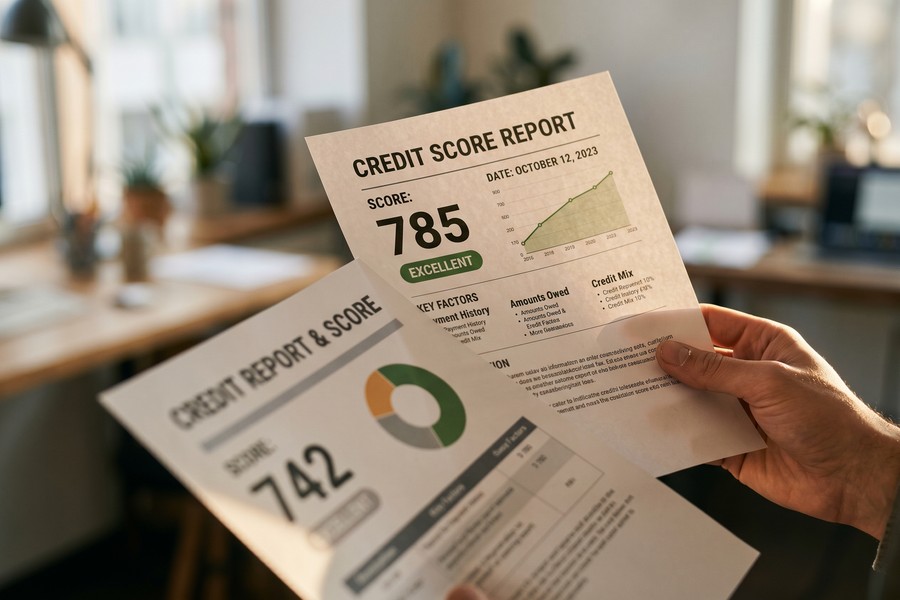
The CFPB describes consumers without any scored history as “credit invisible” or “unscored”, noting that a thin or stale file simply doesn’t produce a number. That’s a neutral starting condition, not a mark against you. Roughly 45 million Americans currently lack a credit score, and the cause is almost always the absence of reportable accounts, not financial irresponsibility.
What the Five FICO Factors Look Like Without a Credit Card
Credit utilization, the ratio that dominates most credit card advice, simply doesn’t apply to you. That’s not a disadvantage.
Utilization is calculated entirely from revolving account balances. With no credit cards, there are no revolving balances to calculate, so this sub-component of “amounts owed” either reads as zero or gets skipped. Most articles treat this as a gap. It isn’t. A zero or absent utilization reading is neutral to slightly favorable, it’s not pulling your score down the way a 30%+ utilization rate would on a card-holder’s file.
What I see in practice: Readers without cards frequently assume their “amounts owed” bucket is a weakness. It’s usually the opposite, their installment loan balances are declining steadily, and without revolving debt, there’s nothing dragging that factor down. The real gap is almost always thin payment history, not utilization.
The honest gap is credit mix. FICO acknowledges that a file with only installment accounts, and no revolving accounts, leaves the 10% credit mix factor partially unoptimized. Under VantageScore, that penalty doubles to roughly 20–21%. If you care about which model applies to your next application, that distinction changes the advice meaningfully.
The Non-Card Accounts That Are Already Working
Student loans, auto loans, personal loans, and mortgages all report to the bureaus and build the factor that matters most: payment history at 35%, per FICO’s scoring breakdown. Federal student loans report even while deferred, which means a borrower who hasn’t made a single payment yet may still be building file length.
The Reporting Gap Most Articles Skip
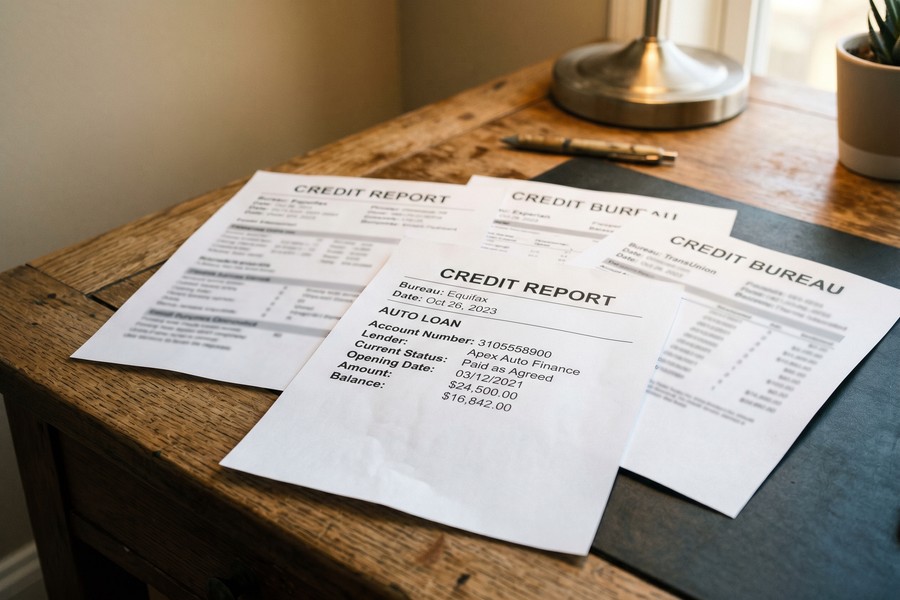
Not all lenders report to all three bureaus. A credit union auto loan might show up on Experian and TransUnion but be absent from Equifax entirely. This means your score can vary significantly across bureaus, and a lender pulling only one report may see a thinner file than actually exists. Check all three reports, not just one.
Where this gets tricky: A collections account or a phone contract sent to collections will also create or damage a credit file, even for someone who has never held a card. What we tell readers in this situation: your first step is confirming nothing negative slipped onto your file before you start building. Negative surprises are common, and fixing them first changes the strategy entirely.
For a worked example: if your only account is a $10,000 student loan opened 18 months ago with zero late payments, FICO assigns that clean payment history full weight in the 35% bucket. Over 18 months, that’s 18 consecutive on-time marks, meaningful history. A single 30-day late payment on that same account, however, would land harder than it would on a thick multi-account file. With fewer accounts, each one carries proportionally more weight.
Rent, Utilities, and the Limits of Alternative Data
Opt-in reporting tools can help, but they don’t all do the same thing, and treating them as equivalent is a mistake.
Experian’s consumer education page explains that Experian Boost adds utility, telecom, and streaming payments to your Experian file. The key word there is “Experian.” Boost affects only one bureau, so your TransUnion and Equifax scores won’t move. Rent-reporting services like Rental Kharma or Rent Reporters can submit to multiple bureaus depending on the service tier, but the payments are treated as payment history data, they strengthen the 35% bucket but do nothing to close the credit mix gap. A credit-builder loan, by contrast, opens a new installment account on all three bureaus, improving both payment history and credit mix simultaneously.
Here’s the thing: rent reporting only works in your favor if every payment has been on time. Adding late rent to a credit file actively damages the score you’re trying to build. Before opting in, verify your rental payment record is spotless. If it isn’t, these credit-building mistakes are worth reviewing before you take any action.
VantageScore is more receptive to alternative data than FICO is, and can generate a score from a single month of history. That’s useful for getting a preliminary picture, but it doesn’t change the FICO picture for lenders.
What Score Can You Actually Reach Without a Credit Card?
The national average FICO Score was 713 in 2025, per Experian’s consumer credit analysis, and a clean installment loan history can get you there. Reaching the “good” range (670+) or even “very good” (740+) is realistic with consistent on-time payments, a seasoned account, and no derogatory marks.
The structural ceiling is around 800+. Nearly everyone in that tier has both revolving and installment accounts, not because of a written rule, but because the scoring model rewards demonstrated management of both types. FICO officially says having both isn’t required, but the data reflects that top-tier scorers almost universally do. For someone whose goal is a mortgage, an auto loan, or an apartment, a score in the 700s is functionally equivalent to 850. Lenders price by range, and both 800 and 850 typically land in the same “exceptional” bucket with identical rate offers.
For readers building credit without a card who also want to build toward homeownership, the path outlined in how a recent college graduate built a 700+ score in under two years is directly applicable, installment history does most of the heavy lifting. And if you’re exploring non-card options more broadly, the alternative ways to build credit beyond secured cards covers credit-builder loans and authorized-user strategies in depth.
Where This Recommendation Falls Short
The biggest drawback of building credit entirely without revolving accounts isn’t the credit mix gap, it’s what happens during a formal loan application with a thin file. A 720 FICO Score built on one installment loan and two years of clean history looks different to an underwriter than a 720 built on five seasoned accounts across revolving and installment categories. The number is identical; the file depth is not.
This is the catch that most “you don’t need a credit card” articles skip. Mortgage lenders, in particular, don’t just see the score, they see the file. A borrower with a thin file may trigger manual review even at a qualifying score, which introduces delays, additional documentation requirements, and potential denial on a technicality. The FHA manual underwriting path does exist for borrowers with no credit score using alternative payment records, but that path is narrow: the GAO found that only about 0.31% of FHA-insured loans used alternative data underwriting between 2016 and 2020. “Just report your rent” is insufficient advice for the large share of readers whose goal is buying a home.
The authorized-user strategy carries its own tradeoff. Adding yourself as an authorized user on someone else’s credit card can add revolving history to your file, but some mortgage underwriters apply overlays that discount or exclude authorized-user tradelines entirely. A score built primarily on authorized-user accounts may not hold up during formal underwriting. If you’re using this strategy, understand that its benefit is bureau-visible but not always lender-recognized.
The risk is also in timing. FICO’s six-month minimum means a reader who just opened a credit-builder loan has no FICO Score yet. Meaningful improvement from a credit-builder loan typically takes 12–24 months of consistent on-time payments. This path works, it just isn’t fast, and it isn’t for everyone whose credit need is urgent.
Finally, for readers targeting the 800+ tier or elite mortgage pricing, the honest concession is this: one secured card, used minimally and paid in full each month, is the most efficient route. Not because debt is good, but because the scoring model rewards revolving credit management that installment loans structurally cannot provide. The comparison between secured and unsecured cards is worth reading before making that decision.
How We Sourced This
This article draws primarily from FICO’s official credit education documentation at myFICO.com, the Consumer Financial Protection Bureau’s consumer credit guidance pages, VantageScore’s knowledge center, and Experian’s Ask Experian consumer education blog, all accessed and verified as current in May–June 2026. The 18% no-credit-card figure comes from the Federal Reserve’s Survey of Household Economics and Decisionmaking (SHED) as analyzed by The Motley Fool (2025). The national average FICO Score of 713 is from Experian’s 2025 consumer credit analysis. The 0.31% FHA alternative data figure originates from the U.S. Government Accountability Office (GAO) report covering 2016–2020. Sources were selected based on institutional authority; no affiliate relationships influenced sourcing decisions.
Frequently Asked Questions
Can you have a credit score if you’ve never had a credit card?
Yes. FICO Scores can be generated from installment loans, student loans, auto loans, or any other account that has been open and active for at least six months. A credit card is not required, only a reportable account meeting FICO’s minimum threshold.
What happens to my credit utilization if I have no credit cards?
Credit utilization is calculated exclusively from revolving accounts. With no credit cards, there are no revolving balances to measure, so this sub-factor either registers as zero or is skipped. This is neutral to slightly favorable, it does not penalize your score the way a high balance on a card would.
Is a VantageScore the same as a FICO Score for lenders?
No. Roughly 90% of top lenders use FICO for major credit decisions, including mortgages and auto loans. A consumer who has a VantageScore visible on a free monitoring app may still have no FICO Score, meaning they are functionally unscored for most formal lending purposes.
How long does it take to build a credit score without a credit card?
FICO requires at least one account open for six months before it will generate a score. After that initial threshold, meaningful improvement from consistent on-time installment payments typically takes 12–24 months. The timeline shortens if you add an authorized-user tradeline with a long, clean history, though some lenders discount those accounts in underwriting.
Does Experian Boost improve my score at all three credit bureaus?
No. Experian Boost adds utility, telecom, and streaming payment data only to your Experian file. Your TransUnion and Equifax scores are unaffected. Rent-reporting services may submit to multiple bureaus depending on the tier you use, but it’s worth confirming bureau coverage before signing up.
What’s the highest credit score I can realistically reach without a credit card?
Reaching the “very good” range of 740+ is realistic with a long, clean installment loan history. Consistently reaching 800+ is structurally harder because credit mix (10% of FICO) and revolving utilization optimization both require a credit card. For most real-world financial goals, a mortgage, auto loan, or apartment, a 700s score delivers the same practical rate as an 850.
Sources
- FICO (myFICO), What’s in Your Credit Score
- FICO (myFICO), FICO Score Requirements FAQ
- Consumer Financial Protection Bureau, What Is a Credit Score?
- VantageScore, 4 Ways to Establish Credit If You Are Credit Invisible
- Experian, What Is the Average Credit Score in the U.S.?
- The Motley Fool, Credit Card Ownership Statistics (Federal Reserve SHED Data)


