
Fact-checked by the The Credit Scout editorial team
Quick Answer
To lower monthly bills as a homeowner, audit your energy use, optimize heating and cooling, shop your insurance competitively, remove PMI when eligible, and cut recurring service costs. Most homeowners can stack these levers to save $400–$600 per month. The highest-impact actions take one to three hours to set up and require no major renovation.
New homeowners can genuinely lower monthly bills by several hundred dollars without touching their comfort or gutting their lifestyle, but the savings come from stacking multiple smaller actions rather than hunting for one magic fix. According to the U.S. Department of Energy’s Energy Savings Hub, a combination of behavioral changes, low-cost upgrades, and smarter spending on recurring services can reduce household costs by thousands of dollars annually. The first 90 days after closing is the window where all of these moves carry the most weight.
Utility costs are rising structurally. Electricity prices climbed roughly 5.5% year-over-year through late 2025, and natural gas remained near historical highs. Meanwhile, the psychological shift from renting to owning is significant: in a rental, inefficiencies were someone else’s problem. Now every drafty window, oversized insurance policy, and forgotten streaming subscription hits your bank account directly. That change in accountability is actually an opportunity, because you can see and fix each cost center clearly.
This guide is written for new homeowners within their first year of ownership, though any homeowner tired of bill creep will find it useful. By the end, you will know which specific actions deliver the fastest and largest savings, which ones require geographic or equity prerequisites, and how to put together a realistic plan that adds up to roughly $600 a month in ongoing reductions.
Key Takeaways
- The U.S. Department of Energy estimates homeowners can save up to 10% per year on heating and cooling simply by adjusting the thermostat 7°–10°F for 8 hours a day.
- Switching all lighting to LED can save the average household about $225 per year, according to DOE lighting data, since lighting accounts for roughly 15% of a home’s electricity use.
- Air sealing and insulating an attic or crawl space saves an average of 15% on heating and cooling costs, per ENERGY STAR’s sealing and insulation methodology.
- Under the Homeowners Protection Act, lenders must automatically cancel PMI at 78% loan-to-value, but borrowers can request cancellation earlier at 80% LTV, a distinction most new homeowners don’t know to act on, as detailed by the Consumer Financial Protection Bureau.
- Americans spend an average of $519 per month on groceries, according to the U.S. Bureau of Labor Statistics Consumer Expenditure Survey, making food one of the highest-ROI categories to audit after housing costs.
- ENERGY STAR-certified heat pump water heaters can save a family of four about $550 per year according to ENERGY STAR’s Home Upgrade guidance, making water heating one of the most overlooked upgrade opportunities.
In This Guide
- Why should I do a home energy audit before spending any money?
- How do I lower my heating and cooling bill without sacrificing comfort?
- How do I reduce my homeowners insurance premium without losing coverage?
- How do I remove PMI and reduce my monthly mortgage payment?
- How do I negotiate lower rates on internet, phone, and subscriptions?
- What tax credits and utility rebates are available to help pay for home upgrades?
- What does $600 per month in savings actually look like broken down?
- Frequently Asked Questions
Step 1: Why should I do a home energy audit before spending any money?
A home energy audit tells you exactly where your money is leaking before you spend a dollar fixing anything. Without one, you risk buying a smart thermostat when the real problem is an uninsulated attic, or replacing windows when caulking the existing frames would have solved 80% of the drafts.
How to Do This
Start by calling your utility provider. Most electric and gas utilities offer free or subsidized home energy audits, and many use a professional auditor who will run a blower-door test, check insulation levels, and scan for air leaks with an infrared camera. The DOE’s Energy Savings Hub maintains a state-by-state database of programs. If your utility doesn’t offer free audits, a certified auditor from the Building Performance Institute typically costs $200–$400 and pays for itself quickly. For a free first pass at home, pick up a basic watt meter (sold for under $30 at most hardware stores) and plug each major appliance into it to measure its real monthly electricity cost.
The audit will generate a prioritized list of improvements ranked by cost-effectiveness. That ranking matters more than most people realize. The top items on almost every list are unglamorous: HVAC filter replacement, caulking around windows and doors, and adding weatherstripping. These typically cost under $100 total and can trim energy bills by 5% to 10% before you touch anything else.
What to Watch Out For
Audits surface problems honestly, not dramatically. Don’t be surprised if the biggest savings come from a $6 tube of caulk rather than a $3,000 HVAC upgrade. The first-mover window, specifically the 30–90 days after closing, is the best time to request an audit because you can use its findings to plan purchases before any promotional offers expire and negotiate introductory pricing with service providers.
When you call your utility company to request an audit, ask in the same conversation whether you qualify for any Home Energy Rebates or bill-credit programs. Many utilities run seasonal promotions that aren’t advertised prominently. Getting both answers in one call takes five minutes and can fund part of your upgrade list before you spend anything out of pocket.
Step 2: How do I lower my heating and cooling bill without sacrificing comfort?
Heating and cooling account for more than half of the average home’s energy bill, which makes your HVAC system the single highest-priority category to address first. The most effective tactics here are also the least disruptive to daily life.
How to Do This
Work through a three-tier approach ordered by cost. First, the free tier: the U.S. Department of Energy estimates that turning the thermostat back 7°–10°F for 8 hours a day saves up to 10% per year on heating and cooling. That’s roughly $100–$200 annually for the average household with no hardware required. Ceiling fans cost nothing extra to run and make a room feel 2°–3°F cooler in summer, allowing you to raise the thermostat setting without noticing a difference.
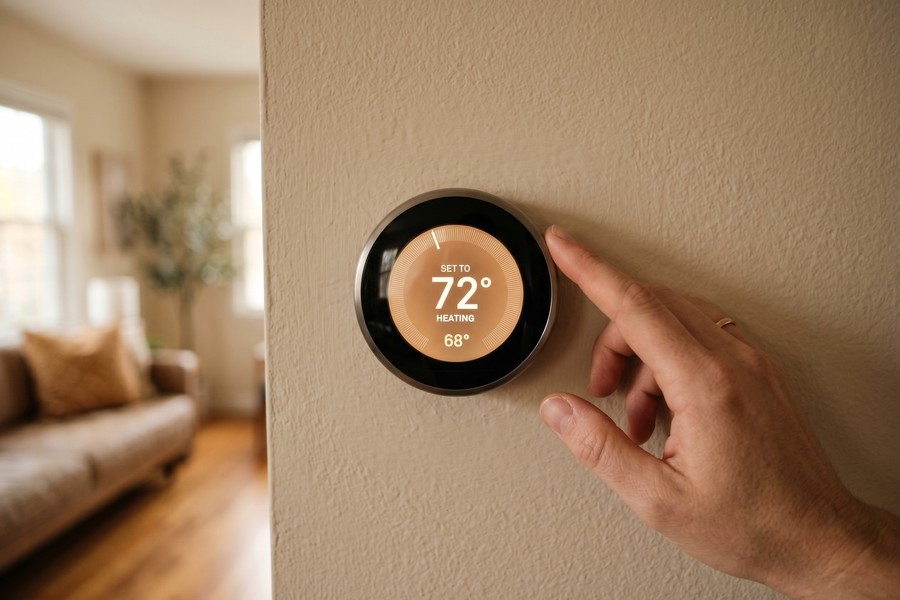
Second, the low-cost tier: a smart thermostat priced under $150 (models from Ecobee and Google Nest are widely available) can reduce heating and cooling bills by an average of 8% according to EPA data cited by Consumer Reports. Many utilities offer rebates of $25–$75 that partially or fully offset the purchase price. The device pays for itself within the first year in most climates.
Third, the medium-cost tier: air sealing with caulk and weatherstripping. The EPA’s ENERGY STAR sealing and insulation data shows that homeowners who air-seal and add insulation in attics, floors over crawl spaces, and basement rim joists save an average of 15% on heating and cooling costs. Most of the materials cost under $200 for a typical house, and the labor is DIY-friendly.
What to Watch Out For
Don’t skip the air filter. A clogged HVAC filter forces the system to work harder, which raises your electricity bill and shortens the equipment’s lifespan. Replacing a $10 filter every 60–90 days is one of the highest-return maintenance habits a new homeowner can build.
In deregulated electricity markets, which currently include 23 states plus Washington D.C., you may be able to switch to a lower-rate electricity or natural gas supplier entirely. This is a one-time action requiring no equipment, yet it appears in very few home savings guides. Check your state’s public utility commission website to find out if that option exists where you live.
Switching to ENERGY STAR certified LED bulbs saves the average household about $225 per year on electricity, according to U.S. Department of Energy lighting data. LED bulbs produce the same brightness as incandescent at roughly 90% less energy, so comfort is entirely unchanged.
Step 3: How do I reduce my homeowners insurance premium without losing coverage?
Homeowners insurance is one of the most overpaid recurring bills in a new homeowner’s budget. Most people accept whatever rate their lender placed at closing and never revisit it. Shopping the policy competitively is not a marginal move; it is foundational.
How to Do This
Start by pulling three to five quotes from competing insurers using independent comparison tools or a licensed broker. Insurers including State Farm, Allstate, USAA, and regional carriers price the same home very differently, and the spread is often $500–$1,000 per year. Bundling your homeowners and auto insurance with the same carrier typically cuts premiums by up to 25–30%. Raising your deductible from $500 to $1,000 can reduce the premium by roughly 25% on its own, provided you have enough in your emergency fund to cover that deductible if needed. The relationship between your deductible choice and your emergency fund balance is worth thinking through carefully before making that change.
One angle that rarely appears in standard bill-cutting guides: energy-efficient and smart home upgrades can also reduce insurance premiums. Installing a monitored security system, smoke and CO2 detectors, or a smart water shutoff device earns discounts with most major carriers. Impact-resistant roofing and updated electrical panels (especially replacing knob-and-tube or aluminum wiring) can meaningfully lower your risk profile and your rate. The same investment that cuts utility bills can compound into insurance savings, though the discount percentage varies by insurer and state.
What to Watch Out For
Filing small claims is the most common insurance mistake new homeowners make. A claim for a $400 fence repair stays on your record for three to five years and triggers a rate increase that typically exceeds what the claim was worth. Reserve insurance for genuinely catastrophic losses. For minor repairs, pay out of pocket and protect your claims-free discount.
If your home was purchased at a price lower than the county’s assessed value, which became more common as the market softened in 2024–2025, you may be overpaying property taxes. Filing a formal property tax appeal with your county assessor’s office can reduce the assessed value and lower your monthly escrow payment, sometimes by $50–$150 per month, with no capital outlay required. This is a deadline-driven process, so check your county’s appeal window as soon as you close.
| Savings Lever | Estimated Monthly Savings | Time to Implement | Prerequisites |
|---|---|---|---|
| Insurance re-shopping | $50–$83/month | 2–3 hours | None |
| PMI removal | $100–$250/month | 1–4 weeks | 80% LTV or 20% equity |
| Smart thermostat + HVAC habits | $20–$50/month | 1–2 hours | Compatible HVAC system |
| Air sealing and insulation | $15–$40/month | 1 weekend | None |
| LED lighting switch | $15–$20/month | 1–2 hours | None |
| Subscription audit | $30–$60/month | 30–60 minutes | None |
| Internet/phone negotiation | $20–$50/month | 30–60 minutes | None |
| Deregulated utility switch | $10–$25/month | 1–2 hours | Deregulated state |
Step 4: How do I remove PMI and reduce my monthly mortgage payment?
Private mortgage insurance (PMI) is one of the largest and most removable recurring costs a new homeowner faces, yet lenders rarely remind borrowers that it can be eliminated. The mechanics of removal matter more than most articles acknowledge.
How to Do This
Under the Homeowners Protection Act, your lender is legally required to automatically cancel PMI when your loan balance reaches 78% of the original purchase price, based on the scheduled amortization. But you don’t have to wait that long. You can request cancellation in writing once your balance reaches 80% loan-to-value (LTV), and your lender must comply if you are current on payments and have a good payment history. On a $300,000 home with PMI at 1% annually, that’s $250 per month that disappears entirely, with no change to your monthly comfort whatsoever.
In a market where home values have appreciated, you may reach 80% LTV faster than your amortization schedule suggests. In that case, you can request a new appraisal (typically $300–$600 through your lender’s approved appraiser) to demonstrate current equity. If the appraisal confirms 20% equity, you can often eliminate PMI years ahead of schedule. Contact your loan servicer directly to ask about their specific process and any required seasoning period (typically two years of on-time payments). For more on how your credit history interacts with mortgage terms, the guide on building strong credit from the ground up offers useful context.
Biweekly mortgage payments are a zero-cost strategy worth implementing from day one. Paying half your monthly payment every two weeks results in 26 half-payments, or 13 full payments per year instead of 12. That one extra payment per year builds equity faster and reduces total lifetime interest without changing your lifestyle at all.
What to Watch Out For
Some lenders require a formal written request and a clean payment history before they will process PMI cancellation; it is not always automatic even at 80% LTV. Send your request certified mail and keep a copy. Also confirm whether your loan is backed by an FHA or USDA program rather than a conventional lender. FHA mortgage insurance premium (MIP) follows different rules and cannot always be removed without refinancing.

In a rising-value market, a new appraisal can demonstrate that you have reached 20% equity faster than your loan amortization schedule predicts. Homeowners who bought before a neighborhood appreciated often find they can request PMI cancellation two to five years earlier than they expected, eliminating a cost that may run $100–$250 per month. Check your current LTV before assuming you have years to wait.
Step 5: How do I negotiate lower rates on internet, phone, and subscriptions?
Internet, phone, and streaming providers routinely offer retention discounts to customers who call and signal they are considering cancellation. Most people never make that call. One phone call of 20–30 minutes carries a realistic payoff of $20–$50 per month, which compounds to $240–$600 per year with no reduction in service.
How to Do This
Before you call, spend five minutes researching what competing providers charge for equivalent service in your area. When you reach a customer service representative, be direct: state your current monthly rate, name a competing offer, and say you are considering switching unless they can match it. Ask specifically to be transferred to the “retention” or “loyalty” department if the front-line rep says they cannot help. Providers including Comcast Xfinity, AT&T, and Spectrum have dedicated teams whose job is to keep customers, and they have access to promotional rates that aren’t publicly advertised.
Next, run a subscription audit. Americans spend an average of $740 per year on subscriptions they don’t actively use, according to Rocket Money’s consumer research. For a new homeowner whose budget just expanded significantly, this audit is worth doing in the first month before the habit of paying those bills becomes invisible. Pull your credit card and bank statements for the past 60 days and highlight every recurring charge. Cancel anything you haven’t used in 30 days. For guidance on tracking these categories, the best budgeting apps for tracking irregular expenses work equally well for homeowners managing a new set of recurring costs.
If you are in a deregulated electricity state, take 30 minutes to compare electricity suppliers through your state’s public utility commission comparison tool. In states like Texas, Ohio, Pennsylvania, and Illinois, switching suppliers can save approximately 5% on your total electricity bill with no equipment required. It is one of the few savings actions that is genuinely zero-effort after the initial switch.
What to Watch Out For
Promotional rates from internet and phone providers typically expire after 12–24 months. Set a calendar reminder to renegotiate or shop again when that window closes. Also check whether any “buy versus subscribe” decisions you made before becoming a homeowner still make financial sense now. The math on ownership versus subscription changes once your costs of ownership shift. The guide on buy-versus-subscribe decisions for everyday purchases breaks down when each option actually wins.
Shift high-draw appliances to off-peak electricity hours. Running your dishwasher, washing machine, and dryer after 9 p.m. or before 7 a.m. can cut your electricity rate by 20–40% per cycle if your utility offers time-of-use (TOU) pricing. Call your utility company and ask whether they offer a TOU rate plan. Enrolling takes one phone call and requires no new equipment.
Step 6: What tax credits and utility rebates are available to help pay for home upgrades?
Federal and state programs can fund a significant portion of energy-efficient home upgrades, but most new homeowners either don’t know these programs exist or assume they don’t qualify. The reality is more accessible than the fine print suggests.
How to Do This
The federal energy tax credit, currently available through the ENERGY STAR federal tax credits program, allows homeowners to claim up to $3,200 (30%) of qualifying upgrade costs as a federal income tax credit. Qualifying improvements include insulation, heat pumps, windows, doors, and home energy audits. This is a nonrefundable credit, meaning it reduces your tax bill dollar-for-dollar but does not generate a refund beyond what you owe. The program is subject to annual caps per category, so staggering upgrades across tax years may allow you to maximize total credits.
On the appliance side, the ENERGY STAR Home Upgrade program provides clear targets. A certified heat pump water heater can save a family of four about $550 per year on energy bills. Certified smart thermostats are also eligible for utility rebates in most states, often stacked on top of the federal credit. The EPA’s WaterSense program certifies water-efficient products including showerheads, toilets, and faucets that use at least 20% less water than standard models, helping reduce water bills alongside energy costs.
For larger projects, the Inflation Reduction Act’s Home Energy Rebate Programs (HEAR) make eligible households eligible for up to $14,000 toward electric appliances and electrical upgrades through state-administered programs. Availability and income eligibility thresholds vary by state, so verify your local program status at the DOE’s database before making any upgrade decision that depends on reimbursement.
What to Watch Out For
The honest limitation: rebate programs vary significantly by state, and some states had not yet launched their HEAR programs as of early 2026. Do not plan a major upgrade specifically around a rebate until you have confirmed your state’s program is accepting applications and you meet the income thresholds. Spending first and hoping for reimbursement later is a real risk. Also note that the federal tax credit is being phased down after 2025, so homeowners planning qualifying upgrades should factor timing into their decision.

The ENERGY STAR low-to-no-cost tips page advises that replacing all bulbs with certified LEDs saves about $40 per year per household, and a certified smart thermostat saves $50–$100 per year on top of that. Neither purchase requires professional installation, and both qualify for utility rebates in most states.
Step 7: What does $600 per month in savings actually look like broken down?
The $600 target is real, but it requires stacking multiple actions simultaneously rather than relying on any single one. Here is how the numbers assemble into a defensible monthly total, along with an honest account of which require specific conditions to work.
How to Do This
Start with the largest and most universal wins. Re-shopping homeowners insurance competitively, something every new homeowner can do regardless of location or equity, typically saves $50–$83 per month for someone who accepted their lender-placed policy without comparison shopping. Add PMI removal for a homeowner approaching 80% LTV on a $300,000 home with 1% PMI: that elimination saves $250 per month in one step. These two moves alone approach $330 per month in savings before touching utilities or subscriptions.
Layer in HVAC optimization through thermostat behavior and a smart thermostat: $20–$50 per month. Air sealing and LED lighting: $25–$40 per month combined. Subscription audit and service bill negotiation: $30–$60 per month. Property tax appeal if applicable: $50–$150 per month. Deregulated utility switching if your state allows it: $10–$25 per month. The total across all categories ranges from roughly $465 to $708 per month, with $600 sitting comfortably in the middle of that band.
What to Watch Out For
Not every action is available to every homeowner, and that is worth stating plainly. PMI savings require sufficient equity. Federal and state rebates require income eligibility and state program availability. Deregulated utility switching requires living in one of the 23 applicable states. The $600 figure represents an optimistic multi-action scenario achievable by a homeowner who systematically pursues every applicable option. A homeowner who only has access to three or four of these categories might realistically save $250–$400 per month, which is still a meaningful outcome worth pursuing.
The homeowners who sustain these savings long-term treat this as a quarterly review habit rather than a one-time project. Re-shopping insurance annually, checking for new utility rebates each fall, adjusting thermostat schedules seasonally, and renegotiating service contracts when promotional periods expire are the behaviors that keep the savings compounding over years rather than eroding back to baseline.
If you are also managing debt alongside these savings goals, the question of whether to pay off debt or build your emergency fund first is worth thinking through before you decide where to direct the monthly surplus you free up. And if you are looking to lock in stronger credit terms on a future refinance, the guide on credit-building mistakes that quietly drag your score down is a practical companion to this one.
Frequently Asked Questions
How much can a new homeowner realistically save on monthly bills in the first year?
A new homeowner who systematically pursues insurance re-shopping, PMI removal if eligible, HVAC optimization, and a subscription audit can realistically save $300–$600 per month, or $3,600–$7,200 over the first year. The upper end of that range requires stacking multiple actions including PMI removal and insurance re-shopping, which are the two highest-dollar categories. Homeowners with fewer prerequisites available should plan for savings in the $250–$400 per month range.
What is the fastest way to lower my electricity bill as a new homeowner?
The fastest action is adjusting thermostat behavior: turning it back 7°–10°F for 8 hours a day costs nothing and saves up to 10% per year on heating and cooling according to the U.S. Department of Energy. Replacing all bulbs with LEDs takes under an hour and saves about $225 annually. Both actions are immediate and require no professional help.
Can I remove PMI before I hit 20% equity on my home?
You cannot request PMI cancellation before reaching 80% LTV under the Homeowners Protection Act, but you can reach that threshold faster than your amortization schedule predicts if your home’s value has risen. A new appraisal ordered through your lender (typically $300–$600) can demonstrate current equity, which may allow you to request cancellation years earlier than expected. Contact your loan servicer to confirm their specific process and any seasoning period requirements.
Should I switch electricity providers to save money on my bills?
If you live in one of the 23 deregulated states (including Texas, Ohio, Pennsylvania, and Illinois) or Washington D.C., switching electricity suppliers is worth investigating. Choosing a lower-rate supplier through your state’s public utility commission comparison tool can save approximately 5% on your electricity costs with no equipment required. If you are in a regulated state, this option isn’t available, but time-of-use rate plans from your existing utility may achieve similar results by shifting appliance usage to off-peak hours.
How do I know if I’m overpaying for homeowners insurance?
If you accepted the policy your lender or builder recommended without requesting competing quotes, you are almost certainly overpaying. Homeowners insurance has risen roughly 48% over the past five years, and lender-placed policies are priced for convenience, not competitiveness. Pull three to five quotes from different carriers and compare them against your current premium. A difference of $500–$1,000 per year is common for the same coverage level.
What federal tax credits are available for energy-efficient home upgrades?
Through the ENERGY STAR federal tax credits program, homeowners can claim up to $3,200 (30%) of qualifying upgrade costs as a federal income tax credit. Qualifying items include insulation, heat pumps, ENERGY STAR windows, doors, and home energy audits. The credit is nonrefundable and subject to per-category annual caps. Consult a tax professional before planning upgrades around this credit, particularly given the phase-down scheduled after 2025.
Does lowering my home’s energy use actually affect my comfort?
The highest-ROI energy actions are largely invisible to daily comfort. A smart thermostat learns your schedule and maintains preferred temperatures automatically. LED bulbs produce identical brightness to incandescent bulbs at about 90% less energy. Ceiling fans extend air conditioning comfort without lowering the thermostat setting. Air sealing reduces drafts, which most homeowners experience as an improvement in comfort rather than a sacrifice. The actions that do require behavioral adjustment (primarily thermostat setbacks during sleep or away hours) are the most straightforward to accommodate.
How do I appeal my property taxes as a new homeowner?
If your home’s purchase price was lower than the county’s assessed value, which became more common as the market softened in 2024–2025, you may be able to file a formal appeal with your county assessor’s office to reduce the assessed value and lower your property tax bill. The process typically involves submitting a written appeal with documentation of your purchase price and comparable sales during a specific filing window (usually 30–90 days after receiving your assessment notice). A successful appeal can reduce monthly escrow payments by $50–$150 with no capital required.
What is a home energy audit and is it worth it?
A home energy audit is a professional assessment of where your home loses energy, typically covering insulation levels, air leaks, HVAC efficiency, and appliance performance. Most utilities offer them free or at low cost, and independent auditors charge $200–$400. The audit pays for itself by directing you toward the highest-ROI fixes first rather than spending money on upgrades that don’t solve your actual problem. The DOE estimates audits help homeowners identify changes that can reduce bills by 5% to 30%. For budgeting these costs alongside other new-homeowner expenses, the cash envelope versus zero-based budgeting comparison can help you decide how to allocate available cash.
How can I reduce my grocery bill without changing how I eat?
Americans spend an average of $519 per month on groceries according to the U.S. Bureau of Labor Statistics Consumer Expenditure Survey. Reducing that figure by 10–15% without changing your diet is realistic through a combination of meal planning before shopping, switching to store-brand versions of staple items, and using loyalty programs at your primary grocery store. The guide on grocery shopping strategies most people overlook covers specific tactics that compound meaningfully over a year.
Sources
- U.S. Department of Energy, Energy Savings Hub
- U.S. Department of Energy, Programmable Thermostats: Heating and Cooling
- U.S. Department of Energy, Lighting Choices to Save You Money
- U.S. EPA / ENERGY STAR, Low-to-No-Cost Energy Saving Tips
- U.S. EPA / ENERGY STAR, Home Upgrade Program Guidance
- U.S. EPA / ENERGY STAR, Federal Tax Credits for Energy Efficiency
- U.S. EPA / ENERGY STAR, Air Sealing and Insulation Savings Methodology
- U.S. Environmental Protection Agency, WaterSense Program
- Consumer Reports, Are Smart Thermostats Worth It?
- Consumer Financial Protection Bureau, When Can I Remove PMI from My Loan?
- The Motley Fool, Average Monthly Expenses in America (BLS Consumer Expenditure Survey)