
Fact-checked by the The Credit Scout editorial team
Quick Answer
A subscription audit involves systematically reviewing all recurring charges across your bank account, credit cards, Apple App Store, Google Play, and PayPal to identify and cancel unused or redundant services. The average American wastes $26.79 per month on unused subscriptions, and 59.9% of U.S. adults have at least one paid subscription they never use, according to Self Financial’s 2026 survey.
Subscription audit savings are real, but most people dramatically underestimate how much they are losing. Americans estimate spending around $86 per month on subscriptions but actually spend closer to $219 per month, according to Self Financial’s 2026 survey of 1,272 U.S. adults, a 2.5x gap that adds up to more than $2,200 in annual blind-spot spending. The reason is structural: small recurring charges never require an active decision, so they become cognitively invisible.
The regulatory environment in 2026 offers less consumer protection than most financial content acknowledges, which makes self-directed auditing more important than ever. This guide walks you through finding every subscription charge across all four billing vectors, prioritizing cuts, handling hard-to-cancel services, and redirecting the freed cash before lifestyle inflation fills the gap.
Key Takeaways
- 59.9% of U.S. adults have at least one paid subscription going completely unused each month, with the average monthly cost of those unused services totaling $26.79 (Self Financial, 2026).
- 70% of U.S. survey respondents have forgotten to cancel a free trial at some point, locking them into paid subscriptions with an average total cost of $34.31 from those forgotten cancellations (Self Financial, 2026).
- The average U.S. streaming video subscriber pays for four services at a combined cost of $69 per month, a 13% year-over-year increase, according to Deloitte’s 19th annual Digital Media Trends survey.
- The FTC’s “Click-to-Cancel” rule was vacated by the Eighth Circuit in July 2025 and is not currently in force; as of May 2026 the FTC has issued a new Advance Notice of Proposed Rulemaking, but no enforceable federal cancellation standard exists (Federal Trade Commission, Negative Option Rule).
- Subscription-tracking apps such as Rocket Money charge $7–$14 per month for premium cancellation features, meaning they only pay for themselves if they recover more than $144 per year in waste, a threshold many households with modest subscription overlap will not reach.
In This Guide
- Why Your Subscription Bill Is Probably Twice What You Think
- How to Find Every Charge Before You Cancel Anything
- Which Subscriptions Should You Cut First?
- How to Actually Cancel, Including the Services That Make It Hard
- Negotiating Down, Bundling Up, and Getting Refunds You Are Owed
- Tools That Help (and Their Hidden Costs)
- Making the Subscription Audit a Quarterly Habit
Why Your Subscription Bill Is Probably Twice What You Think
The core problem is not carelessness. It is the mechanics of how recurring billing works. When a charge processes automatically every month, no decision is required, and without an active decision, the brain stops registering the cost as a real expenditure. This is precisely why subscription audit savings tend to surprise people: the money was leaving silently.
Two Kinds of Subscription Waste
Most people only look for “zombie subscriptions”, services they have forgotten entirely, like a gym app from three phones ago or a meal-kit trial that never got canceled. Zombie subscriptions are often not the biggest dollar drain, though. The larger category is bloat subscriptions: services you genuinely use but are overpaying for because you are on the wrong tier, because a cheaper bundle covers the same ground, or because you and your partner are each paying separately for the same thing.
A household paying for Netflix Premium, Max, Hulu, Disney+, and Peacock is spending well over $80 per month on streaming alone, and almost certainly watching content on two or three of those platforms. The others are not forgotten; they are simply under-used relative to their cost. Addressing bloat requires a different mental frame than canceling zombie charges, and most guides never make that distinction.
Americans estimate spending $86 per month on subscriptions but actually spend closer to $219 per month, a 2.5x undercount that costs the average household more than $2,200 per year in unexamined charges, according to research by C+R Research cited widely in financial media.
Andrea Woroch, a nationally recognized consumer and money-saving expert, has observed that when a service is set on auto-pay, consumers routinely overlook the charge and lose track of what they are actually paying for each month. The auto-pay mechanism is not a convenience feature from a consumer’s perspective; it is a retention mechanism from the company’s.
How to Find Every Charge Before You Cancel Anything
A complete subscription sweep requires checking four separate billing vectors, not just one bank statement. Most guides treat “check your statements” as a single step, but a significant share of recurring charges never appear on a traditional bank statement at all.
The Four Billing Vectors You Must Check
The four places recurring charges hide are: your primary checking account, every credit card you hold (including store-branded cards), your Apple App Store subscription settings, and your Google Play subscriptions page. PayPal and digital wallets like Venmo and Cash App can also carry recurring authorizations that are entirely invisible until you look inside the app itself under “automatic payments.”
- Bank account: Export 12 months of transactions as a CSV file, not just 3 months. Annual subscriptions renew silently once a year, and a 3-month window misses them entirely. Search for round numbers ($9.99, $14.99, $49.99, $99) and unfamiliar merchant names, since many services bill under a parent-company name rather than the product brand you recognize.
- Credit cards: Pull the transaction history on every card separately. A forgotten Amazon store card or a travel card from a closed account can still carry active subscriptions. Chase, Citi, and Capital One all allow transaction exports directly from their online portals.
- Apple App Store: Open Settings, tap your Apple ID, then Subscriptions. Every in-app subscription billed through Apple appears here and nowhere else on your bank statement; it will show only as a single “Apple” charge.
- Google Play: Open the Play Store, tap your profile, then Payments and Subscriptions. The same logic applies.
The household gap is a separate issue worth naming explicitly. If you share finances with a partner, you are statistically likely to be double-paying for at least one service. Ask your partner to run the same four-vector sweep simultaneously, then compare lists before deciding what to keep. Two separate Spotify accounts in the same household is a textbook example: a Spotify Duo plan at roughly $17 per month costs less than two individual plans at $11 each.
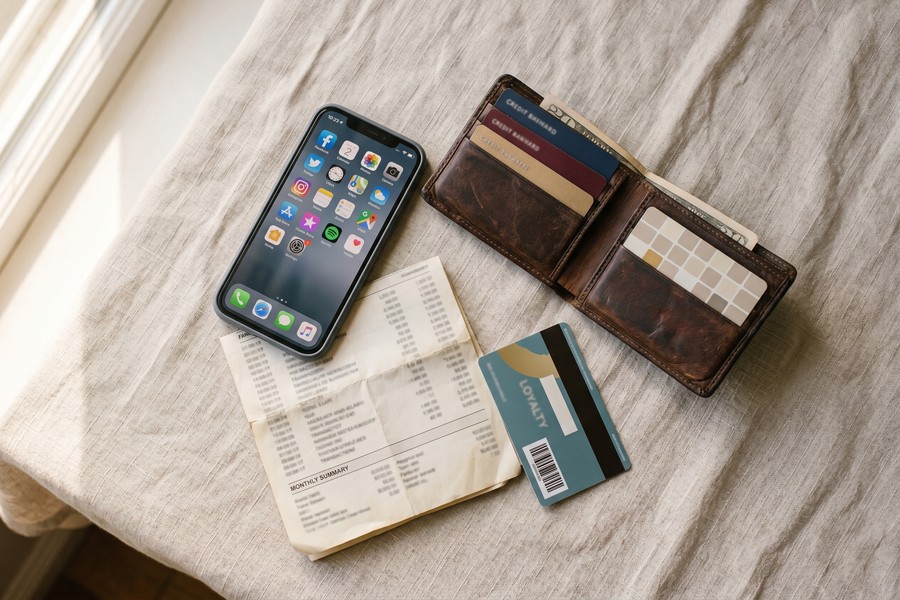
Subscription charges billed through Apple or Google never appear on your bank statement as individual service names, they consolidate into a single charge from “Apple” or “Google.” This is why many consumers have no idea how many in-app subscriptions they are actively paying for until they check app store settings directly.
Which Subscriptions Should You Cut First?
The most useful prioritization tool is a two-axis test: cost per use and replaceability. “Do you use it?” is the wrong question because it treats a service you use twice a year the same as one you open daily. A $15 per month service used twice costs $7.50 per session; a $10 per month service used zero times costs infinitely more per use. Running that math on your actual list ranks cuts far more accurately than gut feeling.
The Highest-Yield Categories
Streaming video stacks are the single largest opportunity for most households. The average U.S. streaming subscriber pays for four services at $69 per month, a 13% year-over-year increase, according to Deloitte’s 19th annual Digital Media Trends survey. After streaming, the next highest-yield categories are duplicate cloud storage (most households are paying for two or more of iCloud+, Google One, and Dropbox), duplicate music services, and stacked news paywalls. A combination of The New York Times, The Wall Street Journal, The Washington Post, and The Athletic can easily exceed $50 per month.
Before canceling, consider the “downgrade, don’t cancel” option. If you use a streaming service but only watch content available on its ad-supported tier, switching tiers retains access without full cost. Most articles treat subscription decisions as binary. A material number of readers genuinely use portions of their premium plans, though, and the goal of a subscription audit is not to cancel everything. It is to pay only for the tier level you actually use.
If you are wrestling with how subscription spending fits into a broader spending plan, our guide on cash envelope vs. zero-based budgeting walks through how to allocate freed cash with a clear system.
| Subscription Category | Typical Monthly Cost | Primary Waste Pattern |
|---|---|---|
| Streaming Video Stack | $69 average (4 services) | 3–4 services, 1–2 actually watched |
| Cloud Storage | $3–$10 per service | Paying for iCloud+, Google One, and Dropbox simultaneously |
| Music Streaming | $11–$17 per account | Two household members on separate plans |
| News Paywalls | $10–$17 per publication | 4 subscriptions, 1 read regularly |
| Fitness Apps | $10–$40 per app | Post-New Year sign-up, unused by March |
| Software / Productivity | $10–$55 per service | Annual plans forgotten after first month |
How to Actually Cancel, Including the Services That Make It Hard
Consumers in most U.S. states have no enforceable federal right to easy subscription cancellation as of May 2026. That is the honest regulatory picture, and it matters for how you approach hard-to-cancel services.
The Current FTC Regulatory Reality
The FTC finalized its “Click-to-Cancel” Negative Option Rule in October 2024, which would have required sellers to make cancellation at least as easy as sign-up. The Eighth Circuit vacated those 2024 amendments in July 2025 on procedural grounds. The rule is not currently in force. The FTC issued a new Advance Notice of Proposed Rulemaking in March 2026 to revisit these requirements, but rulemaking typically takes years. In the meantime, California, New York, Colorado, and Washington D.C. have their own state auto-renewal laws that generally require online cancellation when sign-up was completed online, but protections are uneven and state-dependent.
The Consumer Financial Protection Bureau (CFPB) has affirmed that companies offering negative-option subscription services must clearly disclose terms and cannot make cancellation unreasonably difficult. Enforcement varies, though, and individual consumers often bear the burden of escalating.
The Cancellation Escalation Ladder
When a service resists cancellation, work through these steps in order:
- Cancel online through the service’s account settings page.
- If billed through Apple or Google, cancel directly through the app store subscription settings, this stops charges even if the service itself does not process your request.
- Document your cancellation attempt (screenshot or email confirmation), then contact your credit card issuer to block future charges under the Fair Credit Billing Act.
- File a complaint at ReportFraud.ftc.gov, which creates an enforcement record and can prompt company compliance.
One critical warning most articles omit: check your contract terms before canceling any annual software subscription. Adobe Creative Cloud, for example, charges a fee for remaining months when you cancel an annual plan mid-cycle, a fee that can exceed several hundred dollars. The early-termination cost may be larger than simply letting the plan run out. Check the math before you act.
Paying a subscription fee you cannot easily escape is similar to carrying high-interest debt: the cost compounds quietly. Our article on whether to pay off debt or build an emergency fund addresses how to prioritize freed cash once you have reduced recurring obligations.
Negotiating Down, Bundling Up, and Getting Refunds You Are Owed
Cancellation is not the only exit. For services you value but pay too much for, the cancel flow is a negotiating stage, not a dead end.
The Retention Offer Playbook
Services with high subscriber churn, SiriusXM, home-security monitoring companies, and cable alternatives, routinely extend discounted retention offers during the cancellation process. The offer typically does not appear until you have confirmed your intent to cancel. Come prepared with a specific target price, state it plainly, and be willing to pause rather than immediately accept the first counter-offer.
Bundling deserves honest analysis rather than reflexive praise. Apple One, the Disney+/Hulu/ESPN+ bundle, and Amazon Prime each consolidate multiple services at roughly 30–50% less than buying components individually. But a bundle only saves money if you actually use most of the included services. A bundle of three services where you use only one is still waste, just repackaged at a lower per-unit price that makes it harder to justify canceling.
Asking for a Refund
Some services will partially refund recent charges, particularly if you can demonstrate non-use. The ask costs nothing. The FTC’s enforcement record gives services an incentive to resolve individual complaints quietly: the agency has pursued actions resulting in significant consumer refunds from major companies in recent years. If a company refuses a reasonable refund request, the next step is a credit card dispute for unauthorized or unfulfilled charges.

Before calling to cancel any service that uses retention offers, decide your target monthly price in advance and write it down. Negotiators who enter without a number in mind consistently accept worse offers than those who state a specific figure early in the conversation.
Tools That Help (and Their Hidden Costs)
Three realistic approaches exist for tracking subscriptions: dedicated tracker apps, manual bank-statement review via CSV export, and virtual card numbers for free-trial hygiene. Each has genuine trade-offs that most personal-finance content skips over.
The Break-Even Math on Subscription Apps
Rocket Money’s free tier detects subscriptions by connecting to your bank account via Plaid. The premium tier, priced at $7–$14 per month, cancels subscriptions on your behalf but does not work with all services and requires sharing bank credentials. At $12 per month, Rocket Money costs $144 per year. It only pays for itself if it finds and eliminates more than $144 in annual waste. For a household with modest subscription overlap, this math fails. For a household with significant bloat across multiple streaming, software, and fitness services, it works. The calculation is yours to make.
Trim, another option, takes 33% of any bill savings it negotiates on your behalf, permanently, not just for the first month. That arrangement can cost more over time than the subscription waste it resolved. Name that number before signing up.
The Mint shutdown in March 2024 left a gap for free, full-featured budget tracking. Strong alternatives include Copilot (iOS-only, strongest design), PocketGuard (functional free tier), and Monarch Money ($8.33 per month, best for couples using its household dashboard). If you are already tracking your budget with one of these tools, subscription monitoring comes bundled in, and no separate app is needed.
For freelancers managing irregular income, our review of the best budgeting apps for freelancers covers how these platforms handle non-uniform cash flow, which directly affects how usefully they surface recurring charges.
The manual CSV export method costs nothing and catches everything. Export 12 months of transactions from every account, open the file in a spreadsheet, and filter for recurring amounts. It takes about 30–45 minutes the first time and 15 minutes each subsequent quarter. The trade-off is clear: it requires discipline and provides no automatic alerts when a new subscription appears.
Virtual card numbers, offered by some banks and services like Privacy.com, generate a disposable card number for each free trial. Set the card to expire before the trial converts, and the charge simply fails. This prevents the problem rather than requiring periodic cleanup.
Being thoughtful about spending decisions extends beyond subscriptions. If you are evaluating whether to buy products outright or subscribe to them, our guide on buy vs. subscribe for everyday purchases lays out the math for common categories.
70% of U.S. adults have forgotten to cancel a free trial at some point, resulting in an average of $34.31 in unexpected paid subscription charges, according to Self Financial’s 2026 survey. Virtual card numbers set to expire on the trial end date eliminate this category of loss entirely.
Making the Subscription Audit a Quarterly Habit
A one-time audit has a shelf life of roughly three to six months. Free trials convert. Price increases stack silently: streaming services, cloud storage providers, and software tools have each raised prices repeatedly in small increments, adding $40–$70 or more per month across an average household over two to three years. New sign-ups happen on impulse.
The audit is a system, not a one-time event.
Scheduling the Review and Redirecting the Savings
A 15-minute quarterly calendar block is the actual deliverable. Set a recurring reminder, one day after each quarter ends works well, and run the same four-vector sweep each time. The process gets faster with practice because you already know your baseline and are only looking for changes.
The audit is only complete when the freed cash has a new destination. Readers who free up $80–$150 per month should redirect that exact dollar amount to a specific goal immediately, an emergency fund, a high-yield savings account, or accelerated debt payoff, before the money disappears into discretionary spending. Lifestyle inflation fills gaps quickly and quietly. That is exactly the same mechanism that allowed the subscriptions to accumulate in the first place.
One detail worth flagging: a FICO Score is not affected by subscription cancellations themselves, but any subscription balance that aged into collections because of a missed payment can damage your credit profile. Debt-to-income ratio (DTI) calculations used by lenders like SoFi or a Chase mortgage underwriter will not directly capture subscription spending, but freeing recurring cash does improve real DTI when that money shifts toward debt payoff. Experian, Equifax, and TransUnion do not receive subscription payment data under standard reporting, so on-time subscription payments do not build credit history the way an installment loan or credit card would.
If the freed cash is going toward debt, our piece on whether to pay off debt first or build an emergency fund provides a clear decision framework. For readers focused on building a financial cushion, the story of how a single mom on $45,000 a year built a six-month emergency fund shows what redirected small amounts can accomplish over 18 to 24 months.
A $100-per-month reduction in waste is $1,200 per year, more than many people contribute to an emergency fund in the same period. Treat the quarterly audit as the mechanism that keeps that improvement in place.
Frequently Asked Questions
How long does a subscription audit take?
A thorough first audit takes 45–90 minutes, accounting for all four billing vectors (bank, credit cards, Apple App Store, and Google Play). Subsequent quarterly reviews typically take 15–20 minutes because you are reviewing changes from a known baseline rather than building from scratch.
What is the best free tool for finding subscriptions?
The manual CSV export method costs nothing and is the most thorough option. Export 12 months of transaction history from every account, open in a spreadsheet, and filter by recurring dollar amounts. Rocket Money’s free tier also detects subscriptions automatically for users who prefer an app-based approach, though it requires linking bank credentials.
Can I get a refund on a subscription I forgot to cancel?
Some services will issue a partial refund, particularly if you can demonstrate that you did not use the service recently. The refund is not guaranteed, but asking costs nothing. If the company refuses and you believe the charge was unauthorized or the terms were not clearly disclosed, a credit card dispute is the next step.
Is it safe to use a subscription-tracking app?
Apps like Rocket Money and Monarch Money use Plaid to access bank transaction data, which carries inherent privacy trade-offs. Plaid holds read-only access to your account history; it cannot initiate transactions. The risk is data exposure in the event of a breach. Consumers who prefer not to share bank credentials can achieve the same result through manual CSV review.
Does canceling subscriptions affect my credit score?
Canceling a subscription service does not directly affect your FICO Score or the credit reports maintained by Experian, Equifax, and TransUnion, since subscriptions are not credit accounts. If a subscription charge went to collections because of a missed payment, however, that collection account could affect your score. Address any outstanding subscription balances before they age into collection status. Our guide on credit-building mistakes that hurt your score covers related pitfalls in detail.
What should I do if a company makes it impossible to cancel?
Work through the escalation ladder: attempt cancellation online, then through the app store if billed there, then contact your credit card issuer to block future charges under the Fair Credit Billing Act. File a complaint at ReportFraud.ftc.gov as a final step. State-level protections apply in California, New York, Colorado, and Washington D.C. for subscriptions signed up for online.
How do I handle subscriptions I share with family members?
Assign one household member as the account holder for each shared service and document which person owns each subscription in a shared note or spreadsheet. Before canceling anything, check whether a family or group plan, available for Spotify, Apple One, YouTube Premium, and others, costs less than the separate individual plans your household is currently running.
Sources
- Self Financial, Cost of Unused Paid Subscriptions Survey (2026)
- Deloitte, 19th Annual Digital Media Trends Survey (2025)
- Federal Trade Commission, Negative Option Rule (Regulatory History and Current Status)
- Federal Register, FTC Negative Option Rule Final Text (November 2024)
- Consumer Financial Protection Bureau, Guidance on Negative-Option Subscription Tactics
- Federal Trade Commission, Click-to-Cancel Rule Press Release (October 2024)
- Federal Trade Commission, ReportFraud.ftc.gov Consumer Complaint Portal
- Yahoo / Andrea Woroch, Subscription Audit 5-Step Guide (2026)